Booking.com for China Hotels: What Foreigners Should Know
Booking.com works in mainland China and is trusted by many foreign travelers, but its local inventory is thinner than Trip.com’s and some listings quietly hide foreigner-acceptance problems. You can reserve and pay with a foreign card, yet you should still verify the hotel takes passports before you show up at the door.
Does Booking.com actually function in China?
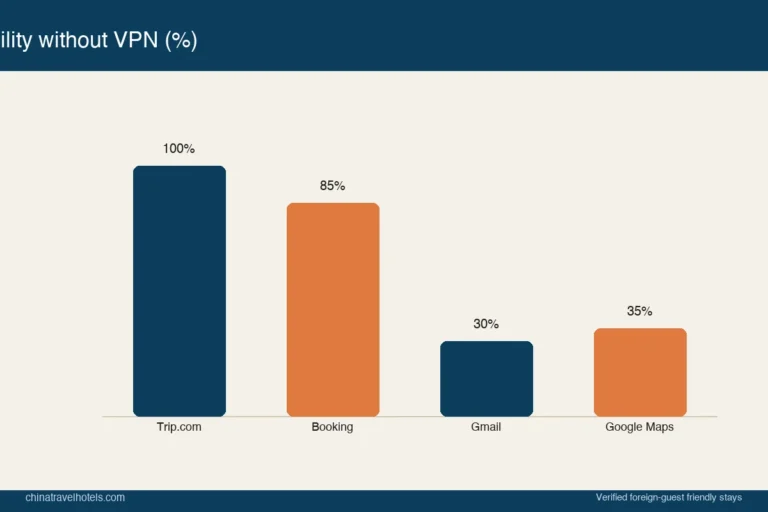
Yes. The site and app are accessible without a VPN, the interface is fully in English, and your existing Booking.com account carries over. For travelers who already use it elsewhere, the familiarity is comforting. You can search Chinese cities, see photos, read reviews, and complete a reservation much as you would in Europe or Southeast Asia.
The catch is coverage. Booking.com lists a decent number of Chinese hotels, but it does not have the deep domestic contracts that Ctrip-derived platforms enjoy. In smaller cities and towns, the selection can be sparse, and the hotels that do appear are often the international chains or the larger local brands.
Inventory and the foreigner-acceptance gap
This is the part that trips people up. Booking.com does not reliably screen every property for foreign-guest licensing. A room can be bookable online and still be refused at check-in because the hotel’s licence only covers domestic ID holders. The platform has improved, but it is not a hard guarantee.
Before you pay, check the property’s policy notes and recent reviews. Look for any mention of passport registration or foreign guests. If nothing is stated, ask. The broader advice on choosing foreigner-friendly hotels explains which property types are safest, and the Booking.com versus Trip.com comparison lays out where each one is stronger.
Paying and the currency question
Booking.com supports foreign cards and lets you choose the display currency. Some rates are “pay now,” others “pay at the property.” With pay-at-property, your card is only used to guarantee the booking, and you settle in person, often in yuan, which brings its own payment quirks at the front desk.
Watch the exchange-rate presentation. Booking.com may offer to charge in your home currency through a dynamic currency conversion. That convenience usually costs more than letting your card issuer do the conversion. Decline the conversion and pay in yuan when the rate is better.
The “pay at property” trap
Pay-at-property sounds flexible, and it can be, but it shifts risk onto you. If the hotel refuses foreign guests on arrival, you have no pre-paid receipt to wave at support, and recovering a no-show charge is slower. For uncertain properties, a pay-now rate with free cancellation is safer than a pay-later one with none.
Also confirm whether “pay at property” truly means no card hold. Some hotels still pre-authorise a small amount as a guarantee. Read the fine print on the confirmation so you are not surprised by a pending charge.
Reading the reviews with a skeptical eye
Booking.com reviews are useful but skewed. Many Chinese hotels seed the platform with guests who booked via other channels, and the star ratings can feel inflated. Focus on written comments from clearly international travelers and on mentions of check-in, passport registration, and breakfast variety.
For a methodical approach, the guide on how to read China hotel reviews walks through the tells that separate genuine feedback from noise. A single detailed negative review about a foreigner being turned away is worth more than fifty generic five-star nods.
What to do if you are refused at check-in
If a Booking.com property refuses you because of your passport, open the app’s help center on the spot and ask for rebooking or a refund. Booking.com’s dispute process works, but it is slower than Trip.com’s mainland-focused desk, and resolution can take days rather than hours.
Keep the hotel’s refusal in writing, ideally a message from the front desk or a photo of a sign. Without evidence, support may side with the property. If you are stranded late at night, secure any room you can and fight the charge afterward; your safety comes first.
Tips for booking safely on Booking.com in China
Start by filtering for properties that explicitly welcome international guests, then widen your search only if needed. In Beijing, Shanghai, and Guangzhou the safe options are plentiful, but in smaller cities lean toward internationally branded hotels where foreigner licensing is standard. The difference between a smooth check-in and a refused one often comes down to property type, not platform.
Use the free-cancellation filter even when the flexible rate costs a little more. China’s travel plans shift with flight changes, weather, and sudden holiday crowding, and a refundable room is insurance you will be glad to have. Pair that with a saved PDF of your confirmation and a screenshot of the policy, and you remove most of the stress.
Finally, do not book a non-refundable room through Booking.com for a property you have not confirmed accepts foreigners. The two risks compound: if you are refused, you lose the night and the refund fight is slower. Confirm first, book second, and keep the message where you can find it at the lobby desk.
Booking.com at a glance
| Feature | What to expect |
|---|---|
| Site accessible in China | Yes, no VPN needed |
| English support | Good, but mainland desk is smaller |
| Foreign-card checkout | Yes |
| Foreigner-acceptance screening | Weaker than Trip.com |
| Best use case | Familiar interface, international chains |
Frequently asked questions
Is Booking.com cheaper than Trip.com in China?
Sometimes. Prices overlap a lot, and one platform will occasionally undercut the other by ten or twenty percent for the same room. Always check both before booking, especially for higher-end properties.
Can I use my existing Booking.com Genius discounts?
Yes, your Genius tier carries over and applies to eligible China listings. The discounted rates are usually the same flexible or non-refundable types you see elsewhere.
Why does a hotel say “no foreign guests” after I booked?
Because Booking.com may list properties without confirming their licence covers foreign passports. The hotel discovers your nationality at check-in and declines. This is why direct confirmation matters.
Does Booking.com show the city tax separately?
Not always. Some listings bundle tax and service into the displayed price; others add them at checkout. Check the price breakdown line by line before you confirm.
Will my card be charged if I choose pay at property?
Usually only a hold or nothing at all, but a few hotels pre-authorise a guarantee amount. Read the policy text on the confirmation email.
Can I cancel a non-refundable Booking.com rate in China?
Almost never without penalty. Non-refundable means exactly that. Only book it when your plans are firm and the savings justify the risk.
Should I book China hotels on Booking.com or a Chinese app?
If you have a foreign card and want English support, Booking.com or Trip.com are the realistic choices. Chinese apps typically demand local ID and payment, which most tourists cannot provide.
Can I book a Chinese hotel on Booking.com without a Chinese SIM card?
Yes. Booking.com does not require a local number, and you can receive confirmations by email. A Chinese SIM helps at check-in for two-factor codes or local calls, but it is not needed to complete the booking.
Booking.com is a solid, familiar tool for China, particularly in big cities and at chain hotels. Just do not let its polish lull you into skipping the one check that actually prevents a ruined arrival: confirming the hotel accepts foreign passports.