Most China hotels take a refundable deposit of about ¥200–¥800 (roughly $30–$110) at check-in to cover incidentals, held on your card and released after you leave. The amount scales with the hotel’s star rating, and the refund speed depends on the platform and your bank, not the hotel.
What the deposit is actually for
The deposit is a temporary hold, not a fee. It covers potential mini-bar charges, missing towels, or room damage. At check-out, if nothing is owed, the hold is released in full. Chinese hotels are required to register foreign guests with the police, and the deposit is part of that desk process — it is standard, not a scam. If a “deposit” is demanded in cash by someone outside the front desk, that is the exception I warn about in how to avoid hotel scams.
Typical amounts by star (illustrative)
Illustrative deposit ranges I have encountered, last verified 2026-10-26. These are holds, fully refundable.
| Hotel tier | Typical deposit (illustrative) |
|---|---|
| 3-star | $30 (≈¥200) |
| 4-star | $55 (≈¥400) |
| 5-star | $110 (≈¥800) |
Budget hostels may ask for a token ¥100, while a luxury suite can hold ¥1,500. The pattern holds: higher tier, higher hold, because the potential incidentals are larger.
How the hold works on your card
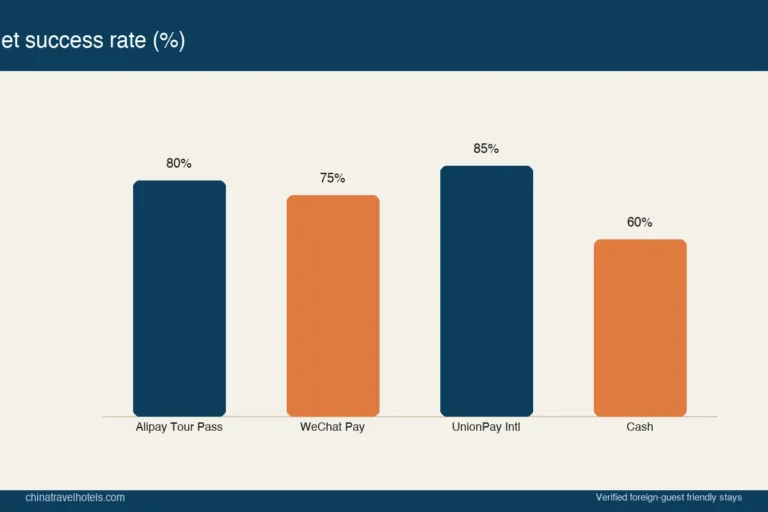
When you check in, the hotel (or the OTA that pre-authorized) places a hold for the deposit amount. It is not a charge — your available balance drops, but no money leaves your account. This is why a low-limit card can feel “maxed out” after a big-city check-in. I explain the card mechanics in how to pay for Chinese hotels with a foreign card.
How long the refund takes
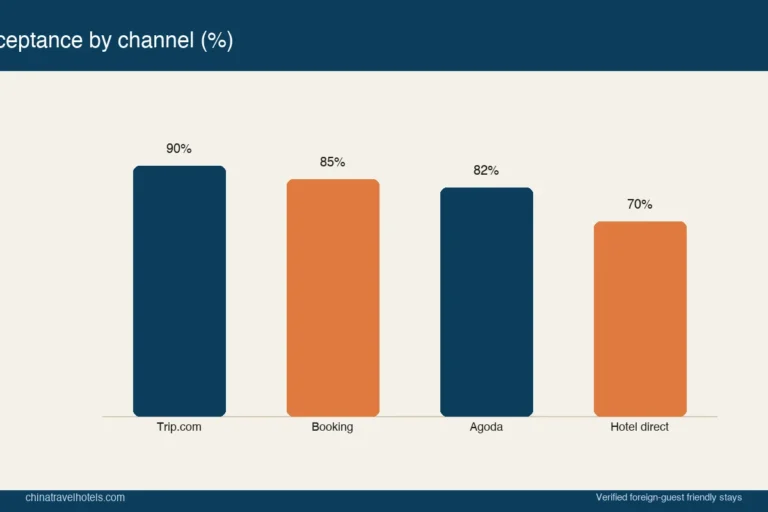
Release speed varies. Trip.com-orchestrated holds tend to drop within three days; Agoda’s can take up to five; a hotel-direct hold depends on your bank’s processing, often 3–7 days. None of this is the hotel keeping your money — it is the card network’s settlement lag. If a hold persists beyond a week, contact the platform’s chat or your bank with the authorization code.
Deposit by booking platform
If you booked through Trip.com, Booking, or Agoda, the deposit is usually pre-authorized at booking or at check-in through the platform, and the release is tracked in your app. Booking direct, the hotel places the hold itself. I have found platform-tracked holds easier to dispute than a vague hotel-direct one, which is one reason I lean on OTAs. The trade-off is in booking direct vs OTA.
When the deposit is not returned
Genuine non-refunds are rare and almost always tied to a real charge: a broken item, a smoking fee (China hotels enforce non-smoking strictly — see smoking vs non-smoking rooms), or an unpaid mini-bar. If you disagree, ask the desk for an itemized deduction before you leave; once you are gone, disputing is slower. Keep the check-out receipt.
Avoiding deposit surprises
Three habits help. First, know your card limit before a 5-star stay so the hold doesn’t block other spending. Second, screenshot the check-in receipt showing the hold amount. Third, if you’d rather not tie up the funds, ask at check-in whether a smaller cash deposit is acceptable — many city hotels will take ¥200 cash instead of a ¥800 card hold. For rural stops like near the Li River, cash is often the only option anyway.
Cash versus card deposits
A cash deposit means no hold on your card, which is gentler on your limit, but you must remember to collect it at check-out — I have almost left a ¥400 deposit behind in a rush. A card hold is automatic and needs no recollection, but it ties up available credit. I use cash deposits at small hotels and card holds at chains, depending on my limit that trip.
For entry and registration context, the National Immigration Administration at NIA is authoritative, and China Tourism lists licensed operators.
Deposits at international chains versus local hotels
The pattern differs by property type. International chains quote the deposit clearly at booking and release it through the same system that took your card — predictable. Local Chinese hotels may state it only at the desk, often in cash, and the release depends on the morning shift remembering to process it. I give local desks a nudge at check-out: “deposit, please return now” in translated Chinese. The hotel star ratings guide helps set expectations by tier.
A real example from my trips
In a Shanghai 5-star, the desk held ¥800 on my card and it cleared three days later — textbook. In a Guilin 3-star, they wanted ¥200 cash and I almost left without collecting it in my rush to the train; the receipt saved me when I walked back. The lesson: chains are automatic, locals need your attention. Budget your limit around the hold, and for rural stops like near the Li River, assume cash.
Is the deposit separate from tax?
Yes. The room rate may include or exclude city tourism tax depending on the hotel, but the deposit is always a separate, fully refundable hold on top of the rate. Don’t confuse a ¥400 deposit with a fee — it returns. If a hotel ever calls the deposit “non-refundable,” that is a red flag worth questioning, and I’d cross-check against how to avoid hotel scams before paying.
Frequently Asked Questions
Q: How much is a China hotel deposit?
Typically ¥200–¥800 (about $30–$110), scaling with star rating. Budget spots may ask ¥100; luxury suites more. It is a refundable hold, not a fee.
Q: Is the deposit refundable?
Yes, in full if there are no incidentals. It releases after check-out; the delay is your bank’s settlement, not the hotel keeping it.
Q: How long until the deposit returns?
Usually 3–7 days depending on platform and bank. Trip.com holds often clear in about three days; Agoda can take up to five.
Q: Can I pay the deposit in cash instead of card?
At many city hotels, yes — a smaller cash deposit can replace a larger card hold. Rural and small hotels may only take cash. Always get a receipt.
Q: Why is my available balance lower after check-in?
The deposit is a hold, not a charge. Your available credit drops by that amount until release. It is normal and reverses after checkout.
Q: What if the deposit isn’t refunded?
Genuine holds always release; if money is actually charged, it is usually for a real fee (damage, smoking, mini-bar). Ask for an itemized receipt at check-out.
Q: Does the deposit apply to hostels too?
Often a small token deposit (¥50–¥100) or a key-card swap. The principle is the same — refundable, returned at check-out.
Q: Can I avoid the deposit entirely?
Rarely. It is standard for foreign check-in. Using a platform that tracks the hold and keeping your receipt is the practical way to stay safe.
Bottom line
China hotel deposits are refundable holds of roughly ¥200–¥800 by star rating, released 3–7 days after check-out depending on platform and bank. Use a card hold for convenience or a cash deposit to free your limit, and always keep the receipt. In my experience the hold has always come back, and the only times I lost sleep were when I forgot to collect a cash deposit in a hurry. Knowing the amount beforehand — roughly ¥200 at a 3-star, ¥400 at a 4-star, ¥800 at a 5-star — lets you plan your card limit instead of being surprised at the desk. If a desk ever pushes back on returning a cash deposit, the check-out receipt and a polite translated reminder have always worked for me. On a Hangzhou stay where the desk initially forgot my ¥200 cash return, showing the receipt and waiting two minutes resolved it without any heat. Treating the deposit as a normal, reversible step — rather than a fee to fear — is the mindset that keeps the whole process calm. Figures are illustrative and last verified 2026-10-26.