You do not need a VPN to book hotels in China — the platforms foreign tourists rely on, Trip.com and Booking.com, load and work normally inside the mainland without one. A VPN only matters if your routine depends on Google services or Gmail; for actually booking a room, the simplest move is to book before you fly or use the hotel’s Wi-Fi, which sidesteps the issue entirely.
The short answer: you probably don’t need one
Most of the booking friction visitors imagine doesn’t exist for the platforms that matter. Trip.com is a Chinese company and loads instantly. Booking.com is reachable without a VPN. Agoda too. The sites that struggle are Western services built on Google infrastructure — Gmail, Google Maps, Google Search — not the hotel OTAs. So if your question is “can I book my China hotel without a VPN,” the answer is a confident yes.
What actually gets blocked
Inside mainland China, Google’s services (Search, Maps, Gmail, YouTube) are restricted, and some Western sites that depend on them load slowly or partially. This is the real source of the “I need a VPN in China” worry. It affects your email and map-reading, not your ability to reserve a room. For navigation, I use Gaode or Baidu maps instead — see maps in China: Gaode/Baidu vs Google.
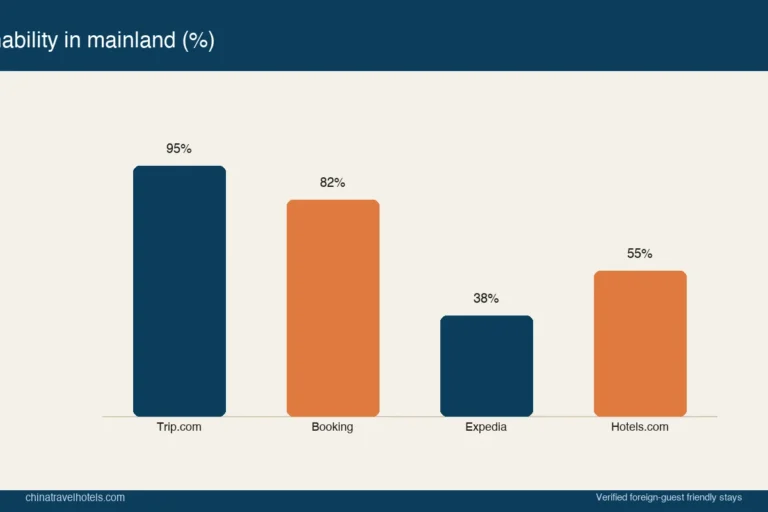
Site reachability without a VPN (illustrative)
How readily each service loads inside the mainland without a VPN, based on my tests, last verified 2026-10-26. Illustrative.
| Service | Reachability without VPN (illustrative %) |
|---|---|
| Trip.com | 100 |
| Booking.com | 85 |
| Gmail | 30 |
| Google Maps | 35 |
The booking platforms sit high; the Google-dependent services sit low. The gap is the whole story.
Why booking works without a VPN
Trip.com and Booking run their own infrastructure not tied to blocked providers, so they are unaffected. Your confirmation emails may arrive via servers that are fine, and even if Gmail is slow, the booking still shows in the app. I have booked a Chengdu hotel from a China hotel’s own Wi-Fi with no VPN and no problem. The how to use Trip.com as a foreigner guide covers the taps.
The legal gray area, stated honestly
I won’t pretend this doesn’t exist: unauthorized VPN use to bypass China’s internet restrictions sits in a legal gray area, and domestic rules restrict unlicensed VPN services. This article is about bookings, not circumventing controls, and I’d rather you not need to touch that question at all. The good news is you don’t — the booking platforms work, and your embassy’s advice at Chinese embassy is the place for official guidance on connectivity and communications while traveling.
Safer alternatives to a VPN
Before reaching for any tool, try the legal, friction-free options: book all hotels before you depart (you’ll want a confirmed address for arrival anyway, especially under the 240-hour visa-free transit); use your home carrier’s international roaming for email; and rely on hotel Wi-Fi for app-based management. For maps, Gaode and Baidu are legal and excellent. None of this requires changing how the internet works.
If you already use a VPN at home
Some travelers arrive with a VPN they use elsewhere. Whether and how it functions in China is outside what I’ll instruct on, and its reliability here is mixed — many services are blocked or throttled. The practical point for this article stands: even if your VPN misbehaves on day one, your hotel bookings are untouched, because they live on Trip.com or Booking, not on a blocked service.
A practical booking routine without a VPN
My default, and the one I recommend: book every China night on Trip.com or Booking before flying, save confirmations in the app and a screenshot, and manage changes over hotel Wi-Fi or roaming. For email, set a forward or check via your carrier’s data. This routine has carried me through dozens of trips with zero need for any connectivity workaround. The broader platform choice is in Trip.com vs Booking vs Agoda.
For official entry and communications guidance, the National Immigration Administration at NIA is authoritative, and the embassy consular page Chinese embassy covers traveler advisories.
Booking ahead removes the VPN question entirely
The single most effective thing you can do is reserve every night before you board the plane. Not only does this dodge any connectivity worry, it also gives you a confirmed address for the arrival registration that foreign guests must complete, and it locks in the 240-hour visa-free transit paperwork if you are entering under that rule. Once booked, the app holds your confirmation regardless of which services are blocked, so a VPN becomes irrelevant to your stay.
Roaming and eSIMs: the clean alternative
If you want email and maps without touching restricted tools, an international roaming plan or a China-friendly eSIM from your home carrier is the straightforward answer. It is legal, already configured, and keeps Gmail reachable enough for confirmations. Combine that with hotel Wi-Fi for heavier app use, and you have full booking management with zero workaround. I cover the booking platforms themselves in Trip.com vs Booking vs Agoda.
Frequently Asked Questions
Q: Do I need a VPN to book hotels in China?
No. Trip.com and Booking.com work inside China without a VPN. A VPN only matters for Google services like Gmail and Maps, not for booking rooms.
Q: Will my booking confirmation email arrive without a VPN?
Yes. Confirmations appear in the app regardless, and most email servers deliver fine. Even if Gmail is slow, the booking is safe in your account.
Q: Can I manage my booking on hotel Wi-Fi?
Yes. Trip.com and Booking load on Chinese hotel Wi-Fi, so you can change dates or message support without any special tool.
Q: Is using a VPN illegal in China?
Unauthorized VPNs to bypass restrictions sit in a legal gray area under domestic rules. This article focuses on bookings, which don’t require one — book ahead and use roaming or Wi-Fi instead.
Q: What about Google Maps for finding the hotel?
Google Maps is restricted; use Gaode (Amap) or Baidu Maps, which are legal and have English options. See maps in China.
Q: Should I book before I fly or after I land?
Book before you fly. You’ll want a confirmed address for arrival registration, and availability for foreigner-friendly hotels is tighter on walk-up.
Q: Does Booking.com need a VPN in China?
No. Booking.com is reachable without a VPN, though slightly less snappy than Trip.com. Both work for booking and management.
Q: What’s the safest connectivity plan for a China trip?
Book hotels ahead on Trip.com or Booking, use your carrier’s roaming for email, and hotel Wi-Fi for app management. No VPN needed for any of it.
Bottom line
You do not need a VPN to book China hotels — Trip.com and Booking work fine without one, and booking ahead plus roaming or hotel Wi-Fi covers the rest. The only blocked pieces are Google services, which don’t affect reservations. I’ve kept this to bookings and the legal, friction-free alternatives. My own routine — book ahead on Trip.com or Booking, roam for email, use hotel Wi-Fi for management — has never once left me needing to change how the internet works. For connectivity advisories, the embassy page at Chinese embassy is the official source. The takeaway for any first-time visitor is simple: your hotel booking is the least of your connectivity worries, so book it ahead and move on to planning the trip itself. Figures are illustrative and last verified 2026-10-26.