Book the room type labelled “family room” rather than two twins, request a cot or rollaway when you reserve, and confirm bed sizes in metres — a Chinese “queen” runs smaller than a US queen. Kids under about 1.2m usually stay free sharing their parents’ bed, and a rollaway costs roughly ¥80–¥150 a night, so the maths often beats paying for a second room.
The bed-size surprise nobody warns you about
Chinese hotels list rooms by area in square metres and describe beds loosely. A “queen” is often 1.5m wide (about a US full, not a queen), and a “king” is 1.8m (close to a US queen). Two adults and a child in a 1.5m bed is tight. Always read the bed width in the listing — “1张大床 1.8米” means one bed 1.8m. I once assumed “king” meant spacious and my family of three barely fit; now I filter by the metre number, not the English word. The rating backdrop is in China hotel star ratings explained.
Family room vs two twins vs a rollaway
| Option | Best for | Cost (illustrative) | Catch |
|---|---|---|---|
| Family room (1 big bed + bunk/single) | 3–4 people | Often ¥50–¥150 more than standard | Limited supply, book early |
| Two twins + 1 rollaway | 3 people, want space | Twin rate + ¥80–¥150 rollaway | Rollaway may be narrow |
| Parents’ bed + free kid | 2 adults + 1 small child | Just the standard room | Under ~1.2m, sharing bed |
In my experience the family room is the calmest choice when travelling with kids — everyone has a defined bed and you are not negotiating a rollaway at midnight. Book on Trip.com surfaces “family room” as a filter in most cities; check Agoda does too, often with photos of the bunks.
The child-height rule that saves a second room
Most Chinese hotels let one child under 1.2m share the parents’ bed free, and some extend that to 1.4m at budget brands. Breakfast is frequently free for that child too. If your kid is clearly small, you can often skip the extra bed entirely and just pay for the standard room — a real saving on a two-week trip. Confirm the height cutoff at booking; it varies by brand and by city. When I checked into a hotel in Chengdu with a six-year-old, the desk waved the breakfast charge without me asking because she was under the line.
Request the cot or rollaway before you fly
Cots (婴儿床) and rollaways (加床) are limited and run out on busy nights. Add the request to the booking note and re-confirm by message a day before — the template is in how to find English-speaking hotels. A rollaway is typically ¥80–¥150 a night; a proper baby cot is sometimes free, sometimes ¥50. At 5-star hotels worth it for foreigners the cot is usually free and good quality; at budget places it may be a thin mattress on a frame, so inspect it.
Where family rooms are easy to find
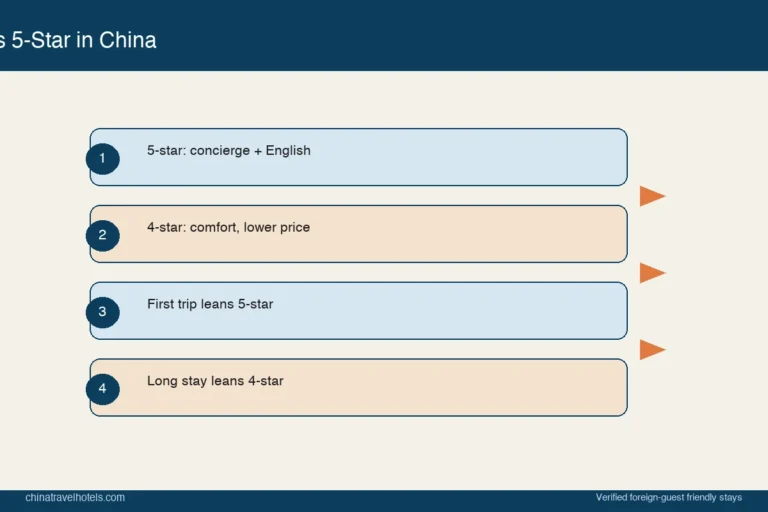
International resorts, Disney-area hotels, and big-city towers stock family rooms as standard. Near Shanghai Disneyland you will find them in abundance, themed and priced for families. Scenic small towns are weaker — book weeks ahead or accept a twin-plus-rollaway. The tier trade-off is in 4-star vs 5-star in China: at 5-star the family setup is smoother and the pool/breakfast soften the price.
Don’t forget the smoke and the sleep
A family room is no good if it smells of smoke — insist on non-smoking and a high floor, per smoking vs non-smoking rooms. Also ask for a quiet room away from the lift; Chinese hotels can be echoey and Chinese New Year corridor noise is real. These small asks matter more with kids than with solo travel.
The money maths
Say a standard twin is ¥400 and a family room is ¥500. A second room would be another ¥400. The family room saves ¥300 a night over two rooms, and a rollaway at ¥120 beats a second room by ¥280. On a 10-night trip that is ¥2,800–¥3,000 kept in your pocket — enough for a few good dinners. Budget chains that allow this are in best budget hotels in China that accept foreigners.
Honest caveats
- “Family room” sometimes just means a standard room with a squeezed single — read the bed layout photo.
- Older hotels may have no real cot; bring a travel inflatable one if your child is tiny.
- Some historic/courtyard hotels simply cannot add beds due to room size.
- The Chinese embassy travel page and the National Immigration Administration cover entry, not beds — but keep them bookmarked for the trip.
On-the-ground tips that make a family stay smooth
A family room is the start, not the finish. A few habits keep the trip calm. Bring a small inflatable toddler bed or a sleep sack if your child is tiny — the “cot” at a budget hotel may be a thin mat on a frame, and a familiar bed helps everyone sleep. Strollers are fine in towers and malls but useless in old towns with stone lanes and no lifts, so wear the baby in a carrier there. Food is easy: congee, steamed buns and fruit cover most kids, and most hotels will boil water for a bottle. Laundry matters on long trips — international and many Chinese chains have a guest washer-dryer on a floor, or you can use the hotel’s same-day service for ¥20 to ¥40 a load; I have never found a city without one. Ask for a quiet room away from the lift and the breakfast-hall kitchen, because Chinese hotels echo. Finally, keep a passport copy for each child in your phone — some hotels register kids, some do not, but having the document ready speeds any check-in. None of this is hard; it just needs a little packing thought before you fly.
A few words on cost, because families feel it most. The family-room premium over a standard twin is usually small and it spares you a second room, so it pays for itself on night one. Rollaways are far cheaper than a second room, and a free under-height child beats both. I price the trip as one room plus food plus the occasional splurge, and the hotel line stays sane. Pack a small nightlight — Chinese hotel rooms can be pitch black and kids wake disoriented — and a few favourite snacks from home, because the breakfast spread will not include chicken nuggets. Small comforts prevent the meltdowns that ruin a good day. Also check the pool before you book on a long stay; a hotel with a pool turns a rest day into a win, and several Chinese chains now build decent ones even at the four-star level, while budget chains rarely have them, so weigh that against the saving. Booking early also widens the family-room choice, because the best ones sell out first in peak season.