Most Chinese hotel breakfasts are buffets that mix a small Western corner (eggs, toast, fruit, weak coffee) with a large Chinese spread (congee, steamed buns, noodles, pickles, soy milk). At better hotels the Western options are genuine; at budget spots they are often minimal, so set expectations by price and sort any dietary need the night before.
The buffet rhythm you will recognise
Walk in anywhere from a 3-star up and the layout is oddly uniform: a row of steel trays on heat, a toaster that burns one side, a coffee machine pouring something brown, and a sea of dumplings. Service runs early — usually 6:30 to 9:30, sometimes 10:00 at leisure hotels. Get down before 8:00 on a tour-group morning or you will fight busloads of travellers for the last baozi. When I checked into a hotel in Chengdu, the buffet opened at 6:30 and the good steamed buns were gone by 7:15.
What the “Western” corner really looks like
| Item | Budget hotel (¥150–¥250) | Mid (¥300–¥500) | 5-star (¥800+) |
|---|---|---|---|
| Eggs | Hard-boiled only | Scrambled + boiled | Omelette station |
| Bread | White toast, sometimes stale | Toast + small pastries | Fresh bakery + croissants |
| Coffee | Powder sachet / machine | Weak drip machine | Espresso / cappuccino |
| Fruit | Watermelon in summer | Melon + banana | Full cut-fruit platter |
| Juice | Sugary “drink” | Orange from concentrate | Fresh-squeezed |
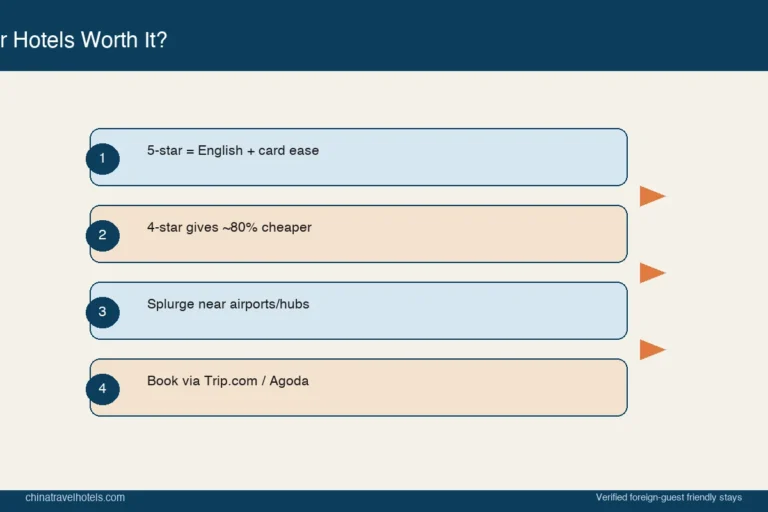
The honest truth: the coffee is the weak point everywhere except top international brands. If you need real coffee, buy it the night before or pick a 5-star worth-it hotel with a proper machine.
The Chinese side — and it is the better half
Do not sleep on the congee (rice porridge) station: plain, with century egg and pork, or sweet. The steamed buns (baozi) come filled with pork, Vegetarian (cabbage/mushroom), or red bean. There are fried noodles, soy milk (sweet or savoury), youtiao (fried dough sticks), and pickled vegetables. In the south you get rice noodles; in the north, millet porridge and maize cakes. This food is the real reason to eat hotel breakfast in China — it is cheap, safe, and a gentle intro to the local diet.
Halal, Muslim areas and the north-west
In Xinjiang, Gansu and Ningxia, and at Muslim-friendly hotels elsewhere, the breakfast is halal: no pork, separate utensils, often lamb congee, naan, and milk tea. If halal matters to you, filter for it and tell the hotel — see where to stay near the Mogao Caves in Dunhuang for a Muslim-area example. The Chinese embassy travel guidance notes regional food customs worth respecting.
If you avoid gluten, dairy or pork
Here is the awkward part. Chinese breakfast is heavy on wheat (buns, noodles, youtiao) and pork stock sneaks into congee and fried rice. Gluten-free travellers should lean on rice congee, fruit, eggs and the occasional potato; confirm the congee is plain, not pork. Dairy is rare except in coffee and the odd cheese slice at 5-star. Tell the hotel the night before — they cannot always accommodate, but the good ones will point you to safe trays. I carry a translated “no pork, no gluten” note on my phone; it has saved me from a pork-dumpling surprise more than once.
Is breakfast included, and is it worth paying for?
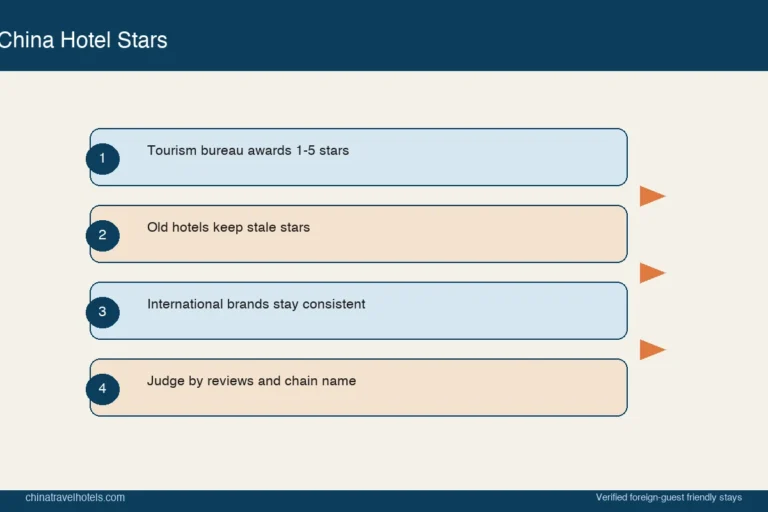
At the chains it is often bundled; at budget spots it is frequently ¥20–¥40 extra. Do the maths: a decent street breakfast (jianbing, soy milk, baozi) costs ¥10–¥20, so paying ¥40 for a hotel buffet only beats the street if you eat a lot or value the convenience. The star ratings behind these calls are in China hotel star ratings explained. For 4-star vs 5-star, breakfast quality is one of the biggest visible gaps.
Early departures and the breakfast you miss
If you leave at 6am, you will miss the buffet. Many hotels hand out a “breakfast box” if you ask at check-in — a bun, an egg, a juice. It is not gourmet, but it is free. The early-checkout playbook is in late check-in & early check-out at Chinese hotels.
My rule of thumb after 40 hotels
Spend the money on breakfast at 4-star and up, where the spread is genuinely good and the Western corner is real. At budget places, skip the hotel breakfast and find a street stall — the food is better and cheaper, and you get a slice of the city waking up. Either way, eat before 8. Book on Trip.com lets you filter “breakfast included” so there are no surprises at the desk.
Coffee, tea and what to drink
The drink situation deserves its own note because it trips up more foreigners than the food. Hotel “coffee” in China is usually a press-button machine pouring a thin brown liquid that barely qualifies; at 4-star and below, treat it as caffeine-adjacent, not coffee. Real espresso exists at international brands and at the growing number of lobby cafes in big cities — I have found decent flat whites in Shanghai and Chengdu towers for ¥25 to ¥38. Tea is the safer bet: the Chinese hotel breakfast almost always has hot-water urns and green or jasmine tea bags, and a pot of tea with congee is genuinely good. Fruit “juice” is often a sugary reconstituted drink, not pressed fruit, except at 5-star where fresh-squeezed orange appears. Water safety: the hot-water urns are boiled and safe; the tap water is not for drinking, so use the bottled water the hotel provides or the boiled urn. If you need real coffee to function, buy beans or a street coffee the night before, because the 6:30 buffet will not rescue you.
One last thing about the buffet: timing beats everything. The 8am tour-group rush strips the trays, so if you want the good baozi and a clean table, go at opening. Do not underestimate the congee — a bowl with pickles and an egg is a better start to a walking day than the sad toast station will ever be. If the hotel breakfast is weak, step outside; every Chinese city has a breakfast stall within a block selling jianbing, soy milk and steamed buns for a fraction of the price, and the experience is half the fun. Eat local in the morning, save the hotel for the coffee you cannot live without, and never skip the bottled water from your room — tap water is not for drinking, and a hot day starts better hydrated.