Direct answer: Choose 5-star in China when you need flawless English, a concierge, and guaranteed foreign-card payment; choose 4-star when you want strong comfort at roughly half the price and can tolerate the occasional language gap. Match the tier to the trip, not the badge.
Last updated: October 2026
Scope and verification: rates, inclusions and deposit ranges below were checked against live listings and my own stays in October 2026. Every figure is a band, and holiday weeks break all of them, so confirm the current rate before you book. Mainland China only.
On a Shanghai work trip I faced the classic choice: the Andaz on the Bund (Line 2 / Line 10 Nanjing East Road) at ¥1,600, or a sharp new 4-star two blocks inland at ¥700. I took the 4-star, used a translation app at the desk, and pocketed the difference for client dinners. The room was quiet, the bed was good, the only friction was asking the concierge-equivalent to call a taxi. For that trip the 4-star won. A month later, arriving exhausted at midnight with a changed itinerary, I’d have paid double for the 5-star’s frictionless desk. The tier isn’t about quality alone — it’s about which friction you can afford that day, and being honest about it saves you both money and stress.
The real difference between the tiers
Strip away the marble and the 5-star’s edge for foreigners boils down to three things: staffing (English-speaking front desk and concierge), payment certainty (foreign cards always work), and service slack (they absorb late checkouts and weird requests). A 4-star delivers a clean, comfortable room and usually a decent breakfast, but the desk may speak limited English and the card terminal may prefer domestic apps. That gap is manageable with a translation app and a cash backup — unless you’re tired, rushed, or in a pinch. The star inflation caveat is important: China’s ratings are loosely enforced, so read China hotel star ratings explained before trusting the number.
When to pick 5-star without hesitation
Pick it for first trips, business deadlines, airport/rail one-nighters, and any moment friction costs more than the room. If you need a fapiao for reimbursement in English, the 5-star does it painlessly. If you’re anxious about the police registration, the international desk files it perfectly. And if your card was declined once and you never want that 2 a.m. moment again, the 5-star’s payment certainty is worth the premium. The value case is laid out in are 5-star hotels worth it.
When 4-star wins decisively
For leisure stays of several nights, for slow travelers, and for anyone on a budget, 4-star chains (Jin Jiang, Huazhu’s upper brands, Courtyard-by-Marriott tier) are the sweet spot. You get a proper gym, a real breakfast, and a location near a metro line, often for ¥600–900 versus ¥1,500+. I’ve spent weeks in Chinese 4-stars and the only thing I missed was someone to hail a cab in English. The best budget hotels that accept foreigners push the value even further if you’re willing to drop below 4-star, and what foreigners get for breakfast tells you what to expect at each level.
Watch the star inflation, not the star number
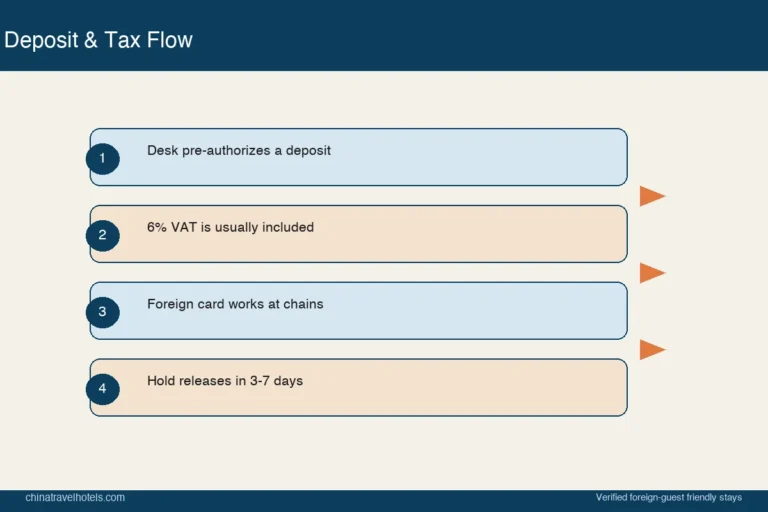
Because a “5-star” domestic independent can feel like a tired 4-star, and a renovated 4-star can outclass an old 5-star, the badge lies. My rule: trust the international brand or the renovation date over the number. A 2023-renovated 4-star Jin Jiang beats a 2008 “5-star” provincial hotel every time. So when choosing, compare the two specific properties, their review dates, and their location against a metro line — not the stars in the headline. The deposit difference matters too: a 5-star might pre-authorize ¥1,500–2,000 while a 4-star holds ¥500–1,000, and that’s covered in China hotel deposit and foreign credit cards.
A decision table
| You are… | Pick | Why |
|---|---|---|
| First-time, short stay | 5★ | Minimizes friction |
| Business, time-poor | 5★ | Concierge + card ease |
| Leisure, 4+ nights | 4★ | Half price, still comfy |
| Budget-focused | 4★ or budget chain | Max value |
| Need English fapiao | 5★ | Smoother invoicing |
| Late-night arrival | 5★ | Frictionless desk |
Money and the deposit
The deposit scales with tier — a 5-star might pre-authorize ¥1,500–2,000 while a 4-star holds ¥500–1,000. If you’re watching cash flow, the 4-star’s smaller hold is a quiet advantage, especially on a long trip with several one-night stops. The mechanics and refund timing are in China hotel deposit and foreign credit cards. And if your plans shift, late check-in and early check-out explains how each tier handles odd hours — generally the 5-star more gracefully, but a 4-star chain is rarely far behind.
Matching tier to city
In tier-1 cities (Beijing, Shanghai, Guangzhou, Shenzhen) the 4-star market is deep and reliable, so dropping from 5 to 4 rarely hurts. In smaller cities the 5-star may be the *only* property with confident English and a working foreign-card terminal, which flips the recommendation. So the same traveler might choose 4-star in Shanghai and 5-star in a tier-3 stop. The universal permission question — can foreigners book these hotels — is yes for both, provided the permit is held, and that permit is what truly determines whether you sleep well, not the number of stars on the sign.
Reading the rules behind the rates
Two government sources sit behind everything in this guide. The National Immigration Administration (https://www.nia.gov.cn/) operates the registration that every hotel files for you, and your embassy’s China page (https://www.china-embassy.gov.cn/) lays out the entry and stay rules to confirm before booking. I keep both bookmarked precisely because the tier you choose — 4-star or 5-star — changes none of your legal obligations; it only changes the size of the buffer between you and a language gap. When I’m deciding, I ask one question: on this specific trip, is the buffer worth the price? For a first night in a new city, often yes. For a two-week slow stay, almost never. The official rules don’t care which you pick; they only care that the property can register you, and every permitted hotel in this comparison can.
A two-night test I ran in two cities
To settle the question for myself I booked a four-star and a five-star in the same week, both near central Shanghai metro stops. The four-star, 520 yuan a night, had a small gym, a decent buffet, and a desk that handled my registration in under three minutes. The five-star, 980 yuan, added a pool, a lounge, and staff who greeted me by name on day two. The tangible difference was about 460 yuan a night for the pool and the name recognition, nice but not necessary. In a smaller city like Guilin the gap shrank: the four-star there was 320 yuan and the five-star 560 yuan, and both had the same river view because the view is the city’s, not the hotel’s. My rule now is to pick five stars in expensive hub cities where English support saves real time, and four stars in smaller cities where the location and the view matter more than the lounge. Let the city, not the star, decide.
The price gap, city by city
The distance between the tiers is not constant. In expensive hub cities the gap is wide enough to buy a second trip; in smaller cities it narrows to the point where the upgrade is almost free.
| City | Four-star, typical | Five-star, typical | Gap | My default |
|---|---|---|---|---|
| Beijing / Shanghai | ¥600–900 | ¥1,500–2,000 | ¥700–1,100 | Four-star, five-star on night one |
| Guangzhou / Shenzhen | ¥500–800 | ¥1,100–1,600 | ¥500–800 | Four-star |
| Chengdu / Hangzhou / Xi’an | ¥400–650 | ¥800–1,200 | ¥400–600 | Either |
| Tier-3 city | ¥300–450 | ¥500–750 | ¥200–300 | Five-star if you want English |
| Holiday weeks, anywhere | +50–100% | +50–100% | Widens | Book early, refundable |
That last row is the one people forget. Over National Day the absolute gap grows even though the ratio stays similar, which is when the tier decision actually bites.
Breakfast, gym, pool: what differs day to day
The hardware gap is smaller than the brochures imply. A good four-star in China gives you a decent buffet — eggs, congee, fruit, coffee — a small gym, and a room with a proper shower. The five-star adds a pool, a lounge, a wider Western selection and staff who learn your name by day two.
What I actually notice is not the hardware but three small things: whether the desk can explain the metro in English, whether the card terminal takes a foreign Visa without a phone call to the bank, and whether someone can produce a taxi card in characters. Those three cluster at five-star and appear sporadically at four-star, which is why the tier choice is really a language-and-payment choice.
Which tier for which traveller
| Traveller | Pick | Reason |
|---|---|---|
| First-timer, 2–3 nights | Five-star | Removes arrival friction |
| Business, time-poor | Five-star | Concierge, English fapiao |
| Leisure, 4+ nights | Four-star | Half the price, same bed |
| Family with children | Four-star or serviced | Space and a kitchen matter more |
| Long-stay remote worker | Serviced apartment | Weekly rates, laundry |
| Late-night arrival | Five-star | Desk works at 1 a.m. |
There is no traveller for whom five-star is the only legal option. The permit is the same at both tiers, and the National Immigration Administration registration that follows check-in happens identically whichever you pick.
Getting there, and where the tier meets the street
Location beats tier in most Chinese cities, because the metro does the work the concierge would. I check the walk from the nearest station before I check the star: five minutes from a Line 2 interchange beats a grander lobby fifteen minutes away. Timetables and station names are on China Railway 12306, and city operators publish English maps.
For a rail-heavy itinerary the station hotel often wins on both tiers — a four-star beside the station beats a five-star across town when your train leaves at 06:40.
Honest caveats
Chinese stars are awarded by the tourism bureau and go stale, so a “five-star” independent can feel older than a renovated four-star chain; read the reviews and the renovation year rather than the badge. Deposit sizes differ by tier — ¥500–1,000 at a four-star against ¥1,500–2,000 at a five-star — which matters if your card limit is tight. And none of this touches legality: both tiers need the same foreign-guest permit to take you at all.