Accessible hotels in China exist mainly among international chains and newer Chinese towers in big-city cores — book a confirmed step-free room with a roll-in shower, and email the hotel about your exact needs before you pay. Old courtyard, heritage and budget guesthouses are usually not wheelchair-friendly, so verify the entry, the lift and the bathroom rather than trust the star rating.
The blunt reality
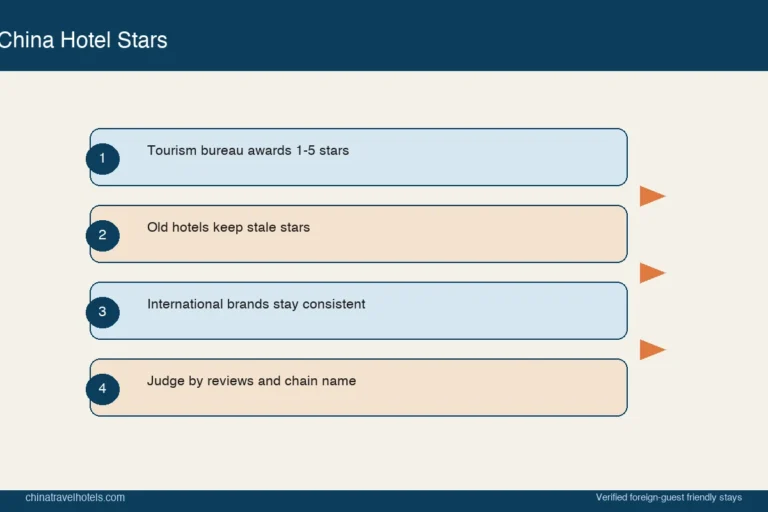
China’s building stock is a mix of brand-new towers and very old structures, and accessibility is uneven. A gleaming 2020 tower in Shanghai’s Lujiazui will have wide doors, low reception counters and roll-in showers. A converted 1920s building near the Forbidden City may have three steps at the door and a tiny bathroom with a lip. The star rating tells you about luxury, not about wheels. I have rolled a bag up steps that a wheelchair user could not, in a “four-star” Beijing lane hotel — stars lied, the steps did not.
Where accessible rooms are genuinely reliable
| Property type | Accessibility | Notes |
|---|---|---|
| International 4–5 star (new towers) | Strong | Roll-in showers, wide doors, trained staff |
| Chinese chain new-build (Atour, Narada) | Good | Newer ones meet modern codes |
| Mid Chinese city hotels | Mixed | Ask for “无障碍房” (barrier-free room) |
| Heritage / courtyard / hutong | Weak | Steps, narrow doors, no lift |
| Budget guesthouse | Weak | Often no lift, tiny bathrooms |
For the brand angle, hotel loyalty programs that work in China lists the international chains whose China properties are most consistent. The rating backdrop is in China hotel star ratings explained.
The exact questions to email before you book
Do not trust the filter alone — send a short, specific email (or app message) and keep the reply:
- “Is there a step-free entrance from the street, or only steps?”
- “Does the lift reach the accessible room, and is the door at least 80cm?”
- “Is the bathroom a roll-in shower (no lip), with a wall-mounted chair?”
- “Is the bed height suitable, and is there space for a hoist?”
I have found that a clear written answer protects you more than any star badge. The message template lives in how to find English-speaking hotels — adapt it for access needs.
Use the platform filters, then verify
Trip.com and Booking both have an “accessible” or “facilities for disabled” filter, but it is self-reported and unreliable in China. Treat it as a starting shortlist, then confirm by message. Book on Trip.com lets you attach the access request to the reservation so the night desk sees it; check Agoda shows “disabled facilities” in the amenities list — cross-check both. When I checked into a hotel in Chengdu, the filter said “accessible” but the room had a 5cm shower lip; the email I had saved let me push for a swap without argument.
Cities and regions: easiest to hardest
Easiest: Shanghai, Beijing, Shenzhen, Guangzhou — new towers and international hotels dominate. Moderate: Chengdu, Hangzhou, Xi’an. Hard: scenic and heritage areas — Lhasa and the Potala area have older buildings and altitude transport issues; small water-town hotels (Wuzhen, Zhujiajiao) have stone lanes and no lifts. In the hard places, stay in the modern district, not the old town, even if it is less photogenic.
Bathroom is the make-or-break
The bedroom can be fine and the bathroom impossible. You need: a roll-in shower with a chair, grab bars, a raised toilet, and no threshold into the room or bath. Many Chinese hotel showers are enclosed tubs with a high side — useless in a wheelchair. Insist on “roll-in shower” specifically; “accessible bathroom” alone is too vague. At 5-star hotels worth it for foreigners the accessible bathroom is usually proper; at budget places it rarely exists, so see best budget hotels in China that accept foreigners only after you have confirmed the bath.
Getting around once you are out
Even a perfect hotel sits in a city with uneven pavements and subway stairs. The Shanghai Metro and Beijing Subway both have step-free stations and lifts, but not at every entrance — plan routes on their English pages. Taxis and DiDi are low-floor inconsistent; book accessible-vehicle services in big cities where available. The National Immigration Administration and the Chinese embassy site carry visitor guidance worth saving before you travel.
Honest caveats
- “Accessible” in a Chinese listing often means “we have a ramp somewhere,” not a full barrier-free room. Verify the specifics.
- Heritage and courtyard hotels (hutongs, tu lou, old towns) are largely off-limits to wheelchairs — beautiful, but skip them.
- Staff may never have hosted a wheelchair user; patiently show them the email confirmation.
- Lifts in older buildings can be tiny — a large power chair may not fit; measure against the car size they quote.
My checklist for an accessible China trip
- Shortlist international or new-tower hotels only.
- Email the four questions; save the reply.
- Book the “无障碍房” (barrier-free room) explicitly.
- Plan metro step-free routes on the operator’s English site.
- Carry a translated “I use a wheelchair, need step-free access” card.
Getting out and about: access beyond the hotel
A step-free room is only useful if the city around it is reachable. Plan day trips with the same rigor. The Shanghai Metro and Beijing Subway both publish step-free station maps in English, but only some entrances have lifts, so pick your gate before you leave — I trace the accessible route on the operator’s site the night before. Taxis are a mixed bag: many are low-floor sedans you cannot roll into, so use DiDi and note “need accessible vehicle” in the comment, or pre-book a wheelchair-friendly car service in big cities. Scenic sites vary wildly — the Mutianyu stretch of the Great Wall has a cable car and a relatively smooth path, while older sections are all steps; check the specific spot, not the region. Hotels can often arrange a car with a boot big enough for a folded chair; ask at concierge, not at the curb. The honest limit: China is improving fast but is not yet reliably step-free, so the accessible traveller wins by researching each leg, not by assuming.
Before you book, call the hotel once. A two-minute check by app translator settles more than any star rating. I now treat the booking confirmation and the access email as a pair: one proves the room, the other proves the room works for a wheelchair. The hotels that answer both clearly are the ones I return to. China builds new accessible towers every year, so the list grows, but the old stock is not going away. Plan the hard parts — the metro gate, the taxi, the shower lip — and the soft parts take care of themselves. A calm, specific email sent before you pay is worth more than any review read after you arrive. If you travel with a foldable chair, tell the concierge at arrival so they stage a car with a big boot; the desk that seemed confused often becomes the most helpful once the request is written down in both languages.