The most reliable English-speaking hotels in China are international chains — Marriott, Hilton, IHG and Accor — plus the larger Chinese chains in the CBD districts of big cities. Use Trip.com’s English filters and scan recent guest photos for English signage before you book, then message the hotel in-app to confirm a staff member is on shift who can help you.
Why “English-speaking” is a tier-1 and CBD thing
Outside the centres of Beijing, Shanghai, Chengdu and a handful of others, English drops off fast. A lovely boutique hotel in a side street may have a brilliant front desk who speaks only Mandarin. That is fine if you just need to sleep and pay — but if you want help with taxis, tickets or a broken shower at midnight, language matters. When I checked into a hotel in Chengdu’s Tianfu district, the night manager switched to clear English without me asking; in a county town the same chain had no one past 10pm who could.
The chains that reliably staff English
| Brand | Where it is strong | Typical English level |
|---|---|---|
| Marriott / Sheraton / Westin | Tier-1 + major tier-2 | Good at front desk, variable in F&B |
| Hilton / DoubleTree | Major cities | Good; app support in English |
| IHG (Crowne Plaza, Holiday Inn) | Nationwide | Reliable, training is consistent |
| Accor (Ibis, Novotel, Sofitel) | Cities + airports | Good, especially Ibis at transit hubs |
| Chinese chains (Home Inn Plus, Atour) | CBDs of big cities | Mixed; Atour is surprisingly strong |
For the points angle, see hotel loyalty programs that work in China — the global brands above are the ones you can actually earn on.
Use the booking app as your translator first
Before you ever arrive, let the platform do the talking. How to use Trip.com as a foreigner explains the setup, but the key move is the in-app message: type your question in English, and Trip.com translates it to the hotel and back. I have confirmed “non-smoking high floor” and “early breakfast” this way in three cities without speaking a word of Chinese. Compare inventory on Trip.com vs Booking vs Agoda in China — Booking’s English interface is clean, though its China stock is thinner.
Read the photos, not just the stars
Star ratings lie about language. The real signal is in guest photos: do you see English on the lift buttons, the restaurant menu, the room directory? A China hotel star ratings explained read helps, but a single photo of a bilingual sign tells you more than a plaque. I filter reviews to “English” and read the last six months only — old reviews about “now they have English staff” go stale.
Cities where English is easy, and where to lower expectations
Easy: Shanghai (especially near the Bund), Beijing (near the Forbidden City), Shenzhen, Suzhou’s tourist belt. Moderate: Xi’an, Hangzhou, Chengdu. Hard: anywhere scenic and small — Yangshuo, a Huangshan village, most of Tibet. In the hard places, pre-book a driver or use translation apps rather than hoping the desk helps.
Message the hotel the day before — a template
Keep it short and specific:
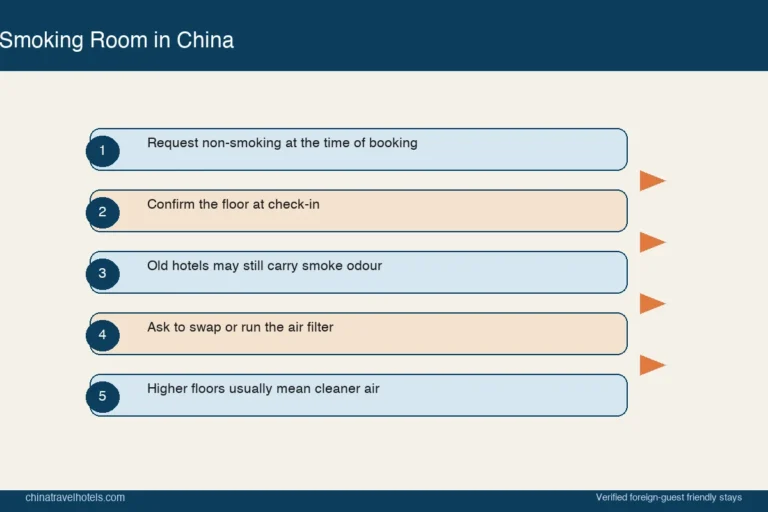
“Hello, I arrive [date] at [time]. Do you have an English-speaking staff member at check-in? I need a non-smoking room and a taxi to [place] tomorrow. Thank you.”
Save the hotel’s reply. If they answer in English, you are set. If they send a confused emoji, lower expectations and load a translator. Book on Trip.com even lets you attach the message to the reservation so the night desk sees it.
Backup tools that do not need hotel staff
- Translation apps: Pleco for text, Google Translate camera mode (needs a VPN in China for some features), or Baidu Translate.
- Maps: save the hotel pin on Gaode/Baidu vs Google before you lose signal.
- Offline phrase card: a screenshot of “I would like to check in” and “my passport” in Chinese characters.
Honest caveat
Even five-star hotels in China can have non-English-speaking housekeeping and restaurant staff. English at the front desk is not English everywhere. Budget for the occasional charades moment, and you will be fine. If you truly need English throughout, stick to the international brands and the city cores. The Chinese embassy’s travel page also lists consular help lines in English if something goes wrong.
Phrases and apps that bridge the gap
When the desk does not speak English, a few prepared lines save the night. I keep four phrases saved as images on my phone: “I have a booking under [name]” (我有预订), “I need a non-smoking room” (我要无烟房), “Please call a taxi” (请帮我叫出租车), and “Where is the breakfast?” (早餐在哪里). Show the characters; the clerk reads them faster than any translator. For back-and-forth, the Pleco app translates typed English to Chinese and speaks it aloud, which surprises desk staff in a good way. Baidu Translate has better Chinese-to-English for menus and signs. Google Translate’s camera mode works but needs a VPN in China for live features, so do not rely on it offline. The single most useful habit is to confirm the big three at check-in by writing, not speaking: room type, price, and breakfast inclusion. Misunderstandings about these three cause most of the friction I have seen. English helps, but a typed Chinese sentence beats fluent English that a tired 1am clerk cannot parse.
The truth is you do not need fluent English at the desk to have a smooth stay — you need one clear message before you arrive and a translation app in your pocket. I have checked into perfectly fine hotels where nobody spoke a word of English and walked out happy because the booking note did the talking. The hotels that stress foreigners are usually the ones booked on a hunch, without confirming the language or the registration. Do the five minutes of prep, save the Chinese address, and the rest is just travel. English helps in a crisis, but preparation helps every day. Treat the app as your translator and the booking note as your contract, and you will manage in cities where English is rare. And remember that body language and patience cover more than people admit; a smile and a phone screen with the right characters have gotten me out of more jams than any phrasebook.