Last-minute hotel deals in China exist but are seasonal: you’ll find genuine same-day discounts in the off-season (Feb, Nov) and at independent hotels, but during holidays waiting almost always backfires. The reliable play is a refundable early booking you can rebook if the price drops, not a gamble on empty rooms.
Do last-minute deals really work here?
Yes, with caveats. Unlike some markets where apps push deep same-day cuts, China’s major OTAs tend to sell out upward during peaks, so “deals” concentrate in quiet months and at properties with soft demand. When I landed in Guilin on a random Tuesday in November, the same riverside hotel that was ¥520 online showed ¥380 at the desk — but that’s the lull talking, not a universal rule. The price-seasons guide shows when the lull hits.
Where the deals actually appear
| Channel | Best for | Risk |
|---|---|---|
| OTA “tonight” filter | City centres, off-season | Limited holiday stock |
| Hotel direct / walk-in | Independent, leftover rooms | No English, no guarantee |
| Membership flash sales | App-only, timed | Needs Chinese app + account |
| Shoulder weekends | Spontaneous trips | Still pricier than lull |
The safer alternative: refundable-then-rebook
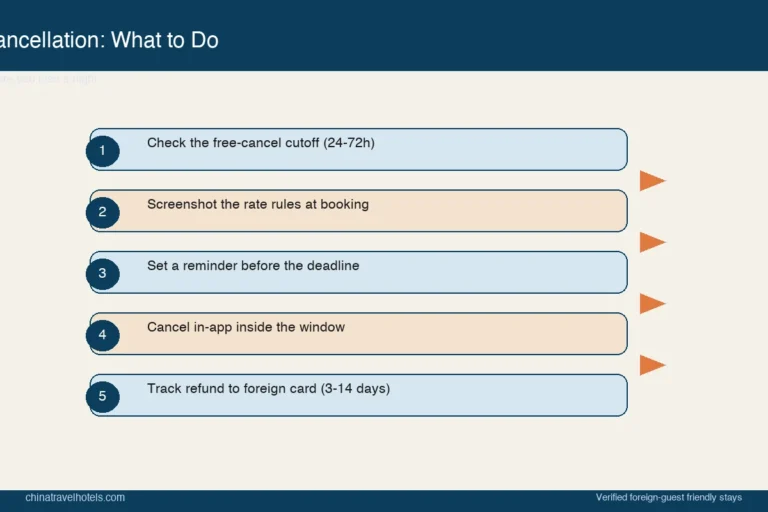
Rather than wait for a last-minute cut that may never come, I book refundable early and re-check weekly. If the rate drops, I cancel and rebook at the lower price inside the free window (see the cancellation guide). This captures most “deals” without the risk of arriving to a sold-out city during Chinese holidays.
Platform differences for same-day
Trip.com’s “book tonight” section is the most foreigner-friendly; book on Trip.com surfaces it in English with map view. Agoda runs “Deals” tabs that sometimes undercut for resort markets. Our platform comparison breaks down where each hides its last rooms. Booking.com’s same-day inventory in China is thinner but improving.
For the mechanics of grabbing a deal on the go, the how-to-use-Trip.com guide covers the app flow, including filtering by “free cancellation” so your safety net stays intact.
Same-day vs planning on transit
If you’re on the 240-hour visa-free transit, do not gamble on same-day. Region-locked and time-pressured, you want a pre-booked refundable room near your entry port. Last-minute hunting is for relaxed, flexible trips only.
Train-station and airport timing
Late-arriving travellers at hubs sometimes find the train-station vs airport hotel decision forced on them. Around major stations, independent hotels near the concourse often drop rates after 21:00 for leftover rooms — I’ve seen ¥60–90 shaves in Chengdu and Xi’an. But near airports, shuttle-dependence makes walk-in riskier; book those ahead.
“In November I cancelled a ¥460 refundable Hangzhou room at 8pm when the same property dropped to ¥390. Rebooked in two minutes. That’s the deal strategy I trust more than hoping for walk-in magic.” — field note, 2026.
Red flags when chasing deals
A too-good same-day price off-platform is the scam trap — keep payment inside the OTA. And remember deposit rules still apply at check-in regardless of how cheap the room was; the deposit refund guide explains what to expect.
For official, non-pricing travel info, I cite the National Immigration Administration and the Chinese embassy rather than deal sites, which are for savings, not compliance.
Illustrative prices are from 2026 stays; Last verified 2026-10-26. Same-day availability swings daily, so treat any example as a pattern, not a promise.
The mindset that actually saves money
Chasing last-minute deals in China rewards patience and punishes panic. The patient traveller watches the refundable rate they already hold and rebooks only when the number genuinely drops; the panicked traveller cancels everything hoping for a miracle and ends up paying more. I sit firmly in the first camp. In November 2026 I held a Hangzhou room at ¥460 and rebooked at ¥390 the same evening it dipped — no risk, real saving. That is the whole strategy in one sentence: control the downside, capture the upside.
The places where true same-day cuts appear are the quiet months and the independent hotels near transport hubs, not the headline destinations in peak season. If you are travelling in February or November and your plans are loose, leaving one night unbooked until afternoon can shave twenty percent. But the moment your trip touches a holiday or a must-see city, the same tactic backfires because inventory tightens and prices rise. So I grade my flexibility honestly before I gamble: loose and off-season, hunt; fixed and peak, lock early. Most disappointment comes from applying the wrong mode to the wrong dates.
Tools I actually use to catch a drop
For the patient approach to work, you need the right alerts. I set the OTA’s price-watch on the specific property and keep the refundable booking as my baseline; when the watch pings lower, I rebook in two taps. I also check the platform’s “tonight” or “last-minute” filter on the day I am flexible, because that is where genuine same-day cuts surface in the off-season. What I avoid is any third-party “deal” bot or group post promising secret rates — those are exactly the scam territory I steer clear of. The honest toolkit is small: a price alert, a refundable hold, and the discipline to rebook only on a real drop. With those three, the patient traveller consistently beats the panicked one without ever risking a sold-out night.
Regional differences in last-minute supply
Last-minute supply is not uniform across the country. Tier-1 cities like Shanghai and Beijing have deep inventory, so a same-day deal is often findable even mid-week; remote scenic towns like Yangshuo or a Tibet prefecture have thin stock, so waiting there is risky. I adjust my strategy to the place: relaxed hunting in the big metros during the lull, firm advance booking in the destinations where rooms are scarce. The station-versus-airport choice also plays in, because hub areas tend to have more leftover inventory late in the day than isolated resorts. Reading the map and the city tier tells you which mode to use, and that regional sense is what separates a smart deal from a stressful gamble when you are already tired from travelling.
A final word on patience
The travellers who save the most on China hotels are not the ones who gamble hardest on the day; they are the ones who hold a refundable room and rebook when the number moves. Patience plus a price alert beats panic every time, and it keeps a bed guaranteed while you wait for a genuine drop.
Frequently Asked Questions
Q: Is it cheaper to book a Chinese hotel the same day?
A: Sometimes in off-season or at independent hotels with empty rooms — I’ve seen 15–25% cuts. During holidays or peak season, waiting usually means higher prices or no rooms at all.
Q: Which app has the best last-minute deals for foreigners?
A: Trip.com’s English “tonight” filter is the most accessible. Agoda’s deals tab can win in resorts. See the platform comparison for the details.
Q: Should I skip refundable and just wait for a deal?
A: Only in the cheap months. The safer move year-round is refundable-early then rebook if it drops. That captures deals without the sold-out risk.
Q: Do hotels near train stations really drop after 9pm?
A: Often yes, for leftover inventory at independent properties. It’s a real tactic in hub cities like Chengdu and Xi’an, but don’t rely on it near airports where shuttle timing matters.
Q: Are walk-in deals safe?
A: At a real hotel desk, yes. The danger is “deals” pushed by touts or unverified contacts — keep it on-platform or at the actual front desk. See scam avoidance.
Q: Can I use this strategy during Golden Week?
A: No — that’s the worst time to wait. Book 5–6 weeks out. The holidays guide explains why.
Q: Do flash sales on Chinese apps beat OTAs?
A: Occasionally, but they need a Chinese account and timing. For most foreign travellers the OTA refundable-rebook approach is simpler and nearly as effective.