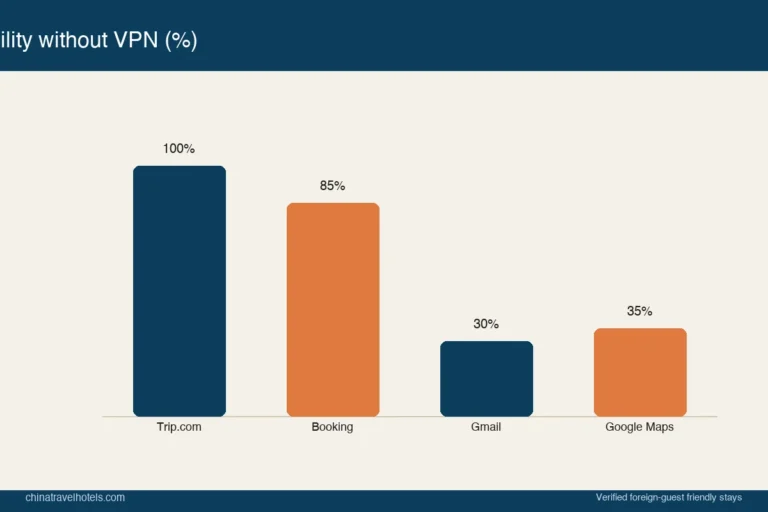
Chinese hotel review sites (Ctrip, Qunar, Dianping) show far more domestic properties and candid local feedback than Western sites, but they’re in Chinese and skew toward Chinese travellers’ priorities. For foreign guests, Trip.com (Ctrip’s English arm) plus Booking.com gives the best bilingual balance — read both before booking.
The two review universes
China runs its own review ecosystem that most Western travellers never see. Ctrip (now Trip.com), Qunar, and Dianping dominate, with hundreds of millions of reviews written by domestic tourists. Meanwhile Booking.com, Agoda, and TripAdvisor serve the international crowd. When I research a Chengdu hotel, I’ll glance at Dianping for the Chinese read and Trip.com for the English one — they often disagree on the same property.
The split matters because Trip.com vs Booking vs Agoda isn’t just about price; it’s about whose reviews you’re trusting. A hotel loved by domestic reviewers for its banquet hall may frustrate a foreigner wanting quiet and English front desk.
Chinese vs Western: side by side
| Aspect | Chinese sites (Ctrip/Dianping) | Western sites (Booking/TripAdvisor) |
|---|---|---|
| Language | Mandarin, sometimes no English | English, occasionally spotty |
| Property coverage | Deepest, incl. small guesthouses | Strong on hotels, weaker on inns |
| Reviewer priorities | Banquet, location, value | Cleanliness, staff English, quiet |
| Photo honesty | Heavy filters, lots of pro shots | More user snapshots |
| Fake-review risk | Moderate, incentivised reviews | Lower but present |
| Booking link | Direct, app-only deals | OTA, pay-at-property common |
Why Chinese reviews are worth the translation
Domestic reviewers catch things Western ones miss: whether the breakfast is genuinely good, if the area gets noisy with street food at 6am, whether the star rating is inflated. I use the camera-translate feature in my map app to skim Dianping comments. It’s rough, but the aggregate signal — “great location, terrible soundproofing” — repeats clearly.
The flip side: Chinese reviewers rarely mention foreigner acceptance or passport check-in friction, which is exactly what why foreigners get rejected and is Trip.com reliable cover from a Western angle.
Trusting Western sites for China
Booking.com’s China inventory improved a lot, but it still misses thousands of domestic properties and sometimes shows “sold out” where Trip.com has rooms. Agoda is solid for resort markets. Our Agoda reliability piece and Booking pros/cons detail the gaps. TripAdvisor remains useful for restaurants near your hotel but weaker for actual bookings.
“I booked a Hangzhou hotel on Booking that domestic reviewers had flagged for thin walls. I asked for a top-floor quiet room in the special-requests box and it worked. Reading both worlds saved a sleepless night.” — field note, 2026.
Spotting fake and incentivised reviews
Both ecosystems have them. On Chinese sites, a wall of nearly identical five-star posts with similar phrasing often signals incentivised reviews (free stay for a rating). On Western sites, watch for vague “great hotel, great staff” with no specifics. Cross-referencing loyalty programmes member reviews and recent dated stays filters noise.
For official, non-commercial travel context, I lean on the Chinese embassy site rather than reviews when it comes to entry rules; reviews are for comfort, not compliance. The National Immigration Administration is the authority for the latter.
Practical read-both method
- Shortlist on Trip.com (English, foreigner-friendly filtering).
- Open the same property on Dianping via translation for the local read.
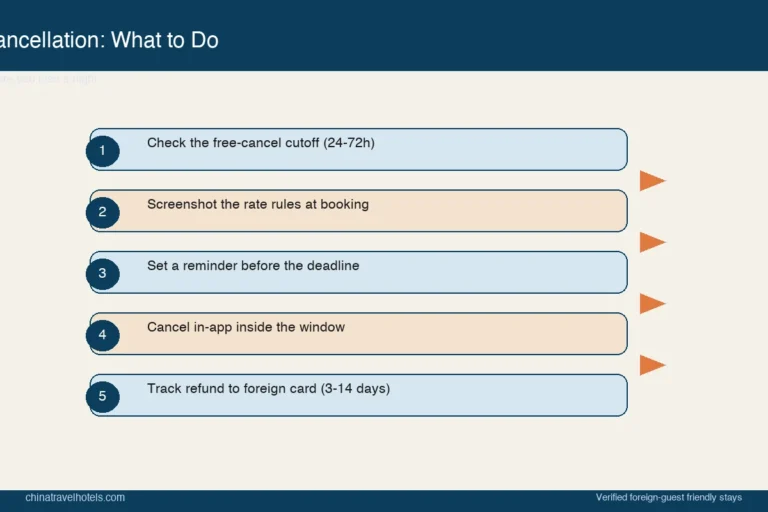
- Check Booking for the Western reviewer consensus and cancellation terms.
- Book where the price + free-cancel window is best.
This dual approach beats trusting any single source, and it’s the habit behind most of the platform guides on this site, including booking direct vs OTA.
Illustrative platform behaviour reflects use through 2026; Last verified 2026-10-26. Site features change, so always check the live app.
My everyday reading routine
To make the dual-source approach concrete, here is what I do for any China hotel I am serious about. First I open Trip.com and filter for foreigner-friendly and free cancellation, skimming the English reviews for staff language and noise. Then I paste the property name into Dianping via my map app’s translate and read the Chinese complaints — they are blunter about soundproofing and breakfast quality. Finally I check Agoda for any price divergence and the Western reviewer consensus. The whole routine takes ten minutes and has repeatedly changed my choice.
The payoff is specificity. English reviews told me a Chengdu hotel was “lovely”; Chinese reviews revealed the “lovely” lobby sat above a night-market street that ran until 2am — I then requested a high floor and slept fine. Neither source alone gave me that. I also weight recent reviews heavily, because hotels change management and renovation cycles swing quality. A property with a strong 2024 but weak 2026 record is a different bet than the reverse. Treat reviews as a dialogue between two traveller cultures, and you book with far fewer surprises than either side would give you alone.
Rating inflation and how to read through it
Both ecosystems inflate, but differently. Chinese platforms sometimes reward a five-star review with a small voucher, so a wall of perfect scores can be soft; Western platforms get vague “great stay” spam from infrequent travellers. My filter is to read the two-star and three-star reviews first — that is where the real, specific complaints live, and where the two cultures agree you learn the truth fastest. I also look for photos dated in the last six months, because hotels renovate and decline. The single most useful habit is weighting recent, specific, mildly critical reviews over glowing generic ones, on either side. Do that and the signal-to-noise ratio jumps, and you book the property that matches your actual priorities instead of the one with the prettiest average score.
Using reviews to judge foreigner-friendliness
The single most useful filter for a foreign guest is whether reviewers mention passport check-in and English front-desk help, because those are the issues that actually break a stay. Western reviews surface them directly; Chinese reviews hint at them through complaints about “foreigner procedures” or praise for “English-speaking staff.” I read for both signals before booking any property I have not stayed in. A hotel can have a gorgeous lobby and terrible foreigner acceptance, and only the right review filter reveals that. This is where reading the two ecosystems together earns its keep — the Western side names the problem, the Chinese side confirms how common it is. Skip either and you book partly blind to the one risk that matters most to you.
Frequently Asked Questions
Q: Should I trust Chinese review sites if I don’t read Mandarin?
A: Use your phone’s camera translate to skim the gist — ratings and repeated complaints come through clearly. Pair with an English site; together they’re stronger than either alone.
Q: Are Ctrip and Trip.com reviews the same?
A: Largely the same inventory and often shared ratings, but Trip.com is the English interface with foreigner-friendly filters. The Ctrip vs Trip.com explainer digs in.
Q: Which site has the most honest photos?
A: Western user photos tend to be less polished and closer to reality; Chinese sites lean on professional shots. Always scroll to the “traveller photos” tab, not the gallery.
Q: Do fake reviews dominate either side?
A: Both have incentivised reviews, but they’re usually identifiable by repetition and vagueness. Cross-check recent, dated, specific reviews on two platforms.
Q: Is TripAdvisor still useful for China?
A: For restaurant and attraction context near your hotel, yes. For actual room bookings, weaker than Trip.com or Booking. Treat it as a research layer, not a booking layer.
Q: Why do Chinese and Western reviewers disagree so much?
A: Different priorities — domestic guests value banquet space and value; foreigners prioritise English staff, quiet, and easy passport check-in. Read for what matters to you.
Q: Can I leave a review as a foreigner?
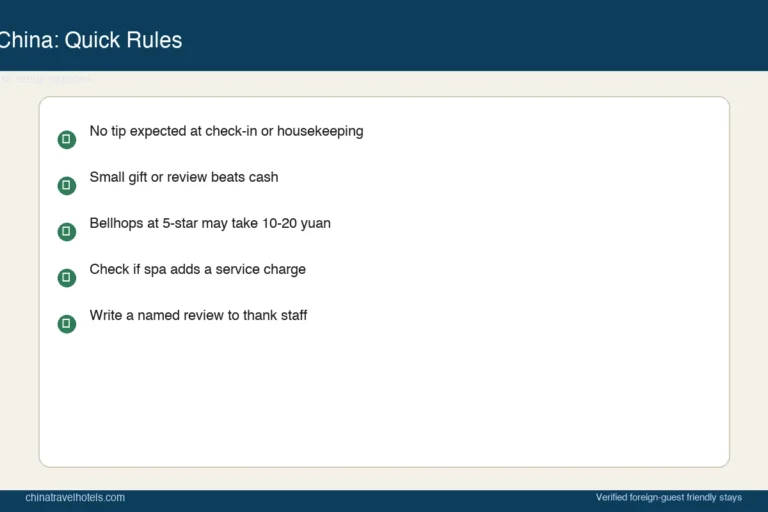
A: Yes, on any platform you booked through. A specific, named review helps future travellers and the staff. It’s also the best “tip” you can leave — see our tipping guide.