Yes — foreign passport holders can absolutely stay in Chinese hotels, and millions do every year. The catch is not the law; it is the licence. Not every property is authorised to register foreign guests with the authorities, so the real question is not “can foreigners stay in China?” but “is this specific hotel allowed to take me?” Once you know how to pick the right property, staying in China is as straightforward as anywhere else.
The short answer
Foreign tourists, business travellers and transit passengers are all welcome at licensed hotels across China. International chains, major Chinese brands, and most mid-range city hotels register foreign guests every day without issue. The handful of properties that cannot take you are usually small, unlicensed guesthouses that were never set up for it — not a sign that foreigners are unwelcome. Book the right hotel and check-in is routine.
The legal basis
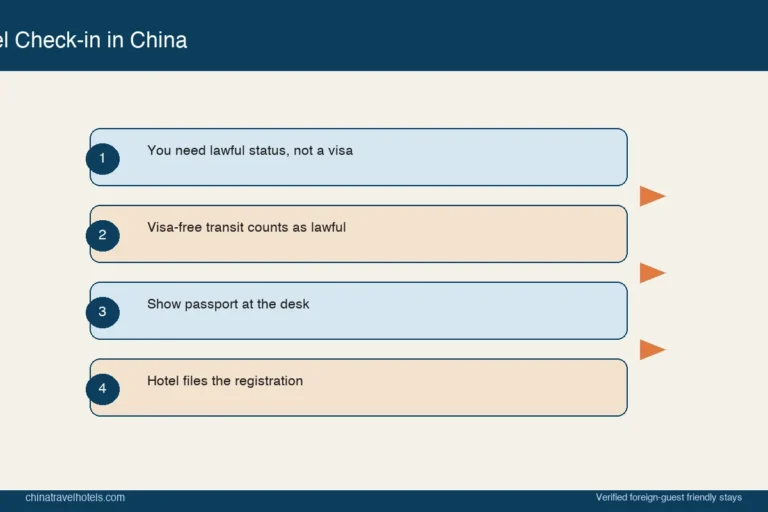
China requires hotels to register each foreign guest’s stay with the local public security bureau through a licensed terminal at check-in. This is a standard administrative step, not a barrier. Hotels that hold the foreign-guest licence have the terminal and trained staff; those that don’t cannot complete the registration and therefore cannot legally host you. The system is what creates the split between “can” and “can’t” — and it is the single most useful thing to understand before you book. Our check-in and passport registration guide walks through exactly what happens at the desk.
Which hotels can take you
- International chains (Marriott, Hilton, IHG, Accor and others): licensed, English-speaking, foreign-card friendly.
- Major Chinese brands (e.g. national mid- to upscale chains): almost always licensed and used to foreign passports.
- Mid-range city hotels in tourist centres: usually licensed; confirm if unsure.
- Airport and rail-station hotels at major hubs: typically licensed for transit guests.
These cover the vast majority of where a foreign visitor would want to stay, so the practical risk is low once you avoid the bottom of the market.
Which hotels can’t
Small independent guesthouses, some budget hostels, and older inns that cater to domestic travellers may lack the foreign-guest licence. They might have availability and a low price, but they cannot register your passport, so they will turn you away at the desk. This is the trap to avoid: a cheap, well-reviewed property that simply isn’t licensed for foreigners. Reading the listing and sending one confirming message removes the risk. Our guide to hotels that accept foreign passports shows the tells.
What you need at check-in
Bring the original passport — not a photocopy, not a driving licence. The desk scans the photo page, sometimes the visa or entry-stamp page, and records your stay. That is the entire requirement on your side; there is no extra permit to arrange. Keep the passport with you until you are in the room, because the scan happens before you get the key. A deposit is also standard and separate from registration. See our paying for hotels in China for how deposits and cards work.

Apartments, homestays and Airbnb
This is where the simple “yes” gets complicated. Private apartments, homestays and Airbnb-style stays are not hotels, so there is no desk running the registration for you — and the legal duty to register your stay with the authorities still applies, usually via the host. Many hosts are not set up to do this, which leaves you technically non-compliant and without the paperwork a visa extension or check might need. For most foreign visitors, licensed hotels are the lower-stress choice. Our Airbnb and rental risk guide covers the trade-offs in detail.
Myths versus facts
| Myth | Fact |
|---|---|
| Foreigners can’t stay in China | They can, at any licensed hotel |
| You need a special permit to check in | Only a valid passport is required |
| Budget hotels never take foreigners | Many do; unlicensed ones don’t, regardless of price |
| The desk refuses because of nationality | Refusals are about licensing, not nationality |
| Airbnb works like a hotel | It doesn’t — registration is on you, not the host |
How to guarantee a smooth stay
Three habits remove almost all risk. First, book licensed hotels — international or established Chinese brands in city centres. Second, send one short message confirming the property can register your passport, and keep the reply. Third, carry the physical passport to the desk and have your booking confirmation open on your phone. Do those and check-in is the same sixty-second scan you’d get in any major city. The email template for confirming foreign-guest acceptance makes the second step effortless.
Do prices differ for foreigners
Registered hotels charge the same rate regardless of passport; there is no legal foreigner surcharge, and any property quoting a higher price for a foreign guest is doing so irregularly, not by rule. If you see a “foreigner price,” question it. The rate you see online is the rate you pay, provided the hotel is licensed to take you in the first place. Pricing transparency is one of the easier parts of the stay once the licensing question is settled.
Group travel and multiple rooms
Travelling as a group of foreigners is no harder than travelling solo, as long as every hotel on the route is licensed. Book the group together and confirm the property can register all passports — large groups at smaller hotels sometimes strain an unfamiliar desk, so international or larger Chinese-brand hotels are the easier call for groups. Our guide to hotel tiers in China helps match group size to property type so the registration step stays routine for everyone.
Children and family stays
Foreign children are registered like adults — passport scanned at check-in, no special permit. Family rooms exist at licensed hotels, though availability varies, so confirm a family room or extra bed when you book rather than at the desk. The registration step is identical for a toddler and an adult; the only difference is whether the room fits you all. A central licensed hotel makes family logistics the easy part of the trip, leaving you to focus on the sights.
Frequently asked questions
Do I need a visa to stay in a hotel?
You need whatever entry status lets you be in China legally — a visa, transit permit or other valid status. The hotel registers your stay; it does not grant you one.
Can a foreigner stay in a three-star Chinese hotel?
Often yes, if it holds the foreign-guest licence. Confirm before paying, because licensing varies more at the budget end than at the top.
What if my preferred hotel says it can’t take me?
Move to a licensed alternative. International and major Chinese-brand hotels in the same area almost always can.
Is there a separate foreigner price?
No. Registered hotels charge the same rates regardless of passport; the only difference is the registration step.
Can two foreigners share one room?
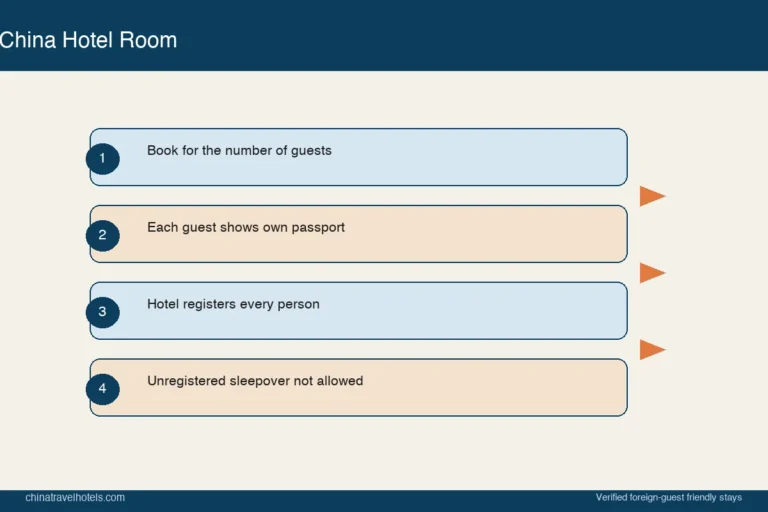
Yes, as long as the hotel is licensed and both passports are registered at check-in.
Do I register myself with the police?
At a licensed hotel, the desk does it for you. Only non-hotel stays put the duty on you or your host.