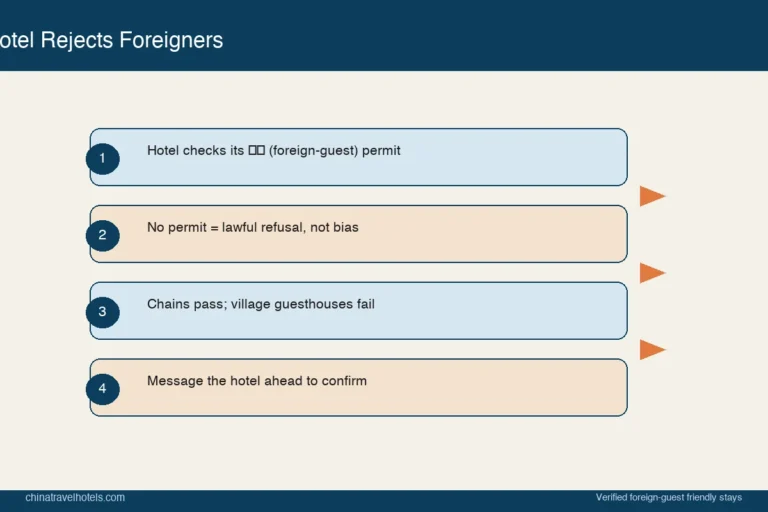
When you arrive at a hotel in China, the front desk will scan your passport into a government registration system before you get a room key. That scan is not optional paperwork — it is a legal requirement for every foreign guest, and it is the exact moment that decides whether a property is allowed to host you. Most international and mid-range hotels finish it in seconds; some budget places cannot do it at all, which is why they turn foreigners away.
Why your passport gets scanned
China requires hotels to register the stay of every foreign national with the local public security bureau (PSB). At licensed hotels this happens automatically: your passport is scanned at check-in and the details are sent through the hotel’s registration terminal. You rarely see the transmission, but it is happening behind the desk.
This is why a valid passport — not a photocopy, not a driving licence — is the one document you must carry to the desk. It is also why some very small or unlicensed guesthouses cannot accept you: they lack the registration system entirely, and taking a foreigner without registering one is a violation they avoid by simply saying no.
What actually happens at the desk
The process is quick and routine at places used to foreign guests:
- You hand over your passport.
- The clerk scans the photo page, and sometimes the visa or entry-stamp page.
- The system records your name, passport number, nationality and room.
- You confirm the registration and get your key.
In larger hotels this is a 60-second step. In smaller ones it can take a few minutes if the clerk is less familiar with the terminal, but the requirement is identical everywhere. Keep your passport handy until you are actually in your room — do not pack it away the moment you walk in.
Hotels that cannot take you (and why)
Not every property in China is licensed to receive foreign guests. The usual reasons you might be refused:
- The hotel is not connected to the foreign-guest registration system.
- It caters only to domestic travellers and has never processed a passport.
- Local rules restrict foreign guests in certain areas.
None of this means you did something wrong; it means that specific property is not set up for it. The fix is to book a hotel that is — which is exactly why confirming foreign-guest acceptance before you pay matters. Our guide to hotels in China that accept foreign passports walks through how to spot the right properties.
Documents to keep ready
| Document | Needed at check-in? | Notes |
|---|---|---|
| Passport (original) | Yes, always | The photo page is scanned; keep it with you |
| Visa or entry-stamp page | Often | Some desks also scan the visa page |
| Second ID (e.g. home licence) | Rarely | Only if the hotel asks |
| Booking confirmation | Helpful | Shows your name matches the room |
| Cash or card for deposit | Yes | Separate from room payment |
A deposit is standard at most hotels and is unrelated to registration — it is a hold against incidentals. See our guide to paying for hotels in China for how deposits and cards work for foreigners.
Staying somewhere that is not a hotel
If you sleep at a private residence, a friend’s apartment, or an unlicensed rental, the hotel-style auto-registration does not happen — and the legal duty to register still applies. In that case the host (or you) must register the stay with the local PSB, usually within 24 hours of arrival. This is a common stumbling block for travellers who assume an Airbnb-style stay works like a hotel. It does not, which is one reason many foreign guests stick to licensed hotels. Our write-up on Airbnb and rental risks for foreigners in China covers the trade-offs in detail.

How to make check-in faster
Arrive with your passport already out, not buried in a money belt. If you booked through a platform, have the confirmation open on your phone with the exact spelling of your name as it appears in the passport. A booking under a nickname can force the desk to re-enter details; a booking under your legal name sails through. If you are travelling with family, everyone’s passport is scanned, including children — there is no separate process for kids.
Name mismatches and dual passports
If your booking was made under a different version of your name, the desk may need to re-enter it. That is a minor delay, not a refusal. If you hold two passports, use the one you entered China with — the registration should match your entry record. Using a different passport at the hotel than at the border can create a mismatch in the system that slows things down, so keep it consistent.
If something goes wrong at the desk
Most check-ins are painless. If a desk hesitates, stay calm and show your booking confirmation with your name as printed in the passport. If the issue is registration capability — the hotel simply cannot process foreigners — no amount of discussion changes it. The right move is to contact your booking platform or move to a nearby international hotel, which almost always has the system. A short, polite email confirming acceptance before you travel prevents the situation entirely; our step-by-step on confirming a hotel accepts foreign guests shows the exact wording that gets a clear yes or no.
Keep your registration proof
After check-in you are normally not handed a separate paper for a hotel stay — the hotel’s system record is enough. But if you later need to show where you stayed (for a visa extension or a routine police check), the hotel can print a registration form on request. Ask at the desk if you think you will need it. For longer stays or visa matters, our visa and accommodation guides explain when proof of address actually matters.
Frequently asked questions
Do all hotels in China register foreigners?
No. Only hotels connected to the foreign-guest registration system can, and some small or unlicensed properties are not. That is the main reason a foreigner might be refused at the door.
Can I check in with a copy of my passport?
Almost never. The desk needs the original to scan into the registration terminal, so carry the physical passport to the desk.
What if I lose my passport while in China?
Report it to the local PSB and your embassy immediately, then follow their replacement process. You cannot normally check in to a new hotel without a valid passport, so sort the replacement first.
Is the registration the same as my visa?
No. Your visa lets you enter and stay; the hotel registration records where you sleep each night. Both matter, but they are separate steps.
Do I need to register again if I change hotels mid-trip?
Yes, each new hotel re-registers you on arrival. There is nothing extra for you to do beyond the normal check-in scan.
Can a hotel refuse me even with a valid passport?
A licensed hotel generally will not, but an unlicensed one legally cannot take you regardless of your documents. Booking the right property avoids the problem.