The best area for foreigners to stay in Shanghai is the central corridor along Lines 1, 2, and 10 linking the Bund, People’s Square, and Jing’an. These districts keep you near international hotels and the metro, with the river and main sights within easy reach. Avoid the far suburbs.
Why central Shanghai beats the outskirts
Shanghai’s metro is world-class, but the city is huge and the interesting parts are strung along the river and the old concessions. A hotel near a major interchange like People’s Square, Jing’an Temple, or Lujiazui means you can reach almost anything in twenty minutes. Foreign guests specifically benefit from the international hotels concentrated downtown, because they handle passport registration and foreign-card payment without blinking — the exact friction described in our foreigner-friendly hotels guide. Staying central turns a confusing megacity into a walkable base.
The Bund and Huangpu: the postcard base
Staying near the Bund gives you the skyline, the river walk, and immediate access to both old and new Shanghai. Hotels here are mostly upscale, with strong English service and foreign-card acceptance. You are steps from Nanjing Road East (Line 2, 10) and a short metro hop from everywhere. The downside is price and crowds; the Bund strip is touristy at night. For a first visit where you want the iconic view and a hotel that expects foreigners, it is hard to beat, and it pairs naturally with our where to stay near the Bund resource.
Jing’an: polished, central, and calmer
Jing’an sits west of the centre along Line 2 and Line 7, anchored by the Jing’an Temple interchange. It is where many expats and business travellers stay: great hotels, malls, and restaurants, but a touch less frantic than the Bund. You get quick access to People’s Square and the French Concession by metro, and a more local feel after dark. For a several-night stay, Jing’an often offers better value than the Bund for the same hotel quality, with none of the tourist throng at your doorstep.
The former French Concession: character and cafés
West of People’s Square, the tree-lined former French Concession (around Xintiandi and Fuxing Road) is beloved for its low-rise charm, boutique hotels, and café culture. It is less of a single metro hub and more a neighbourhood to wander. Hotels here range from design boutiques to four-star towers. The trade-off is that you walk a bit to a major line, but Lines 1, 10, and 13 bracket it. If your trip is about atmosphere and food rather than ticking sights, this is the sweet spot.
Lujiazui and Pudong: the skyline across the river
Pudong’s Lujiazui is the cluster of supertall towers — the Oriental Pearl, Shanghai Tower — and it is packed with five-star hotels. Staying here puts you in the financial district with jaw-dropping views, but it feels isolated from the older city, and crossing the river adds time. It suits business travellers and skyline lovers. For pure sightseeing, the west bank (Huangpu) keeps you closer to the action, though Pudong’s hotels are impeccably set up for foreign guests.
Hongqiao and the west: transit, not tourism
Hongqiao is the transport hub near the high-speed railway station and one airport terminal. Some travellers stay here for an early train, and the hotels are modern and foreigner-ready. But it is a long ride from the sights, so only choose it if you are arriving or leaving by rail and want one convenient night. The same caution applies as in Beijing: a suburban saving rarely pays off on a short visit.
Choosing by trip style
| If your trip is… | Best area | Why |
|---|---|---|
| First visit, iconic views | The Bund / Huangpu | Skyline, river, Line 2/10 |
| Business or calm | Jing’an | Polished, central, less crowded |
| Food and atmosphere | French Concession | Cafés, boutiques, walkable |
| Skyline lover | Lujiazui / Pudong | Towers, views, five-star |
Budget and the foreigner-acceptance question
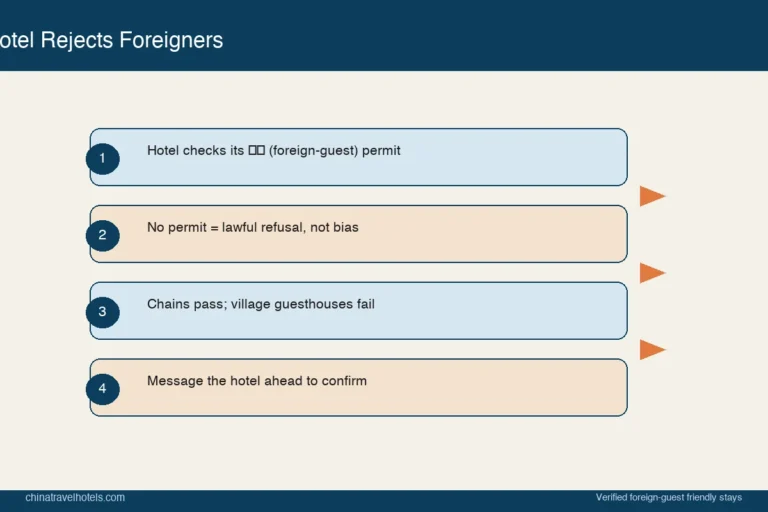
Shanghai is generally more used to foreigners than smaller cities, but cheaper suburban hotels can still fumble passport registration or refuse foreign cards. The guidance in our guide on why some hotels refuse foreign guests applies here too: book where foreigners are expected, confirm acceptance before paying, and you avoid the single most avoidable headache. Central international-brand hotels cost more but remove the risk entirely.
Getting around from your hotel
Shanghai’s metro is the easiest way to move, and your hotel near an interchange keeps everything close. For taxis, keep the hotel name in Chinese to show the driver, because English place names confuse them. Ride-hailing works through apps but needs a Chinese payment method; the concierge can call a cab if yours fails. The river separates Puxi and Pudong, so check which side your evening plans are on before choosing transport — a wrong-side hotel adds a tunnel or bridge crossing that eats an hour at rush hour.
Safety, language, and local etiquette
Shanghai is safe and tourist-polished, with more English signage than most Chinese cities, but the language gap still appears off the main strips. A translation app and your hotel’s Chinese address cover most moments. Tipping is not expected anywhere. Queue for the metro, and step aside on escalators to let others pass — small courtesies that read well. Scams targeting tourists are rare but watch fixed-price agreements for rickshaw or “tea ceremony” invitations near the Bund; a polite no ends them, and the concierge can steer you to legitimate experiences.
Booking tips and confirmation
Book on an English-displaying platform that takes your foreign card, and reconfirm with the hotel a day ahead that they accept foreign guests and note your arrival time. Keep your passport and confirmation ready, since check-in requires both. If your trip is short, resist the cheaper Pudong or suburb rooms — the commute tax is real, and central convenience is worth the premium for a first visit, especially when you factor in the cost of lost sightseeing hours.
Day trips and the water towns
If you want a break from the city, the canal water towns (Zhujiajiao, Suzhou) are easy half-day trips by metro and train, and a central Shanghai hotel makes the return simple. Book these as day outings rather than changing hotels, since the towns are best seen and left the same day. A central base also lets you exploit Shanghai’s late-opening malls and riverside bars without worrying about the last train, which matters more than most visitors expect when planning a first trip.
Frequently asked questions
Which Shanghai area is best for first-time foreigners?
The Bund or Jing’an. Both have international hotels, English service, and central metro access to the sights.
Is the French Concession a good place to stay?
Yes for atmosphere and food. It is walkable and charming, though you walk a bit to a major metro line.
Should I stay in Pudong or the Bund?
The Bund keeps you closer to old Shanghai and the sights; Pudong suits business and skyline views.
Are Shanghai hotels foreigner-friendly?
Downtown international brands are very practised. Suburban budget spots can still struggle with registration.
How do I avoid hotels that reject foreigners?
Stay central, book international brands, and read our refusal-reasons guide before booking.
Is Shanghai metro enough to get around?
Easily. Lines 1, 2, and 10 connect the main districts; stay near an interchange to save time.
Where should I stay for an early train?
Hongqiao, near the railway station, is the practical one-night choice before a high-speed departure.