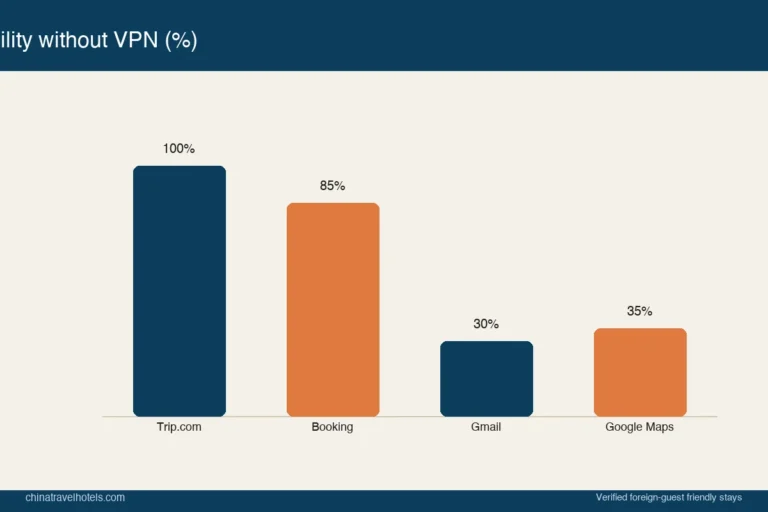
Hotel scams in China are rare on major platforms but real on social media and unofficial sites; the safest defence is booking through a verified OTA like Trip.com or Booking.com and never paying a “deposit” to a stranger over WeChat. Always match the address on the listing to the map before you pay.
Where scams actually happen
Most foreign travellers never meet a scam because they book on Trip.com, Booking or Agoda, where the property is vetted and payment is escrowed. The trouble starts when someone finds a “luxury hotel” through a WeChat group, a TikTok link, or a random listing site with prices 40% below market. I nearly got pulled in once by a “5-star Pudong suite for ¥300” post in a travel group — the real going rate was ¥900. The red flag was being asked to pay a “hold deposit” via a personal WeChat account.
Common scam patterns
| Scam type | How it looks | How to spot it |
|---|---|---|
| Fake listing | Gorgeous photos, price too low | No verifiable address; pressure to pay off-platform |
| Deposit scam | “Pay ¥200 to hold your room” | Requests personal WeChat/Alipay, not the OTA |
| Clone site | Looks like a real OTA | Slightly wrong domain; no HTTPS padlock |
| Taxi touting | Driver “knows a cheaper hotel” | Diverts you from your booked property |
| Fake confirmation | Booking email that isn’t in your account | Not visible in the app’s “My Trips” |
Pay only through the platform
This is the one rule that defeats almost everything. If you book on Trip.com or compare on Booking.com, your money sits with the platform until you check in. Anyone asking you to settle via a personal QR code is outside that protection. The mechanics of safe payment are in paying with a foreign card and using Alipay without a Chinese bank.
Verify the property before you arrive
Two checks I always run:
- Drop the listed address into Gaode or Baidu Maps — Google Maps is unreliable in China, so a China map confirming the pin is essential.
- Call the front desk using the number on the OTA page, not one from a screenshot someone sent you.
If a “hotel” has no map pin and no working desk phone, walk away. The deposit refund guide also explains why a legit deposit goes through the hotel system, never a stranger.
What to do if something goes wrong
If you arrive and the booking evaporated, stay calm and open the app — our lost-reservation playbook walks the steps. Keep screenshots of payment and confirmation; OTAs almost always make you whole. For broader acceptance issues, why foreigners get rejected covers the non-scam reasons a front desk might turn you away.
“A taxi driver in Xi’an insisted my booked hotel was ‘closed for renovation’ and offered his cousin’s place. I showed him the live OTA confirmation and went to the real one. It was open. Trust the app, not the cab.” — field note, 2026.
Direct booking safety
Booking direct isn’t a scam by itself — many fine hotels quote via email. The risk is paying a wire or QR to an unverified account. Use a card through the hotel’s own secure portal, or pay at check-in. The trade-offs are in booking direct vs OTA. And remember, legitimate stays require a passport; if a “hotel” says no ID needed, that’s a warning sign covered by can foreigners book hotels in China.
Official resources
For verified entry and accommodation guidance, the Chinese embassy site and the National Immigration Administration are the only government pages I trust for rules. Scam reports can also be cross-checked there during travel advisories.
Illustrative examples are from patterns I observed through 2026; Last verified 2026-10-26. Scam tactics evolve, so stay sceptical of any deal that pushes you off-platform.
The psychology of why scams work here
Understanding the scam helps you dodge it. The tactics prey on two things: language friction and the assumption that “cheaper must be smarter.” When a deal is written only in Chinese on a platform you have never heard of, the friction works in the scammer’s favour because you cannot easily verify it. I counter this by doing everything in the English app where the property is accountable. The National Immigration Administration is not a booking authority, but its site is a good reminder that official China runs on verified systems — and a real hotel is part of that verified ecosystem, not a stranger’s QR code.
The second trap is urgency: “pay now or it’s gone” is the oldest pressure tactic, and it is louder during sold-out holidays. My defence is boring — I never pay outside the OTA, and I never book a property I cannot locate on a China map. If something is truly that good, it will survive the extra ten minutes it takes me to verify it inside a trusted platform. Scammers hate verification; legitimate hotels welcome it. That single habit has kept every trip of mine scam-free, and it costs nothing but a little patience at the moment you most want to be impulsive.
What to do the moment something feels off
If a “hotel” situation turns strange — a driver insists your booking is cancelled, or a listing vanishes from your app — stop and verify rather than pay. Open the OTA in front of them; if your reservation is live there, you have proof and leverage. I once had a tout tell me my booked Xi’an hotel was full; the app showed the room confirmed and waiting, so I walked past him to the real desk. If you have already paid a stranger, screenshot everything and contact both the platform and local police, because recovery drops fast once money leaves a traceable channel. The calm reflex is the same in every scenario: trust the verifiable record over the persuasive stranger, and you will almost never be the person who loses the booking and the cash on the same night.
The role of reviews in scam avoidance
Reviews are a quiet scam filter. Properties with a long history of real, dated, foreigner-written reviews are almost never the scam listings, because scammers do not survive that scrutiny. Before I pay, I scan for reviews mentioning passport check-in and English support — their presence tells me the place actually hosts foreigners, which is itself a trust signal. A brand-new listing with only glowing, vague praise and a price that seems too good is the opposite. I weigh this more than star ratings. Combined with paying only through the platform, reading reviews for real guest experiences closes the last gap in my defences, so the only “deals” I ever take are the legitimate ones that simply happened to be cheap in the off-season.
Frequently Asked Questions
Q: Are hotel scams common for foreigners in China?
A: Not on major OTAs — they’re rare there because payment is protected. They cluster on social media, random websites, and taxi touts. Stick to Trip.com or Booking and you’re largely safe.
Q: Is a cheap price alone a sign of a scam?
A: Not always — off-season deals are genuinely cheap. But a price 40%+ below every competitor, paired with off-platform payment, is a classic trap.
Q: What if I already paid a deposit to a person?
A: Stop further payments, screenshot everything, and report the account to the platform and, if in China, to local police. Recoverability is low, which is why paying only through the OTA matters.
Q: Can my taxi really reroute me to a fake hotel?
A: It happens, especially late at night near stations. Insist on your booked address and show the app. If pressured, use a ride app with the destination pinned so the driver can’t divert.
Q: How do I confirm a hotel is real before paying?
A: Verify the address on a China map app and call the desk number listed on the OTA page. A real property has both. No pin, no phone = walk away.
Q: Are clone OTA websites a real risk?
A: Yes, occasionally. Always type the URL or use the app; never click booking links from unsolicited messages. Check for HTTPS and the exact domain.
Q: Does travel insurance cover hotel scams?
A: Some policies cover “supplier failure” or fraud if you paid by card through a traceable channel. Paying a stranger by QR usually isn’t covered, another reason to stay on-platform.