Lhasa is the only realistic base for the Potala Palace, and within it the choice is narrow: the old city near the Barkhor for atmosphere, or north toward Norbulingka for quieter streets that suit altitude. Both are a short ride from the palace and need a foreigner-licensed hotel.
First, the permit that shapes everything
Unlike most of China, Tibet has an extra layer for foreign passport holders. You need a Tibet Travel Permit issued through a registered Tibetan travel agency, and you must travel on an organised tour with a guide and vehicle — independent wandering is not permitted on this paperwork. That permit, not your hotel, dictates your itinerary, and many visitors find the agency books the Lhasa hotel for them. If you book your own room, it still has to be on the approved foreigner-licensed list, so confirm before you pay.
The permit rule is the single biggest difference between Lhasa and, say, Chengdu or Xi’an, and it is worth internalising before you choose a neighbourhood, because your guide’s logistics may already point you at one area.
Where the Potala actually sits
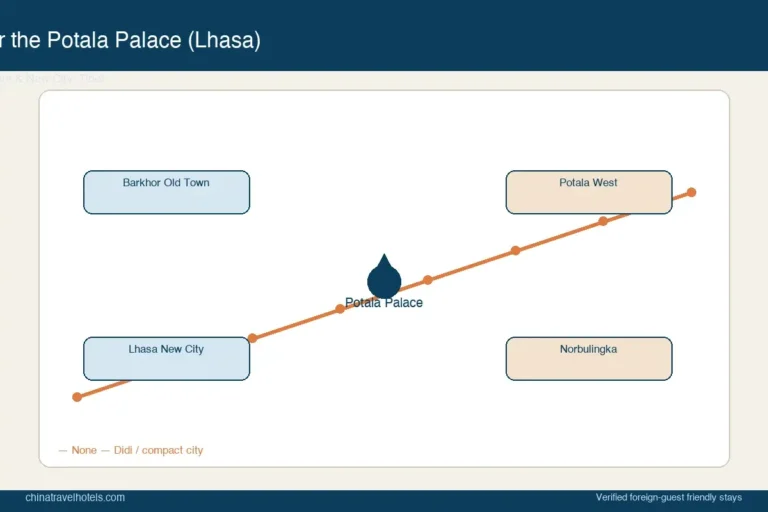
The Potala Palace rises on the Red Hill in the northwest of old Lhasa, a white-and-ochre mass that dominates every sightline. The Jokhang Temple and the Barkhor pilgrimage circuit are about two kilometres east, across the old city. Norbulingka, the summer palace and its gardens, lies further west and south of the Potala. The railway station is five-plus kilometres south, and the airport is well outside town.
So “near the Potala” realistically means the blocks immediately west and north of the palace, or the old city to its east. Both are within a short taxi or a 20-minute walk of the palace gate, which is the only entrance for visitors.
Old city and Barkhor: stay in the thick of it
The Barkhor loop around the Jokhang is the cultural heart of Lhasa, and hotels here put you among pilgrims, rooftop teahouses, and the smell of burning juniper. For a first-time visitor this is the most memorable base, and many of the foreigner-licensed hotels are restored Tibetan houses with inner courtyards. You can walk to the Potala in 20 to 30 minutes or take a short taxi when the altitude makes walking heavy.
The trade-off is real: the old city’s lanes are narrow, vehicle access is restricted around the Barkhor, and taxis may drop you a block from the door. At 3,650 metres that final walk with a bag is no joke on day one. Pick a hotel that can arrange a close drop or porter help.
North and west of the Potala: calmer and greener
The streets between the Potala and Norbulingka are wider, quieter, and easier for vehicles, and several licensed hotels sit here with gardens and fewer stairs. For travellers worried about altitude, this area is the gentler base: you can rest, step out for a flat walk, and still reach the palace gate in five to ten minutes by car. Norbulingka itself is a green, leafy spot if you want maximum calm, though it is a longer walk to the old city’s life.
Near the railway station: only for arrival night
A few foreigner-licensed hotels sit by the station, five kilometres south of the centre. They are handy if you roll in late on the train and want to crash, but they are far from the Potala and the old city, so they make a poor multi-night base. Most visitors spend one arrival night there, then move central the next day once they have breathed the thin air.
Comparing your Lhasa bases
| Area | To Potala Palace | Foreigner licence reliability | Altitude ease | Best for |
|---|---|---|---|---|
| Old city / Barkhor | 20-30 min walk | Medium to high | Harder, narrow lanes | Atmosphere, pilgrimage life |
| North / west of Potala | 5-10 min drive | High | Easier, flat, green | Quiet, altitude rest |
| Norbulingka area | 10-15 min drive | High | Easier, leafy | Calm gardens |
| Railway station | 15-20 min drive | Medium | Easy access | Arrival night only |
Licence status is per hotel, and in Tibet the approved list is shorter than in big cities, so verification is not optional.
Getting to the palace gate
The palace visit is timed and ticketed, tied to your passport, and you enter from the foot of the hill on the south side. From any central base it is a short taxi or a walk; from the old city the walk is flat but at altitude. Arrive with your passport and, if your tour includes it, your permit paperwork, because the checks are strict and there is no flexibility for missing documents.
Foreigner check-in realities in Lhasa
Lhasa hotels must register foreign guests with public security exactly as elsewhere, but in Tibet the approved hotel list is the extra gate. A property that looks fine may simply not hold the foreigner licence, and the desk will turn you away regardless of your booking. Our guide to passport registration at Chinese hotels explains the registration step, and our guide to what to do if a hotel refuses a foreign guest is the one to read before you are standing in a Lhasa lobby with a problem, because the permit context makes refusals more likely here than in Chengdu.
Paying and permits together
International cards work at the bigger Lhasa hotels, but the permit fee and tour are usually settled separately, often in cash or Chinese transfer, so carry yuan. Deposits are standard. Because your agency may prepay the room, confirm at check-in what is settled and what is held, and keep the receipt — our guide to hotel deposits for foreign guests explains the hold-and-return so you are not short-changed on the way out.
A two-night Lhasa plan
- Arrive by train or flight, transfer to a central licensed hotel, rest the remainder of day one.
- Morning visit to the Potala (timed entry), easy afternoon at the Barkhor.
- Second day Jokhang and Sera Monastery, light pacing for altitude.
- Move on with your tour, or add a Norbulingka afternoon.
The key is to protect day one for rest; the palace is a climb of many steps and altitude punishes a rushed start.
Altitude and your hotel choice
At 3,650 metres, the single most useful hotel feature is a lift and an oxygen option, not the view. Some Lhasa hotels offer in-room oxygen or lobby oxygen bars; if you are unsure how you will react, prioritise that over a Barkhor courtyard. Staying north or west of the Potala means flatter walks and easier taxi access, which reduces day-one strain. This is one place where the “closest” hotel is not always the kindest.
Family and accessibility notes
Steps are unavoidable at the Potala itself, so travellers with mobility limits should plan a lower-circuit visit and confirm accessible routes with the guide. Family hotels in the north-Potala belt are the easier pick with children, offering space to rest between sights. Always carry the passport for every ticket and registration, and brief kids that the thin air means slow days.
Frequently asked questions
Do I need a permit to stay in a Lhasa hotel?
You need a Tibet Travel Permit to be in Tibet as a foreigner, arranged via an agency tour. The hotel must also be foreigner-licensed.
Is it better to stay in the old city or near the Potala?
Old city for atmosphere, north or west of the Potala for quiet and easier altitude adjustment. Both reach the palace quickly.
Can I book my own Lhasa hotel?
Yes, but it must be on the approved foreigner list; many visitors let the tour agency book to be safe.
Will my card work in Lhasa?
At larger hotels, usually yes. Permit and tour fees are often cash or Chinese transfer, so carry yuan.
How far is the railway station from the Potala?
About five kilometres, a 15 to 20 minute drive, too far for a good multi-night base.
Do I need my passport at the palace?
Yes, the timed ticket is tied to your passport, and checks are strict with no exceptions.
Should I rest on arrival in Lhasa?
Strongly yes. Altitude makes a rushed first day unpleasant; protect day one for rest before the Potala climb.