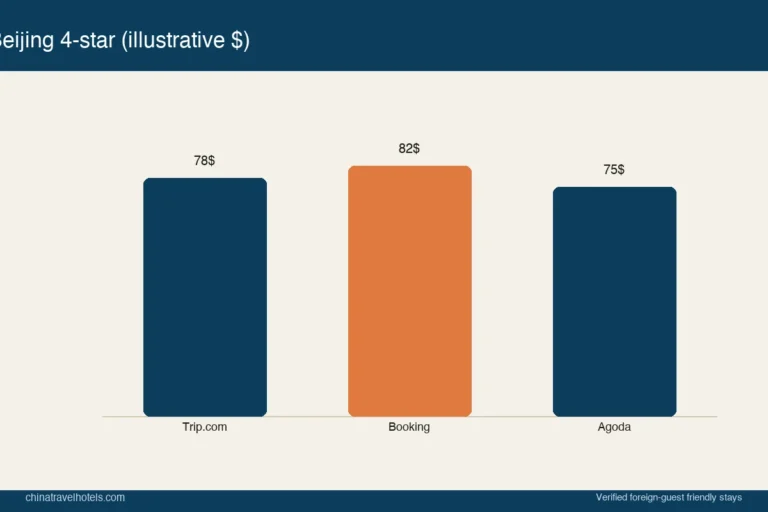
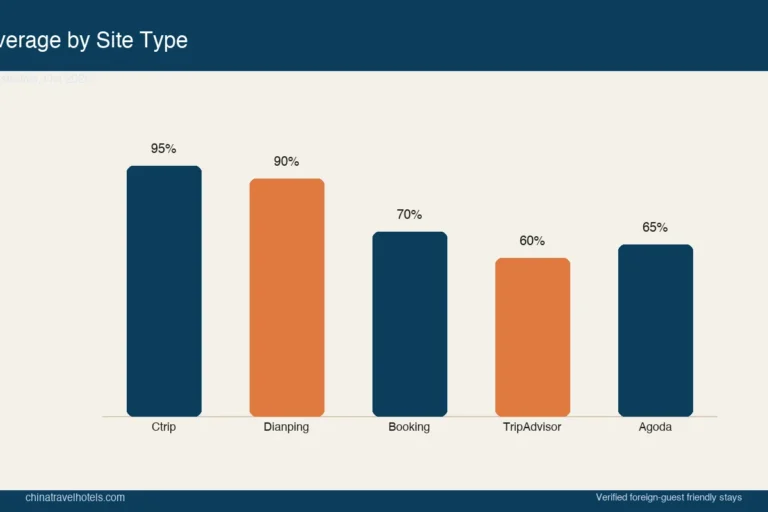
The dependable way to find the lowest China hotel price is to compare the all-in cost across platforms for the same room and dates, not a single headline nightly rate. Prices flip by platform, rate type, and sign-in status, so a two-minute comparison beats any one promo code.
Why the headline price lies
Every platform shows a nightly figure that may exclude city tax, service fees, or a mandatory deposit, and the exclusions are not always obvious. Two sites can list the “same” room at wildly different numbers because one includes tax and the other does not, or because one is quoting a non-refundable rate while the other is flexible. As a foreign guest, the all-in, refundable-or-not price is the only number worth comparing, because a cheap non-refundable room that you cannot change is not cheaper if your flight moves.
The three-tab method
Open Trip.com, Booking, and Agoda in three browser tabs, search the identical room and dates, and note the total at checkout including taxes. Sign in first on each, because member rates are often lower than logged-out prices and the gap can be larger than a promo code. Then compare not just the total but the cancellation terms, because the cheapest tab may be the one you cannot cancel. Our best OTA comparison ranks the platforms by scenario so you know which to open first.
Rate type is part of the price
A non-refundable rate is a different product from a flexible one even at the same nightly number. When you compare, line up like with like: same room, same dates, same cancellation window. If platform A is twenty dollars cheaper but non-refundable and platform B is flexible, the real question is the odds your plans change. For a foreign guest whose visa or flight can shift, the flexible rate is often the genuinely cheaper choice once risk is priced in.
| Comparison factor | What to check | Why it changes the real price |
|---|---|---|
| All-in total | Rate plus tax and fees | Headline may exclude charges |
| Cancellation | Free, partial, or none | Non-refundable hides risk |
| Member vs guest | Sign-in price | Logged-out can be higher |
| Deposit method | Pay now vs at property | Affects cash flow and holds |
Don’t ignore the hotel’s own site
At international-brand and luxury hotels, booking direct often matches or beats the OTAs and can add perks like breakfast or late checkout that third parties do not. Check the hotel’s own site after your three-tab sweep, especially for high-end stays you will use repeatedly. The trade-off is losing the OTA’s comparison convenience and sometimes its flexible cancellation, so weigh the perks against the terms before you commit. Our Trip.com vs Booking guide adds the nuance of when direct wins.
Watch the currency and the conversion
Platforms may display prices in your home currency while the hotel ultimately settles in yuan, and the exchange rate applied can differ from your bank’s. A price that looks lower in dollars may include a less favourable conversion than paying in yuan on a card with no foreign fee. If you have a card with low overseas charges, comparing the yuan price directly can reveal a better deal than the converted headline suggests.
Timing and length-of-stay effects
Prices move with demand, and a stay of seven nights is not simply seven times one night — many platforms apply a weekly discount or a longer-stay rate that only appears when you enter the full range. Compare the total for your actual dates rather than multiplying a single night, and re-check if your dates shift by even a day, because a conference or holiday can swing the rate sharply. Flexibility of a day or two is sometimes the cheapest “discount” available.
Loyalty tiers and stacked perks
All three platforms run tiers — Booking’s Genius, Agoda’s VIP, Trip.com’s membership — that quietly lower rates or add breakfast after a few stays. Sign in before searching to see member prices, and consider concentrating bookings on one platform if you travel often, since the perks compound. Less obvious: some hotel chains have their own programmes that beat OTA perks when you book direct. The dependable win is to compare the all-in price each time; loyalty helps but should not override a clearly cheaper listing.
Red flags in a too-cheap listing
If a price is far below every other platform and the payment method is unusual — wire transfer, a personal account, a request to pay outside the app — it is likely a clone or scam using a real hotel’s name. Book through the official app and keep the confirmation; paying outside the platform removes every protection you have. A genuine property takes payment through the site or a corporate card machine, and it will confirm foreigner registration without pressure.
Using price as a foreigner-acceptance signal
Price alone does not tell you whether a hotel takes foreigners, but an unusually low rate at a no-name property can correlate with a licence that excludes foreign registration. Treat a suspiciously cheap listing as a prompt to confirm acceptance directly before paying, especially if the rate is non-refundable. Our budget hotels guide helps you judge what a realistic foreigner-friendly price looks like in a given city.
Comparing refundable versus non-refundable across platforms
The cleanest comparison is to run the same room twice on each platform: once as the flexible rate and once as the non-refundable, then note both totals and both cancellation windows. The gap between them is the price of flexibility, and that gap tells you whether a platform’s “cheap” rate is actually cheap or just locked. A foreign guest whose plans are firm can take the non-refundable lowest; one whose visa or flight is uncertain should compare the flexible totals, which often reorder the leaderboard entirely.
When to stop comparing and just book
There is a point of diminishing returns. Once you have checked the three main platforms plus the hotel’s own site, signed in, and confirmed the all-in price and terms, further refreshing rarely changes the picture and can cost you a room as inventory tightens. Book the genuine lowest all-in, refundable-enough option, and keep a screenshot of the comparison in case a price drops and you want to rebook. The goal is the best realistic price, not a perfect one that evaporates while you hunt for it.
Using price alerts without losing the room
Some platforms let you watch a property or set a target price, which is useful for a stay weeks out. The risk is that an alert fires after the room you wanted is gone, especially in peak season. If the all-in price is already fair for your dates, book rather than wait for a drop that may never come. For flexible travellers, alerts work better for choosing dates than for squeezing a specific night, because shifting by a day or two often saves more than any promo the alert would have caught.
Frequently asked questions
Which platform is usually cheapest in China?
There is no constant winner; the lead flips by property and date. Compare Trip.com, Booking, and Agoda for the same room, and check the hotel’s own site for high-end stays.
Should I trust the nightly headline?
No. Compare the all-in total including tax and fees, and match the cancellation terms, because the headline hides both.
Is a non-refundable rate really cheaper?
Sometimes, but only if your plans are firm. For a foreign guest with changeable travel, a flexible rate can be the better value once risk is counted.
Do member prices matter?
Yes. Signed-in rates are often lower than logged-out ones, sometimes by more than a promo code, so always compare while logged in.
Should I check the hotel’s own site?
At international and luxury hotels, often yes, with possible perks. For small and mid-range China hotels, the OTAs usually have broader selection.
Why does the price change by currency?
Platforms convert to your currency at their rate, which may differ from your bank’s. Comparing the yuan price on a low-fee card can reveal a better deal.
What if a price looks far too low?
Be cautious. A price far below all platforms with an odd payment method is likely a clone or scam. Book through the official app only.