The safest budget stays for foreigners are the big domestic chains — Home Inn Plus, 7 Days Premium, Jinjiang Inn and Orange — plus international names like Ibis and Holiday Inn Express. They are licensed to register foreign passports, which many unrated guesthouses are not. Expect to pay roughly ¥150–¥350 (about $21–$49) a night for a clean, foreigner-friendly room.
Last updated: October 2026
Prices and rules were checked against official sources in October 2026 and can change — confirm the current figure before you book. Rates below are for a standard double in a tier-1 or tier-2 city; scenic towns and holiday weeks differ.
Key takeaways
- Budget in China means ¥150–¥350 a night, and the rooms are better than the price suggests.
- Only licensed hotels can register your passport; unlicensed guesthouses will turn you away.
- Home Inn Plus, 7 Days Premium, Jinjiang Inn and Orange are the reliable domestic names.
- Ibis and Holiday Inn Express are the cheap international options that always take foreign cards.
- Book on a platform that accepts a passport number, and message the hotel before you arrive.
- Rates swing 20–40% with the season, so shift your dates if you can.
Why “budget” means something different in China
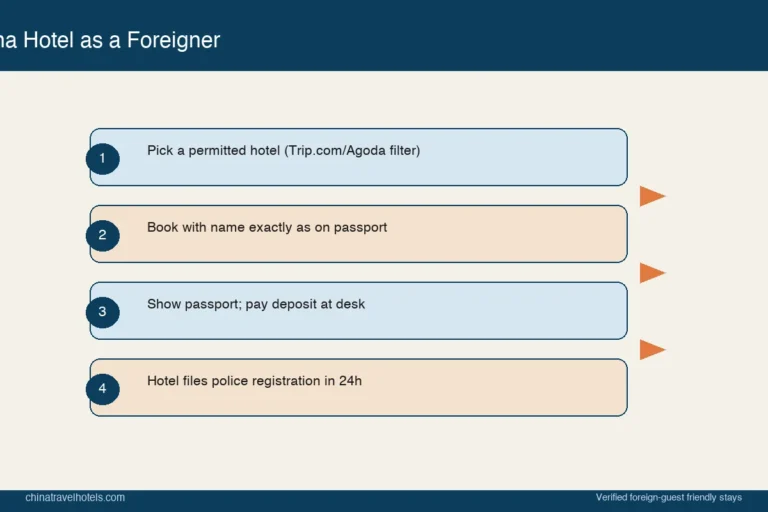
In the West a $40 room often means a motel on a ring road. In China the same money buys you a lobby with a marble floor, an elevator that works, and a front desk open 24 hours. The catch is not the quality — it is the paperwork. Every hotel that takes a foreign guest must send your passport details to the local police within 24 hours. Small family guesthouses, the cheap “zhusu” joints near bus stations, and most Airbnb-style apartments simply are not set up to do that. The registration duty is national and echoed in Chinese embassy guidance for overseas travellers, so a licensed hotel is the safe choice. So when I say “budget hotel that accepts foreigners,” I mean a licensed hotel that has done this registration before, not the cheapest bed in town.
I learned this the hard way in a county-level town outside Guilin in 2023. The ¥90 room looked fine online. At the desk, the clerk shook her head, tapped her system, and said “bu neng” — cannot. No foreigner registration. I walked back out at 11pm. The best budget hotels in China that accept foreigners are the ones that never put you in that position.
The chains that reliably take foreign passports
These four domestic brands show up in every city of any size, and all of them register foreigners as standard practice:
- Home Inn Plus (Home Inn Select) — the upgraded tier of Home Inn; cleaner linens, better soundproofing, usually ¥220–¥320.
- 7 Days Premium — the reliable tier of 7 Days; avoid the bare-bones “7 Days” budget variant, which sometimes lacks English systems.
- Jinjiang Inn — part of the huge Jinjiang group; solid in tier-2 cities, around ¥200–¥300.
- Orange Hotel (Orange Crystal) — a step up in design, often ¥280–¥400 but worth it for longer stays.
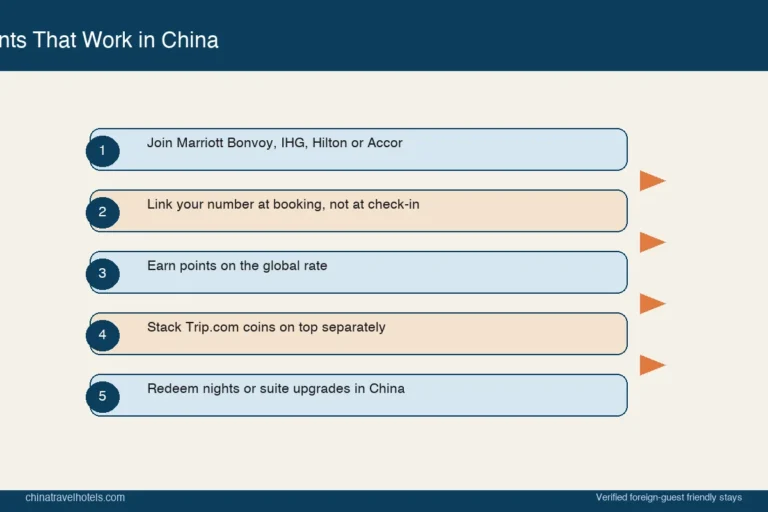
On the international side, Ibis (Accor) and Holiday Inn Express are everywhere and their staff handle foreign cards and passports without blinking. If you want points, see hotel loyalty programs that work in China — those two brands are the easiest to earn on.
Independent hostels and guesthouses (with a real caveat)
Yes, you can find foreigner-friendly hostels, especially in backpacker hubs like Yangshuo, Dali and Lijiang. The trick is to verify *before* you book. Two signals I trust: the listing explicitly says “foreigner accepted” or “passport registration available,” and the most recent reviews include other non-Chinese guests checking in smoothly. If neither is true, assume it will not work. The deeper explanation is in why foreigners get rejected at Chinese hotels — read it once and the pattern becomes obvious.
Where to book without a Chinese ID
You do not need a Chinese ID number to book. You need a platform that asks for your passport, not your resident ID. How to use Trip.com as a foreigner walks through the app, but the short version: Trip.com and Agoda both let you enter a passport number, and they show a “foreigner-friendly” filter on many city searches. Booking.com works too, though its China inventory is thinner. Compare the three on Trip.com vs Booking vs Agoda in China before you commit — prices swing by 15–20% between them on the same night.
When I checked into a Home Inn Plus in Chengdu last spring, I had booked on Trip.com with my passport, and the desk just scanned the page and handed me the key in under two minutes.
What you actually get for ¥150–¥350 a night
| Price band (per night) | Typical brand | Room you get | Foreigner registration | Breakfast |
|---|---|---|---|---|
| ¥150–¥220 | 7 Days Premium, Jinjiang Inn | ~18–22 m², queen or twins, tiny desk | Yes | Usually no |
| ¥220–¥300 | Home Inn Plus, Ibis | ~22–26 m², better mattress, kettle | Yes | Sometimes (bare) |
| ¥300–¥350 | Orange, Holiday Inn Express | ~26–30 m², gym, English TV | Yes | Often included |
Note the “m²” — Chinese rooms are listed by area, not bed name, and a “queen” is often closer to a US full. Check the real size before you complain. For the rating system behind these, see China hotel star ratings explained.
Cities where budget foreigner-friendly stays are easy — and where they are not
Easy: Beijing, Shanghai, Chengdu, Xi’an, Hangzhou, Guangzhou, Shenzhen. These have dozens of chain hotels with English-speaking night staff. A budget foreigner room is a five-minute search.
Harder: small scenic towns (e.g. a village outside Huangshan), border towns, and anywhere the only options are guesthouses. There I widen the search radius to the nearest county seat, where a Jinjiang Inn almost always exists. If you are on the 240-hour visa-free transit hotel booking guide, stick to the listed city cores so registration goes through cleanly.
Red flags that a “budget” hotel will reject you
- The listing has no English and no “foreigner accepted” note, and the only photos are of the exterior.
- Price is suspiciously low (under ¥90 in a real city) — that is usually a local guesthouse.
- Reviews are 100% Chinese-language with no mention of passports or IDs.
- The address is deep in a residential lane with no visible signage.
When in doubt, message the hotel through the app and ask, in English and Chinese if you can: “Can foreign guests check in with a passport?” A screenshot of “yes” has saved me more than once.
My field notes: three stays under ¥250
- Jinjiang Inn, Xi’an (Railway Station branch), ¥198. Five minutes from the wall, the night clerk spoke enough English to confirm my visa-free entry. Room was 23 m², spotless.
- 7 Days Premium, Hangzhou (West Lake east), ¥215. Walkable to the lake. No breakfast, but a congee shop next door opened at 6:30.
- Home Inn Plus, Chongqing (Jiefangbei), ¥248. Tiny window but great bed; the deposit was ¥100 on a foreign card, refunded on checkout. More on deposits in China hotel deposit, taxes & foreign credit cards.
Tip from the desk: if you arrive after midnight, book the “foreigner accepted” filter AND message the hotel. Some budget desks still close the foreigner-registration terminal at certain hours.
What budget hotel prices look like by season
The same room can cost ¥188 in March and ¥398 during a holiday week, so timing beats haggling. Chinese chains price dynamically against occupancy and the platforms follow them. Count on a low season in January and February outside Chinese New Year, shoulders in March–April and September–October, and hard peaks around May Day, National Day and the summer school break.
| Season | Typical budget rate (tier-1/2 city) | What to expect |
|---|---|---|
| Low (Jan–Feb, excl. Chinese New Year) | ¥150–¥220 | Walk-in rates often below the app price |
| Shoulder (Mar–Apr, Sep–Oct) | ¥220–¥300 | Best balance of price and weather |
| Summer (Jul–Aug) | ¥260–¥350 | Family demand pushes twins up fastest |
| Golden weeks (May Day, National Day) | ¥350–¥500+ | Book two to three weeks ahead |
I paid ¥198 for a Jinjiang Inn in Xi’an in early March and watched the same room list at ¥398 for the first week of October. Moving my dates by four days saved more than any discount code ever did.
Hidden costs at the budget end
The nightly rate is not the whole price. Budget chains take a deposit at check-in — usually ¥100–¥200, pre-authorised on your card and released at checkout rather than actually charged — and a few city properties add a couple of yuan of local tax per person per night. Breakfast is usually excluded below ¥220 and costs ¥20–¥40 if you want it. Heating in older northern properties can be a seasonal add-on. The one charge worth guarding against is the no-show rule: if you have not prepaid and you do not arrive, a same-day booking can be released after 18:00 and the first night billed.
Staying a week or more
Longer stays are where the domestic chains quietly shine. Many Home Inn and Jinjiang branches quote a weekly rate at the desk that runs 10–20% below the nightly app price, and monthly rates exist in most tier-2 cities if you ask in person rather than online. The catch is that long-stay rates are usually paid up front and non-refundable, and you still need to re-register each time you extend. I took a ten-night Jinjiang Inn in Kunming at ¥165 a night against an app price of ¥205, paid on arrival, and the desk extended my registration week by week without fuss.