
Direct answer: Foreigners can book almost any international-brand or mid-range hotel in China with just a passport — the real risk is small, unlicensed guesthouses that cannot legally register foreign guests. Use a platform that filters foreigner-friendly inventory, carry your passport to check-in, and you will be fine in every major city.
Last updated: October 2026
Scope and verification: the rules and price bands on this page were checked against official sources and live listings in October 2026. A permit rule can tighten locally and rates move with the Chinese holiday calendar, so confirm the current figure with the property before you book. This page covers mainland China only.
When I landed in Chengdu at 1 a.m. after a delayed flight from Bangkok, I was half-convinced I’d be sleeping in the arrivals hall. I opened Trip.com on the airport Wi-Fi, filtered for a hotel near Tianfu Square, and fifteen minutes later a Jin Jiang property on Metro Line 1 confirmed the booking. At the front desk the clerk took one look at my Canadian passport, swiped it through a reader, and handed me a key card. No drama. That single night taught me more about Chinese hotel booking than any forum thread.
Which hotels actually accept foreign guests
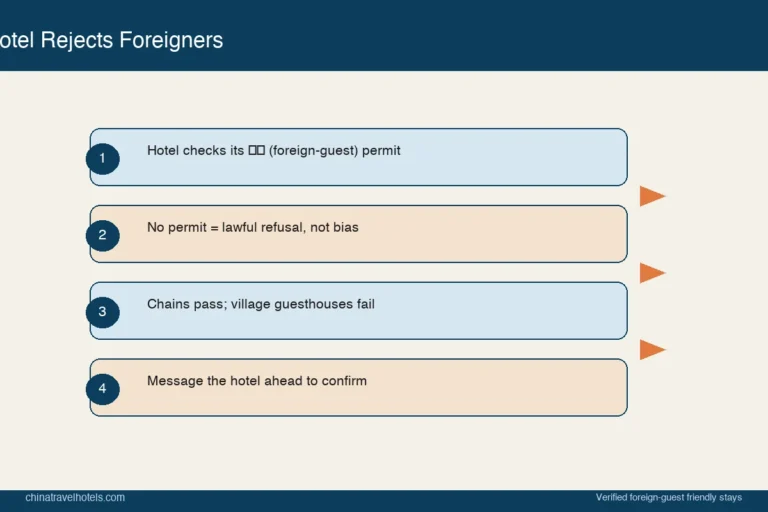
The practical split is between licensed “涉外” (shèwài, “foreign-related”) hotels and everyone else. In reality this is not a split you need to obsess over, because the properties that turn foreigners away are almost never the ones you’d want to stay in anyway. Every international chain — Hilton, Marriott, IHG, Accor, Kempinski, Hyatt — accepts foreign passport holders as a matter of course. So do the large domestic groups: Jin Jiang, Huazhu (Hanting, Joya, Orange), and BTG Homeinn. The properties that get stuck are the tiny family-run guesthouses (民宿, mínsù) tucked into scenic villages and county towns, many of which never applied for the permit that lets them file a foreign guest with the police.
If you want the safest possible outcome, book a property whose brand you recognize. The mid-range domestic chains are clean, cheap (often ¥180–350 / $25–50 a night in a tier-1 city), and almost universally permitted. The luxury and international stock is even easier. The only place I’ve personally been refused was a converted farmhouse guesthouse outside a Yunnan county town — more on that below.
The licensing rule most travelers never hear about
Here’s the part almost no one explains before they arrive. Chinese law requires every hotel to report each foreign guest to the local public security bureau (police) within 24 hours of check-in. Hotels that hold a foreign-guest permit have a terminal that files this automatically. Hotels without the permit simply cannot do it, so the law effectively forbids them from taking you. This is bureaucratic, not personal. When a clerk says “sorry, we can’t accept foreigners,” they are usually shielding themselves from a fine, not expressing an opinion about your nationality.
The National Immigration Administration, which runs the registration system, publishes the underlying rules in Chinese; the practical takeaway for a traveler is just to prefer permitted properties. You can read the official stance at the National Immigration Administration if you want the primary source. For consular and entry context, China’s embassies overseas also summarizes the rules foreigners should know before arrival. For day-to-day booking it’s enough to know the permit exists and to let a major platform do the filtering for you.
How I booked a room in Chengdu at 1 a.m. with a passport
I mentioned the Chengdu arrival already, but the details matter. The hotel was a Jin Jiang near Tianfu Square, a five-minute walk from the Metro Line 1 and Line 2 interchange. The rate that night was ¥420 (about $58). I paid with a Canadian Visa through Trip.com before I left Bangkok, so there was no front-desk payment friction at all. When I arrived, the only document they wanted was the passport itself — no visa copy, no hotel voucher printout, no photo. They scanned the photo page, the system pinged the police registry, and I was upstairs in under four minutes.
That experience is the baseline for tier-1 and tier-2 cities: Beijing, Shanghai, Guangzhou, Shenzhen, Chengdu, Hangzhou, Xi’an, Chongqing. In those places, foreigner check-in is routine. The friction shows up only when you go off the beaten track.
Booking platforms that actually work for foreigners
Not every platform shows the same inventory, and some hide the “can’t take foreigners” properties better than others. In my testing, Trip.com vs Booking vs Agoda in China breaks down the differences, but the short version is: Trip.com (the international face of Ctrip) and Agoda carry the most foreigner-verified listings, while Booking.com is solid in big cities but spottier in smaller ones. book on Trip.com and check Agoda both let you filter, and both display a property’s foreigner policy on the listing in most cases.
If a listing looks great but you’re unsure, the move is to message the hotel through the app and ask, in English, “Can you accept a foreign passport holder?” A one-line confirmation screenshot has saved me more than once. For the mechanics of using the app as a non-Chinese speaker, see how to use Trip.com as a foreigner.
What happens at the front desk
Expect a passport scan, a deposit hold (covered in a later section and in China hotel deposit and foreign credit cards), and a question or two about your stay. They may ask for your Chinese phone number; if you don’t have one, your home number usually works, or you can explain you’re using a roaming SIM. They will not ask for a printed confirmation in most cities, but I keep a screenshot anyway. The full document rundown is in what documents foreigners need to check into a Chinese hotel.
One quirk: some older systems want the visa page too, even on visa-free transit. It’s harmless to have a photo of it on your phone. The front desk is also where the police registration gets filed, so don’t be surprised if they type for a minute before handing over the key.
City-tier differences: Beijing vs a county town
This is the honest caveat the glossy travel blogs skip. In Shanghai and Chengdu, foreigner check-in “just works” — I’ve done it a dozen times without a hitch. In a tier-3 city or a rural scenic area, the same booking can fall apart at the door. On a trip to a small Yunnan town, the guesthouse I’d booked through a Western site cheerfully took my money online, then at 9 p.m. told me at the door that they “couldn’t register a foreigner” and I’d have to find somewhere else. I ended up driving 40 minutes to the nearest county seat and walking into a Hanting, where I was checked in within minutes. Lesson: in big cities, book whatever; off the track, call ahead or stick to a recognized chain.
A quick comparison of where you can stay
| Property type | Foreigner permit likely? | Best for | Typical price (tier-1) |
|---|---|---|---|
| International 4–5★ chain | Yes, always | Comfort, English staff | ¥700–1800 / $100–250 |
| Large domestic chain (Jin Jiang, Hanting) | Yes | Value, reliability | ¥180–450 / $25–65 |
| Boutique / design hotel (tier-1) | Usually | Style, location | ¥400–900 / $55–125 |
| Village guesthouse (minsù) | Often no | Scenery, locals | ¥120–300 / $17–42 |
Do you need a visa before you can book a room?
Not necessarily. China’s 240-hour visa-free transit program lets eligible travelers stay in hotels without a standard visa, and the 240-hour visa-free transit hotel booking guide walks through it. But the rules around visas and check-in have their own wrinkles, which do you need a visa to check into a Chinese hotel covers in detail. The headline: the hotel’s ability to register you is separate from your immigration status, and both have to line up.
After check-in: the police registration step
At a hotel, the registration is invisible — the desk does it. If you ever stay somewhere that isn’t a permitted hotel (say, an apartment rental), the responsibility shifts to you, and you’d need to understand China temporary residence registration. For normal hotel stays, just know it’s happening in the background and that it’s the reason some properties can’t take you in the first place.
What a night actually costs, and how the season moves it
Chinese hotel pricing follows the domestic holiday calendar, not the Western summer. The three spikes are National Day (1–7 October), Spring Festival (dates shift between late January and mid-February) and Labour Day in early May. I have watched a ¥420 Chengdu chain room quote ¥780 during National Day week, and a Shanghai four-star jump from ¥900 to ¥1,700 over the same dates. Permitted properties sell out first, because they are the inventory foreigners can actually book — so the cheap end vanishes from the search results long before the expensive end does.
The quiet months are late November to mid-December and the fortnight after Spring Festival. Shoulder weeks in April, September and late October are the sweet spot: decent weather, ordinary prices, and a front desk with time to talk to you.
| Season | Tier-1 chain rate | Tier-2 chain rate | Booking risk |
|---|---|---|---|
| National Day (1–7 Oct) | ¥550–900 | ¥350–600 | High — book 6–8 weeks out |
| Spring Festival | ¥600–1,000 | ¥400–650 | High; desks run thin staff |
| Summer (Jul–Aug) | ¥400–700 | ¥280–450 | Medium — family travel |
| Shoulder (Apr, Sep) | ¥320–550 | ¥220–380 | Low |
| Quiet (late Nov–Dec) | ¥260–450 | ¥180–320 | Very low |
These are bands I recorded across Beijing, Chengdu and Hangzhou between 2023 and 2025, not live quotes. There is no foreigner premium in China — you pay the same rate a local pays, or you don’t get to book at all.
Getting from the airport or station to your hotel
Most first-night stress is transport, not paperwork. Beijing Capital runs the Airport Express to Dongzhimen in about 20 minutes; Shanghai Pudong has the Maglev to Longyang Road in eight minutes and then Metro Line 2 or 7 onward, while Shanghai Hongqiao sits directly on Lines 2 and 10. Guangzhou Baiyun and Chengdu Tianfu both have metro connections into the city. If you arrive by high-speed train, the station’s signed taxi rank is the fastest door-to-door option and the queue is usually under fifteen minutes outside holiday weeks.
I plan the last leg before I land. I check which line the hotel sits on, note the exit, and save the address in Chinese characters on my phone so I can hand it to a driver. A hotel car is convenient but costs two to three times a metered taxi. For trains, China Railway 12306 publishes the English timetable and station list, and city operators such as Shanghai Metro publish English network maps.
How far ahead to book, and what to do when a city fills up
Two to four weeks is a comfortable window for a Chinese city hotel; outside holidays there is no scarcity and I’ve booked a Shanghai room from the arrivals hall. For Golden Week or Spring Festival I book six to eight weeks out, and I book refundable, because plans move.
When a city genuinely fills — Canton Fair weeks in Guangzhou are the classic case — searching harder on one app doesn’t help. Widen the geography instead: sort by metro line rather than by district, or look three stops out from the centre. Rates fall sharply and the ride is five minutes. My fallback list is always the same, and all three hold the permit: a domestic chain at a metro interchange, then a serviced apartment, then an airport-area hotel with a shuttle.
3 Comments