Short answer: Airbnb no longer operates a meaningful business in mainland China, and the handful of private rentals you might still find through other channels usually cannot register a foreign passport. For a foreign visitor, that makes short-term apartment rentals a weak choice compared with licensed hotels. Here is the legal reality, the practical risks, the narrow exceptions that do work, and the booking alternatives that actually deliver a clean, legal stay.
What happened to Airbnb in China
Airbnb (operating locally as “Aibiying”) wound down its mainland China listings in 2022, exiting the domestic home-share market to focus on Chinese travellers booking trips abroad. The practical effect for you: you can no longer reliably book a China stay through Airbnb’s platform. A few host listings persist on other apps, but those channels are fragmented, often Chinese-language only, and — critically — most are not set up to register foreign guests with the police. Planning your China accommodation around Airbnb in 2026 is planning around a door that’s already closed.
Why short-term rentals are risky for foreigners
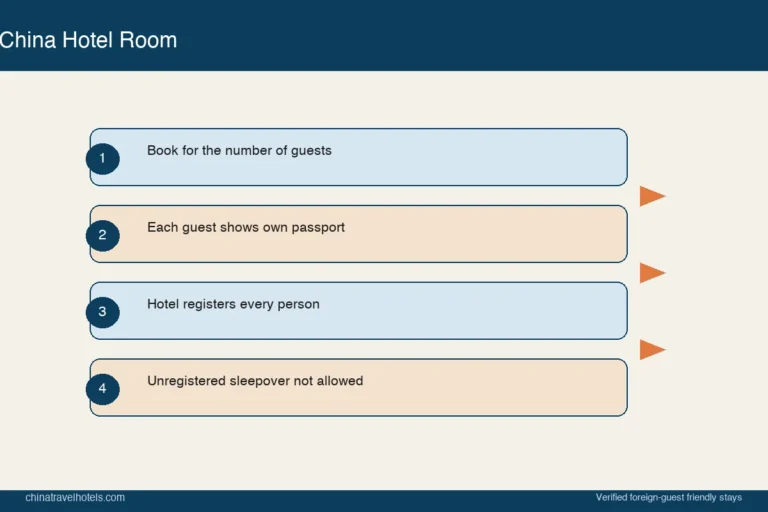
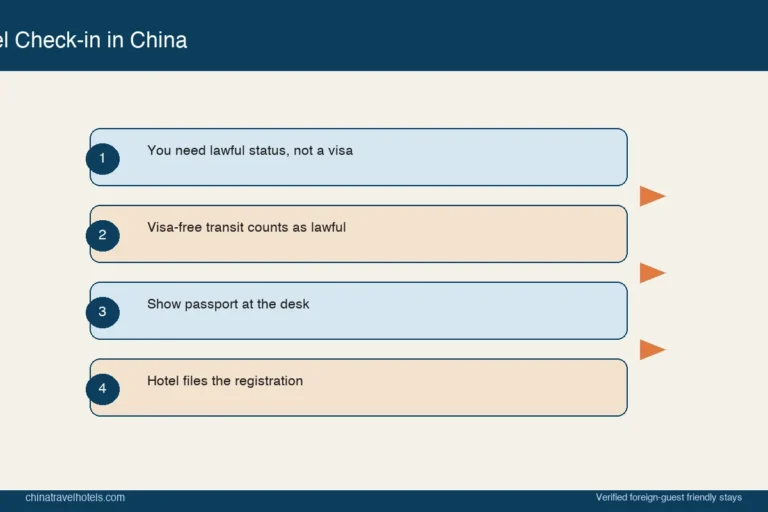
Chinese law requires every foreign guest to be registered with the local public security bureau within 24 hours of arrival. Hotels do this automatically at check-in — it’s part of the front-desk routine, and your passport data flows to the system while you drop your bags. A private host or apartment landlord usually does not handle this, and in many cities a short-term rental to a foreigner without that registration is operating outside the rules. If you stay in an unregistered rental, you — not just the host — can be the one questioned during a routine check. The quiet advantage of a hotel is that the registration is handled for you without a thought.
The licence gap, again
The same licence concept that blocks some hotels also blocks almost all private rentals. A landlord letting a room to a domestic traveller is one thing; accepting a foreign passport and completing the registration correctly is a different, rarer capability. Even well-meaning hosts often don’t know the procedure, and the platform they list on won’t guarantee it. This is why our guide to hotels that reject foreigners steers your energy toward licensed hotels rather than fighting the rental market, where the upside is small and the downside is legal.
When a rental might still work
There are genuine exceptions. Serviced apartments attached to international brands — think Ascott, Oakwood, or hotel-run residences — register guests properly and are a legitimate alternative, especially for long stays where you want a kitchen and more space. Some high-end, legally operated serviced apartments explicitly support foreign registration and function as hotels with apartments attached. The distinguishing factor is whether the property runs a real front desk that handles passport registration. If it does, it is functionally a hotel. If it is a stranger’s spare room, treat it as unregistered until proven otherwise, and the proof should come in writing.
Safer alternatives that book like a hotel
| Option | Registers foreigners? | Best use |
|---|---|---|
| Licensed hotel (intl/Chinese brand) | Yes, automatically | Every trip |
| Serviced apartment with front desk | Usually yes | Long stays, families |
| Homestay via booking platform | Rarely | Avoid as a foreigner |
| Private rental app | Usually no | Avoid |
How to spot a rental that can’t host you
Red flags include listings that say “domestic guests only,” hosts who dodge the passport question, or platforms with no English support and no visible licence. Green flags are a real reception, a request for your passport details at booking, and a location inside a managed building with a concierge. When in doubt, default to a hotel — you trade a little apartment charm for legal certainty and a desk that solves problems at 2 a.m. Our foreigner-friendly hotel guide lists what to look for, and how to confirm acceptance before booking locks in the licence in writing before you pay.
What you gain by choosing a hotel anyway
Beyond registration, hotels give you a 24-hour desk, luggage storage, help with taxis and trains, and a staff member who can call your next hotel to confirm your arrival. Rentals rarely offer any of that, and when a trip goes sideways — a delayed train, a lost passport, a sudden weather closure — the desk is worth far more than the few dollars saved on a rental. For a first-time visitor especially, the hotel’s support layer is part of the value, not a frill.
What to do if you already booked a rental
If you’ve already paid for a private rental before realising the registration gap, contact the host immediately and ask directly whether they will complete the foreign-guest registration with the local police. If they can’t or won’t, treat the booking as unreliable and line up a licensed hotel as backup before you fly. Don’t arrive with no plan and hope it works — the desk that turns you away at midnight is the expensive scenario. Keep your booking confirmation as evidence if you later dispute the charge, and consider using the platform’s support to rebook if the host admits they can’t host foreigners.
Long-stay alternatives that are safe
For stays of a week or more, serviced apartments with a proper front desk are the smart play: you get kitchen, laundry, and space at a rate that undercuts nightly hotel rooms, and the registration is handled. Negotiate a weekly or monthly rate directly, and confirm in writing that foreign registration is included. This is the one corner of the “rental” world that genuinely competes with hotels for a foreign guest, and it’s where the apartment appeal is real rather than risky.
The registration rule in plain terms
Strip away the nuance and the rule is simple: within 24 hours of checking in, your presence as a foreigner must be recorded with the local police. A hotel does this as a matter of course — it’s why they take your passport at the desk. A private host generally doesn’t, and ignorance of the step doesn’t excuse it. This single requirement is the reason the entire short-term-rental market is a poor fit for foreign guests in China, and it’s also why the small extra cost of a licensed hotel is money well spent. You’re not paying for a room alone; you’re paying for the paperwork that keeps your stay lawful.
Frequently asked questions
Can I use Airbnb in China now?
Not meaningfully. Airbnb exited mainland China listings in 2022, so you should plan around licensed hotels instead.
Is it illegal for me to stay in an Airbnb in China?
Staying is not the issue; the missing police registration is. An unregistered foreign guest can face questions, so licensed hotels are the safer route.
Are serviced apartments okay?
Yes, if they run a front desk that registers passports like a hotel. Brand-name serviced residences are reliable for long stays.
What if a host says they can register me?
Ask them to confirm the procedure in writing and verify at check-in that the registration was filed. If unsure, choose a hotel.
Why not just book a cheap local rental?
The cheap rental often can’t register you, and the resulting risk isn’t worth the savings. A licensed budget hotel is the safer deal.
Where should I book instead?
Use a major OTA that shows licensed inventory, confirm the licence by message, and keep the reply. Our best OTA guide for foreigners compares the platforms.