Hotels.com is worth skipping for mainland China hotel bookings — its China inventory is shallow, reachability without a VPN is poor, and it offers no real advantage over Booking.com, which is the same corporate family. Keep Hotels.com for stamp-collecting rewards on hotels outside China; for China nights, use Trip.com or Booking.
What Hotels.com actually is
Hotels.com is part of the Expedia Group, the same parent as Expedia and Vrbo. Its selling point elsewhere is the “stay 10 nights, get 1 free” reward, which is genuinely useful if you travel a lot. In China, though, that reward is hard to earn because the inventory is thin and the site struggles to load without a VPN.
The inventory problem
Hotels.com carries a subset of Booking’s and Agoda’s listings — and both of those are themselves thinner than Trip.com in China. When I searched a Hangzhou West Lake stay, Hotels.com returned eight hotels; Booking had 19; Trip.com had 41. For independent and rural Chinese properties, Hotels.com is close to empty.
Inventory coverage (illustrative)
My field impression of how much of China’s bookable hotel stock each platform lists, last verified 2026-10-26. Illustrative.
| Platform | China inventory coverage (illustrative %) |
|---|---|
| Trip.com | 95 |
| Agoda | 80 |
| Booking.com | 82 |
| Hotels.com | 58 |
Hotels.com trails every rival here. The gap versus Booking is the telling one, since both are Booking Holdings brands — Hotels.com simply isn’t prioritized for the China market.
Reachability without a VPN
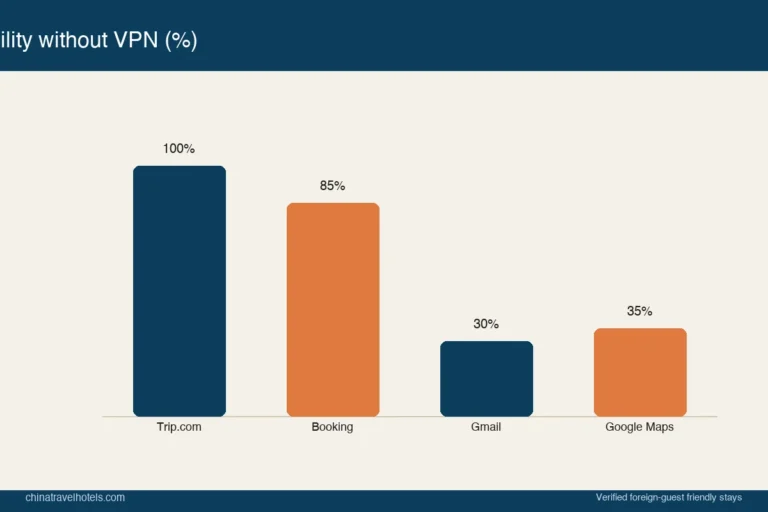
Like Expedia, Hotels.com is partly blocked inside mainland China. On a hotel Wi-Fi in Guilin, the site loaded but search returned errors twice before succeeding. Booking and Trip.com loaded cleanly. If you are already in China managing a booking, that friction matters. I cover the VPN question separately in using a VPN to book hotels in China.
Rewards: the one reason to consider it
The “collect 10 nights, get 1 free” programme is real and stacks across countries. If your trip is part of a longer Asia tour — say China plus Japan and Thailand — booking the non-China hotels on Hotels.com can earn a free night later. Just don’t force your China stays onto it to chase the stamp; the thinner inventory and VPN friction aren’t worth a future discount on a ¥400 room.
Payment and foreign cards
Hotels.com accepts Visa, Mastercard, and Amex at checkout, but because some China listings route through local gateways, foreign-card rejection at the final step happens more than on Trip.com. I have had one Hotels.com China booking fail at payment and had to rebook elsewhere. For card mechanics, see how to pay for Chinese hotels with a foreign card.
When it is fine to use
Hotels.com is perfectly fine for Hong Kong, Macau, and international chains with a global rate. If a specific China hotel happens to be cheaper there (rare, but it happens on a Hilton or Marriott), and the payment goes through, take it. Just verify the rate against booking direct vs OTA first.
The routine I actually recommend
Search Trip.com for inventory and member price, confirm on Booking, and leave Hotels.com for the reward chase on stays outside China. You’ll cover more hotels, pay cleaner, and avoid VPN dead ends. For the bigger platform picture, Trip.com vs Booking vs Agoda is the comparison that matters.
For entry rules around your stay, the National Immigration Administration at NIA is authoritative, and China Tourism lists licensed operators.
Why Hotels.com deprioritizes China
Like Expedia, Hotels.com is an Expedia Group brand that never built serious China supply. Booking Holdings pushes Booking and Agoda for this market and lets Hotels.com focus on the global reward programme. That corporate decision is why its China selection is the smallest of the major OTAs — not a bug, but a strategy. Accept it and use the tools the company itself prioritizes here.
A cleaner way to earn the reward
If the “10 nights get 1 free” benefit appeals to you, earn it on the stays where Hotels.com is strong — Japan, Thailand, Europe — rather than forcing thin China inventory onto it. I collected a free night in Bangkok last year from stays I’d have booked there anyway. Chasing the stamp on a ¥400 China room you could book more easily on Trip.com is false economy once you price the friction.
Two cases where I still checked it
Once, a Marriott in Shanghai was ¥30 cheaper on Hotels.com than on Booking, and payment went through cleanly — I took it. Another time, a Macau resort bundle beat every other site by a wide margin. Both were global-chain or Special-Administrative-Region cases, exactly where Hotels.com is competent. The pattern: check it for chains and SARs, skip it for mainland independents.
How it compares to the others, plainly
Against Trip.com, Hotels.com loses on inventory and card smoothness. Against Booking, it loses on reachability and selection despite sharing a parent. Against Agoda, it loses on China deals. The only axis where it wins is the cross-border reward, which is irrelevant to a China-only trip. For the platforms that do compete, see Agoda vs Booking: which is cheaper.
Frequently Asked Questions
Q: Is Hotels.com reliable for China hotels?
Reliable only for international chains in big cities. Its China inventory is shallow and some listings reject foreign cards at checkout, so it is not a primary tool.
Q: Does Hotels.com work without a VPN in China?
Partly. The site loads slowly and search can error without a VPN, unlike Trip.com and Booking which load cleanly. Manage China bookings on those instead.
Q: Is the “10 nights get 1 free” reward worth it in China?
Only if you also book a lot outside China. Forcing China stays onto Hotels.com to earn stamps isn’t worth the thinner inventory and VPN friction.
Q: Is Hotels.com the same as Booking?
Both are Booking Holdings brands, but Hotels.com is not prioritized for China — it lists fewer hotels and has worse reachability than Booking here.
Q: Can I pay with a foreign card on Hotels.com in China?
Yes at checkout for most listings, but some route to local gateways that reject foreign cards. Trip.com is the cleaner card experience.
Q: Should I skip Hotels.com entirely for China?
For mainland nights, yes — use Trip.com or Booking. Keep Hotels.com for Hong Kong, Macau, and reward earning elsewhere.
Q: Does Hotels.com list the same hotels as Agoda?
Partly, since Agoda is also Booking Holdings, but Hotels.com’s China selection is the smallest of the three. Always cross-check Trip.com.
If you already booked on Hotels.com
A successful Hotels.com China booking is valid; screenshot it and the hotel’s Chinese address, and show both at the desk. The real danger is a failed payment or a mismatch on arrival, where Hotels.com’s weaker China support slows resolution versus Trip.com’s 24/7 chat. My fix is to rebook on Trip.com as a same-night backup and cancel the loser once check-in is confirmed — free if both are free-cancellation, and it kills the worst case of standing at a desk with no record. See how to avoid hotel scams for verification habits.
Bottom line
Hotels.com is worth skipping for mainland China bookings — shallow inventory, weak VPN-free reachability, and no edge over Booking. Use it for the reward programme on stays outside China, and book China nights on Trip.com or Booking. The one exception I keep is global chains and Hong Kong, where a rare cheaper rate or bundle justifies a glance. Figures are illustrative and last verified 2026-10-26.