Booking hotels during Chinese holidays means planning 3–6 weeks ahead and paying 40–120% more than off-season, because domestic tourism peaks all at once. The safest move for foreign travellers is to lock refundable rooms early on a platform like Trip.com, then watch for drops rather than waiting for last-minute deals that almost never appear.
The big holidays that wreck availability
China has seven public holidays, but four actually move the hotel market: Spring Festival (Chinese New Year), Qingming, Labour Day (early May), and National Day’s “Golden Week” in early October. I was in Beijing for the tail of a Golden Week once and watched a usually-¥400 Sanlitun hotel hit ¥1,050. The China hotel price seasons guide maps these spikes month by month, but the short version is: if it’s a week-long break, assume everything near a tourist site is sold out or tripled.
Spring Festival is the extreme case. Tens of millions travel home, and while some business hotels in tier-1 cities dip, family-destination and transport-hub hotels explode. The 240-hour visa-free transit hotel booking guide is worth reading if your dates straddle a holiday, because the transit clock doesn’t pause for festivals.
How far ahead to book
My rule of thumb, refined over a dozen trips:
- Golden Week / Spring Festival: book 5–6 weeks out, refundable.
- Labour Day, Qingming, Dragon Boat, Mid-Autumn: 3–4 weeks out.
- Normal weekends: 1–2 weeks is fine, sometimes less.
Waiting for a deal during a holiday is a losing game. Unlike the last-minute hotel deals in China you might score in February, holiday inventory tightens and prices climb as the date nears. The curve only goes up.
Price jumps by holiday (illustrative)
The multipliers below are from rates I compared in October 2026 for the same Hangzhou West Lake 4-star across two years of calendar dates; Last verified 2026-10-26.
| Holiday period | Typical price vs off-season | Availability risk |
|---|---|---|
| Spring Festival | +80% to +120% | Very high |
| National Day Golden Week | +70% to +110% | Very high |
| Labour Day (May) | +40% to +70% | High |
| Qingming / Dragon Boat | +25% to +50% | Moderate |
| Ordinary weekday | baseline | Low |
Where the crowds actually go
Foreign tourists cluster around the classics — the Forbidden City, the Bund, West Lake, the pandas — and so do domestic tourists, which doubles the squeeze. If your heart is set on staying near the Bund in Shanghai during a holiday, you’re competing with the entire Yangtze Delta. Spillover neighbourhoods (Putuo, Hongkou) are 20–30% cheaper and a 15-minute metro ride away; the Shanghai Metro site makes the trade-off easy to judge.
OTA strategy during peaks
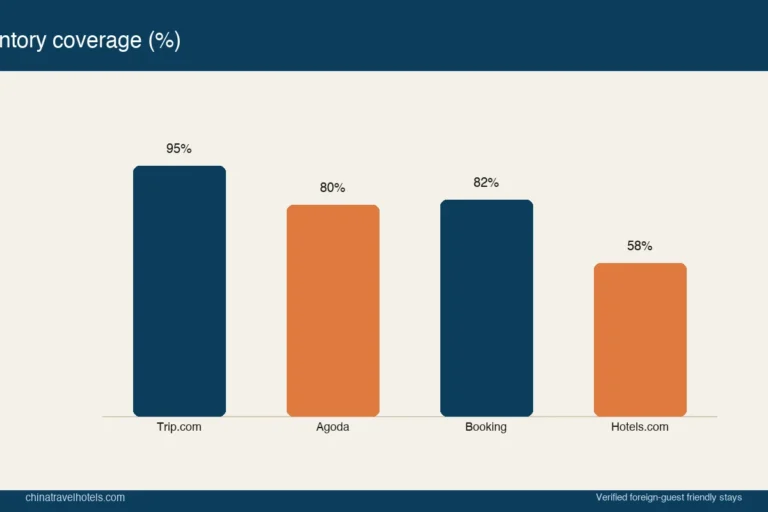
Not all platforms hold inventory equally when things sell out. Trip.com tends to keep the deepest China stock; Booking.com and Agoda sometimes show “sold out” on the same property Trip.com still lists. That’s why I cross-check, and why our Trip.com vs Booking vs Agoda comparison exists. You can book on Trip.com and check Agoda in parallel tabs — prices and availability genuinely differ.
Direct booking vs OTA during holidays
Hotels often release their last rooms to OTAs first because that’s where the volume is. Direct booking can still win for long stays or suites, but for a standard holiday-night stay the OTA usually has the edge on both price and English support. The full trade-off is in booking direct vs OTA in China.
“I once found a Chengdu hotel ‘full’ on every OTA, called the front desk in Mandarin, and they had three rooms at the walk-in rate — ¥60 cheaper. Calling ahead during a holiday is underrated.” — field note, 2026.
Practical safeguards
- Book refundable, then re-check weekly; if the price drops, cancel and rebook (watch the cutoff).
- Avoid non-refundable during holidays unless your flight is ironclad.
- For transport logistics, pair your stay with train-station vs airport hotel choices so a missed connection doesn’t strand you.
- Keep the Chinese embassy’s travel advisories handy for any entry or holiday-service changes.
Illustrative figures are from October 2026 samples; Last verified 2026-10-26. Holiday dates shift yearly on the lunar calendar, so confirm the exact week before you commit.
A booking timeline that actually worked
Concrete beats theory, so here is the timeline I used for a Golden Week trip to Hangzhou in 2026. In late August I locked a refundable West Lake 4-star at ¥880 through the platform. By mid-September the same room showed ¥1,040, so the early lock-in already looked smart. I re-checked every Friday and nothing dropped, which is normal for peaks — the curve only climbs. Two weeks out, I added a second refundable night as a buffer in case the high-speed train ran late, then cancelled it once timings were confirmed. Total faff was maybe twenty minutes spread across six weeks, and it bought a central room that friends booking in October simply could not find at any price. The lesson is not cleverness; it is starting early and using the refundable-rebook trick instead of gambling on a last-minute deal.
The year before, I tried the opposite: I waited for a Golden Week drop in Xi’an and watched a ¥520 room become ¥980, then vanish. I ended up forty minutes out by metro in a quieter district, paying more than if I had booked in August. That failure is exactly why the early-refundable method is now non-negotiable for me during any of the four big holidays. If your dates are fixed, the only real variable is how early you click. Cross-checking two platforms before you commit takes five minutes and regularly surfaces a cheaper twin that one site had hidden. I also set a calendar reminder for every cancellation cutoff so a buffer night never lapses by accident — small discipline, big payoff when the whole country is travelling at once.
A few holiday-booking mistakes I’ve watched
Beyond my own timeline, I have seen the same avoidable errors repeat among friends. The first is booking the wrong city zone — during Golden Week a “Shanghai” pin can mean two hours from the sights if it lands in a far suburb, so I always confirm the district against the metro map. The second is trusting a single platform’s “sold out” when another still has rooms; cross-checking has rescued more than one trip. The third is forgetting that small family-run hotels often close reception oddly early, which matters when a holiday train dumps you at midnight. I now message the property about arrival time before I pay, especially in tier-2 cities where English support is thinner. None of these are complicated, but each one has stranded a traveller I know, and all of them are preventable with ten minutes of checking. The through-line is simply to treat a holiday booking as a small project rather than a tap-and-forget purchase, because the stakes are higher when the whole country is travelling at once.
Frequently Asked Questions
Q: Is it true hotels sell out completely during Golden Week?
A: Essentially yes for tourist zones. Major cities don’t go fully empty, but rooms near attractions and transport hubs sell out weeks ahead and survivors cost double or triple. Book early or pick a suburb with metro access.
Q: Do prices ever drop right before a holiday?
A: Almost never. The trend is the opposite of last-minute deals. As inventory shrinks, remaining rooms get more expensive. The only “drops” are properties releasing held-back rooms, which still aren’t cheap.
Q: Should I book refundable and rebook if it falls?
A: Yes, that’s my standard play. Book the refundable rate the moment you have dates, set a reminder for the cutoff, and re-check every week. If it drops, cancel and rebook at the lower rate.
Q: Are tier-2 cities safer than Beijing/Shanghai for holidays?
A: Relatively, yes — places like Xi’an or Guilin feel the spike less than the headline cities, but they’re still busy. The deeper you go (tier-3), the calmer, though English support thins out fast.
Q: Can I visit China during a holiday on the 240-hour transit rule?
A: You can, but it’s stressful. The transit clock runs regardless of festivals, and transport gets jammed. Plan buffer days and read the visa-free transit guide before committing.
Q: Do hotels charge a holiday surcharge I can’t see upfront?
A: Reputable OTAs show the all-in price including the holiday premium at checkout. Surprises usually come from “resort fees” at luxury properties, not holidays specifically. Always expand the price breakdown.
Q: Is Spring Festival a good time to travel as a foreigner?
A: It’s atmospheric but logistically hard — many small restaurants close and transport is packed. If you go, book everything early and treat it as a cultural trip, not a convenience trip.