Ten days lets you string together Beijing, Xi’an and Shanghai if you base cleverly: three or four nights per city, one overnight on the move by high-speed rail, and licensed hotels near the metro in each. This plan treats sleeping well as the backbone, not an afterthought.
The logic of three bases
Trying to see China in ten days means resisting the urge to add a fourth city. Beijing, Xi’an and Shanghai form a clean triangle joined by fast trains, and each deserves a real base rather than a whistle-stop. You sleep in Beijing for the opening, take a day on the train to Xi’an, settle there, then rail on to Shanghai. The only “travel night” is the train itself or a single hotel change — not a nightly relocation. A stable room in each city means one registration, one familiar front desk, and no packing marathon.
Night-by-night overview
| Night | City / area | Base rationale | Rail or flight |
|---|---|---|---|
| 1 | Beijing (Dongcheng) | Forbidden City on foot | Arrive by air |
| 2 | Beijing (Dongcheng) | Same base | — |
| 3 | Beijing (Dongcheng) | Wall day trip | — |
| 4 | Xi’an (Bell Tower) | Central, near Muslim Quarter | High-speed train |
| 5 | Xi’an (Bell Tower) | Warriors day trip | — |
| 6 | Shanghai (People’s Square / Bund) | Metro hub, river views | High-speed train |
| 7 | Shanghai (People’s Square / Bund) | Same base | — |
| 8 | Shanghai (People’s Square / Bund) | Day trip out | — |
| 9 | Shanghai (Pudong or near airport) | Buffer before flight | — |
| 10 | Departure | — | Fly out |
Days 1–3 in Beijing
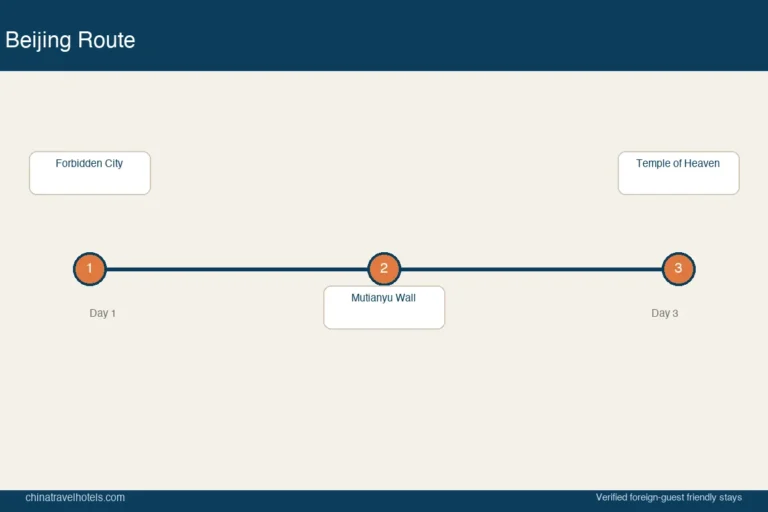
Arrive and base in Dongcheng; see the Forbidden City, the wall at Mutianyu, and the Summer Palace as loops back to the same room. Three nights is the minimum that lets the wall be a relaxed day rather than a panic. Keep the Beijing hotel until you physically leave — you will not need it again.
Days 4–5 in Xi’an
The high-speed train from Beijing to Xi’an runs about four to six hours depending on the service; book a seat and treat the ride as a sightseeing day with a moving window. Check into a Bell Tower hotel and use it for the city wall, the Muslim Quarter and the Terracotta Army. For the wider picture, our 5-day Beijing plan shows how the capital slots into a longer route, and the foreigner-friendly hotel guide explains what to look for in each new city’s licence and desk.
Days 6–9 in Shanghai
Another fast train brings you to Shanghai; base near People’s Square or the Bund so the metro and the river are both close. Use the room as a launch pad for the Bund, the former French Concession, and a day trip to a water town. On night nine, either keep the central room or shift to Pudong near the airport if your flight leaves early.
Why the train beats a flight between cities
High-speed rail drops you in the city centre, not an airport an hour out, which protects your hotel-check-in window. You also skip the airport registration shuffle twice. Trains are punctual and the seats are roomy; a foreign passport books fine through the right platform.
Booking across three cities
Each new hotel files its own passport registration, so expect to show the document at every check-in. Policies and English level vary by property — pick foreigner-friendly hotels and confirm acceptance before paying. Deposits and card holds differ too; ask. The best booking platforms for foreigners tend to display the foreigner-acceptance flag, which saves a cancelled booking later.
Choosing each city’s district
In Beijing, Dongcheng near the Forbidden City is the default for a first trip; it keeps the imperial core walkable and the metro close. In Xi’an, the Bell Tower area inside the wall is the right call for a short stay — it is where the Muslim Quarter, the wall and two metro lines meet. In Shanghai, base at People’s Square or the Bund side of Huangpu so Lines 1, 2 and 8 converge and the river is a stroll. None of these districts is exotic; they are simply the ones where foreigner-friendly licensed hotels cluster and where a taxi from the station is short. Avoid the temptation to save money at a fringe property an hour out — on a ten-day trip the lost transfer hours compound across three cities. Spend on central location in all three and you will feel the saving in rest, not in the room rate.
Booking three cities without triple trouble
Book each city’s room as a separate reservation on a platform that shows the foreigner-acceptance flag, and keep all three confirmations in one folder on your phone. The Beijing, Xi’an and Shanghai desks are different businesses; a smooth Beijing check-in says nothing about the Xi’an one, so confirm each. Refundable rates cost a little more but let you shift a night if a train is delayed. For the train legs, book seats the moment your city dates are firm — the fast Beijing–Xi’an and Xi’an–Shanghai services sell out in peak season, and your passport is the boarding ID. Tie the bookings together mentally: when you arrive in a new city, your room should already be waiting, so the travel day is a transfer, not a hunting expedition.
Luggage and the train-handoff day
On each travel day, pack a small day bag and keep your main case with you; high-speed trains have luggage racks at the car ends and overhead space, but a 28-inch case is awkward at peak. When you check out of the Beijing room, ask the desk to store anything you do not need for the Xi’an leg — most will, free, for the day. The same at the Xi’an desk before Shanghai. This trimming means the train is comfortable and the new-city taxi is easy. Late checkout is not automatic in China; if your train leaves in the evening, request a 14:00 departure at check-in. None of it is difficult, but on a three-city trip these small logistics are exactly what separate a calm fortnight from a tired one. Plan the handoffs and the hotels do the rest.
Refunds, rebooking and peak-season reality
Chinese peak seasons — the May holiday, the October National Day week, and Chinese New Year — tighten availability and lift prices across all three cities at once, so your ten-day window should be booked early if it overlaps them. A refundable rate is the hedge: you can drop a Beijing night and add a Xi’an one if your interests shift after arrival. If a hotel declines foreign passports after you booked, the platform’s acceptance flag is your evidence for a free cancellation — keep the screenshot. The point is not to fear the booking; it is to book with options so a hiccup becomes a rebook, not a crisis. A ten-day trip lives or dies on these details more than on the sights.
Frequently asked questions
Can I add a fourth city in ten days?
Not comfortably. Three bases keep hotel moves to two; a fourth turns the trip into a relay.
Is the train between Beijing and Xi’an hard to book?
No, but book ahead for the fast services. Your passport is the ID used at boarding.
Should I keep the same hotel chain in each city?
Not necessary. A consistent base area matters more than the brand; chains just make the desk routine familiar.
Do I register my passport in all three cities?
Yes, at each separate check-in. It is routine at licensed hotels and takes a few minutes.
Where should the last night be?
Central Shanghai until departure, or a Pudong airport hotel if you fly out at dawn.
Is ten days enough for these three?
Barely, and that is the point — three bases, no rush, sleep as the spine of the trip.
Will small-city hotels take my passport?
Xi’an and Shanghai major-district hotels do. Confirm at booking; the guide above lists what to check.