Best Area to Stay in Shenzhen for Foreigners (2026)
The best area to stay in Shenzhen for most foreign visitors is Futian — it puts you on the Metro, near the convention center, and a short hop from both the Hong Kong border and the airport express. If you are on a tech or business trip, Nanshan works just as well; if you want the older, grittier border-town energy, Luohu is the budget classic. I have based in all three across five trips, and the difference is mostly about which side of the city your days happen on.
Why Shenzhen is a different kind of China base
Shenzhen is barely 40 years old as a city, and it shows. Unlike Beijing or Xi’an, there is no ancient wall to orbit — the logic here is districts, not a historic core. That matters for where you sleep, because a “central” hotel in Shenzhen can still leave you an hour from where you actually need to be. The city runs roughly north–south along the east side of the Pearl River Delta, and most foreign-relevant action sits in Futian (center), Nanshan (west, tech), and Luohu (east, the original border crossing into Hong Kong).
If your trip also touches Guangzhou, reading up on the best area to stay in Guangzhou for foreigners helps you decide whether to anchor in one city or split your nights. A lot of first-timers do a Guangzhou–Shenzhen route and sleep in each once.
Futian — the all-rounder base
Futian is where I send friends who have never been. The district wraps the Convention and Exhibition Center, the civic center, and several dense Metro interchanges (Lines 1, 2, 3, 4, and 11 all cross here). From Futian you reach Shenzhen Bao’an Airport in about 35–50 minutes on Metro Line 11, and you reach the Lo Wu / Lok Ma Chau border into Hong Kong in roughly 20 minutes on Line 1.
Hotels here are mostly modern towers — international brands, new Chinese chains, and serviced apartments. English signage and foreigner check-in are routine. The trade-off is price: Futian commands a premium over the suburbs, but for a first trip the time you save is worth more than the discount you would chase elsewhere.
Nanshan — tech, coast, and quieter nights
Nanshan is Shenzhen’s innovation district (Tencent, DJI, and a string of startup campuses sit here) and it backs onto the Shekou coastline. If your meetings are in Nanshan or you are flying in just to see the tech scene, base here. You also get the Sea World area, which has the most relaxed evening atmosphere in the city and a genuine mix of cuisines that cater to expats.
The catch is distance to the Hong Kong border — Nanshan to Lo Wu is a 40–55 minute Metro ride, so if daily Hong Kong runs are part of the plan, Futian is kinder.
Luohu — the budget border classic
Luohu is where Shenzhen began, wrapped around the Lo Wu crossing into Hong Kong. It is denser, older, and cheaper, with malls, markets, and a constant cross-border hum. For a short stay built around the border, or for travelers watching costs, Luohu delivers real value. The hotels are a notch more dated than Futian’s glass towers, and the streets are busier, but the Metro connection is excellent and the energy is unmistakably “Shenzhen.”
District comparison
| District | Best for | Metro to HK border | Typical vibe | Price tier |
|---|---|---|---|---|
| Futian | First-timers, conventions, mixed trips | ~20 min (Line 1) | Central, modern, connected | $$$ |
| Nanshan | Tech, business, coastal evenings | ~45 min | Quiet, polished, expat-friendly | $$$ |
| Luohu | Budget, border runs, markets | ~5–10 min | Busy, older, energetic | $$ |
| Bao’an (airport) | Overnight before a flight | n/a | Functional, isolated | $$ |
Futian vs Nanshan: which should you book?
This is the comparison most business travelers actually face. Choose Futian if you want one base that minimizes total transit — it is central to the airport, the border, and the conventional-center. Choose Nanshan if your days are spent in the tech corridor or you value a calmer, greener evening by the water. I have swapped from Nanshan to Futian mid-trip before and immediately shaved 30–40 minutes off every airport and border run; for a 3-day trip that adds up to a half-day recovered.
If your trip is part of a longer southern China swing, pair the stay with a 3 days in Shenzhen plan and consider whether a Hong Kong stay near Victoria Harbour makes more sense than commuting across the border each day.
Booking and paying as a foreigner
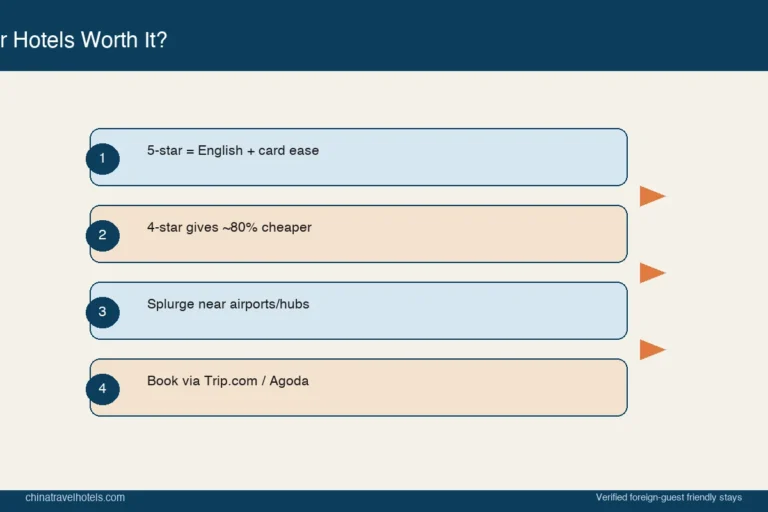
Shenzhen’s hotels are among the most foreigner-friendly in China — international brands dominate the districts above, and even mid-range Chinese chains here register foreign passports without fuss. Still, the same rules apply as everywhere in the country. Use a platform that shows real, foreigner-acceptable inventory and book Chinese hotels from abroad with a card you know will clear. If you are arriving around a major trade event, Canton Fair hotel demand spills into Shenzhen too, so book earlier than you would in a quiet month.
On payment, bring a physical foreign card and don’t be surprised if a hotel pre-authorizes a deposit — see how foreign cards actually work at Chinese hotels so a hold on your account doesn’t catch you off guard. Alipay and WeChat Pay at hotels are handy for incidentals but are not a substitute for a card at check-in.
Check-in, registration, and staying connected
Every foreign guest in China must be registered with the local police through the hotel, and Shenzhen’s front desks do this smoothly — usually while you wait. Skim the step-by-step hotel registration FAQ before you arrive so the one extra form feels normal rather than alarming. Wi-fi is fast and free in the business districts; if you rely on a laptop, check what works for foreigner hotel wi-fi in China so a VPN plan is sorted before you need it.
One more: if a budget listing looks too good to be true and refuses foreign passports, that is a known pattern — our guide to why foreigners get rejected at Chinese hotels explains how to spot and avoid it.
Where I would actually book
For a first trip I would lock a four- or five-star tower in Futian within walking distance of a Line 1 station, confirm in writing that foreign guests are accepted, and keep one night flexible in case a Hong Kong day-trip turns into an overnighter near Victoria Harbour. Business travelers on the tech circuit should default to Nanshan and treat Futian as the place they pass through, not sleep in.
If your company is footing the bill, Shenzhen has some of the strongest business hotels for foreign travelers in China, and the city’s newness means the inventory is fresher than in older destinations.
FAQ
Do I need a visa to stay in a Shenzhen hotel? Yes, a valid visa (or applicable transit exemption) is required, and the hotel will record it during registration. Confirm your status before booking.
Is English widely spoken at Shenzhen hotels? In Futian and Nanshan international-brand front desks, yes, to a useful degree. Smaller Luohu properties may have limited English, so keep your hotel’s name in Chinese on your phone.
Which district is closest to Hong Kong? Luohu, directly at the Lo Wu crossing (5–10 minutes by Metro). Futian is the next best at around 20 minutes.
Should I book now or wait for lower prices? Shenzhen pricing is steadier than resort towns, but it spikes during major tech expos. Book 3–4 weeks out for the best balance.
Can I use foreign booking sites, or do I need a Chinese app? Both work. The key is picking a listing that explicitly accepts foreign guests; our guide on booking from abroad covers the safest routes.
Is Shenzhen safe for solo foreign travelers? Very. The business districts are well-lit, patrolled, and used to international visitors. Standard big-city caution applies at night markets.
Written by Karl Huang. Last verified: 2026-11-03.