Direct answer: At check-in you need your original passport — the photo page, and sometimes the visa page too. That is the core, non-negotiable requirement. A booking-confirmation screenshot, a phone number, and a card for the deposit help but aren’t strictly mandatory. Carry a passport photocopy as backup.
Last updated: October 2026
Scope and verification: document requirements and the special cases below were checked against official sources and front-desk practice in October 2026. Individual properties add their own house rules on top, so message the hotel if your situation is unusual. Mainland China only.
In Nanjing I once arrived at a riverside hotel near the Line 1 Sanshanjie stop with only my passport and a dead phone. The clerk scanned the photo page, asked politely for the visa page (I was on an L visa that trip), and waved through the booking I’d made on Trip.com — no printed voucher needed. The only moment of friction was the phone number: their system wanted one, and my dead roaming phone forced me to borrow the desk’s Wi-Fi to pull up a number. Since then I keep a screenshot of the confirmation and a note of my home number before I land, and the check-in has been boring every time since.
The one document that’s non-negotiable
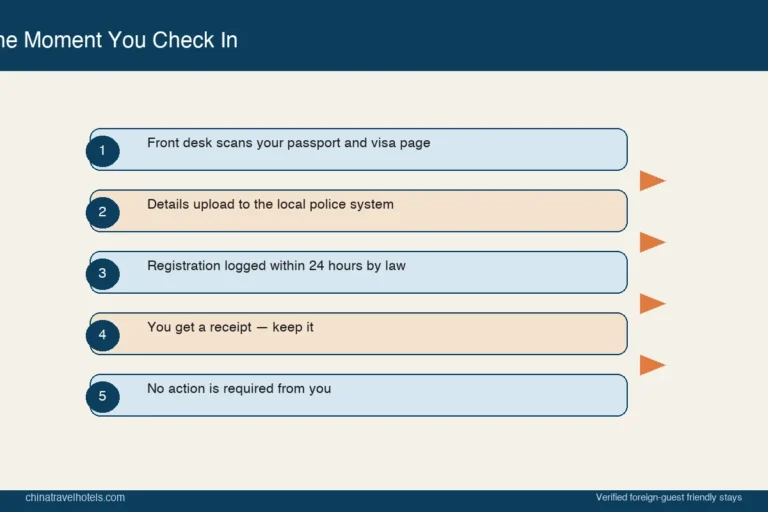
Your passport, in physical form, is the only thing a hotel legally must see. China requires the desk to record your identity for police registration, and a passport is the sole accepted travel document for that. A driver’s license, an ID card from your home country, or a photo on your phone will not substitute — the scanner reads the machine-readable strip. If your passport is being held for a visa extension, that’s a special case covered in staying in hotels during a visa extension; a receipt from the bureau usually stands in. The broader admission rules are in can foreigners book hotels in China.
Passport photo page versus visa page
Most modern hotel systems only need the photo page, because they query your immigration status electronically rather than reading the visa sticker. But I’ve hit older terminals — usually at smaller or provincial hotels — that still ask for the visa page to be scanned. The safe habit: have both pages ready, and keep a clear photo of each on your phone in case the book is away at the bureau. The status question itself is separate and explained in do you need a visa to check in. For consular documents, China’s embassies overseas is the reference if your passport is lost.
Helpful but not strictly required
A booking confirmation is useful but rarely demanded in big cities — the desk pulls your reservation from the system. A phone number smooths the check-in form but your home or roaming number is accepted; I’ve used a Canadian number without issue. A payment card covers the deposit; if you lack one, cash works. None of these are legal requirements, just practical conveniences. The rejection causes if something’s wrong are in why foreigners get rejected, and they’re almost always about the permit, not your paperwork.
Booking confirmation and the desk
I stopped printing confirmations years ago. On Trip.com or Agoda the hotel sees your name and dates the moment you arrive; a screenshot is only a backstop if their system is slow. During a power outage at a Chengdu property, my screenshot was the thing that got me checked in manually. Keep one — it costs nothing. For app mechanics, how to use Trip.com as a foreigner walks through the booking and the confirmation location, and it’s the platform I recommend for first-timers precisely because the confirmation is easy to find.
Deposit and payment identification
The deposit pre-authorization (covered in China hotel deposit and foreign credit cards) needs a card or cash, not an ID document beyond the passport already scanned. Some desks ask for the card to match the booker’s name; if a friend booked for you, bringing the booking confirmation with the booker’s name helps. The deposit is a guarantee, not a document requirement — don’t confuse the two, and don’t let a clerk wave you away over it.
Documents at a glance: a table
| Document | Required? | Notes |
|---|---|---|
| Original passport (photo page) | Yes | Non-negotiable; scanned |
| Visa page | Often | Older systems still ask |
| Booking confirmation | Helpful | Screenshot backstop |
| Phone number | Helpful | Home/roaming accepted |
| Card or cash for deposit | Helpful | Not a legal requirement |
| Passport photocopy | Backup | Useful if book is held |
Special cases: children and second passports
Children need their own passport scanned too — a parent’s passport doesn’t cover them, which matters for family rooms and extra beds. If you carry two passports, use the one you entered China on, or the desk’s system may flag a mismatch with your immigration record. And if you’re a minor traveling without parents, some hotels want a consent note — see hotel check-in age requirements for the age rules. The registration that follows check-in is detailed in temporary residence registration, and it all starts with that one document on the scanner.
A checklist I actually keep on my phone
To make check-in dull, I keep a single note on my phone that I open before every arrival. It holds a screenshot of the booking confirmation, my home phone number written out, and a photo of both passport pages. The confirmation saves me when a desk system is slow; the phone number fills the form without me hunting for signal; the passport photo covers the rare moment the book is at the visa office. None of it is required individually, but together they erase the small frictions that add up on a long trip. If you book through a platform, you can book on Trip.com and pull the confirmation straight from the app, or check Agoda where the same document lives in your account — either way, having it before you land turns a possible hold-up into a thirty-second scan.
The photo I wish I had taken at check-in
On a trip to Xi’an I watched a French traveler turned away because his passport’s machine-readable zone was scratched and the scanner kept failing. The fix was low-tech: the clerk typed the details by hand and asked him to hold a phone flashlight at an angle so the numbers could be read. It took twenty minutes and a short queue behind him, but he got the room. I learned to photograph the identity page and the entry stamp the moment I land, stored offline in a folder I can show without Wi-Fi. The hotel never asked for the photo, but having it removed the panic when my own passport once slipped behind the nightstand. The documents that matter are boring: a valid passport, a readable entry stamp, and sometimes a second ID if your name spans two passports. Pack a paper copy too. In a blackout or a frozen scanner, paper is what gets you a key.
What actually happens to your passport at the desk
New travellers sometimes worry about handing the book over, so it is worth describing the routine. The clerk places it on or under a scanner, waits for the registration software to read the machine-readable zone, and hands it straight back. The whole exchange lasts under a minute at a chain and perhaps two at a small property where the reader is slow.
Legally they need it only long enough to record you. No Chinese hotel has ever kept my passport overnight, and if a desk asks to hold it, I ask why and wait. The one exception I have met is a property that wanted a second look at a visa page; they did that at the counter while I stood there.
If your passport is lost, held or expiring
Three scenarios, three different answers. Lost: report it to the police and your embassy, and expect to check in on an emergency travel document rather than a photocopy — a copy will not scan and will not register. Held for a visa extension: the acceptance receipt from the exit and entry administration is what the desk sees instead; I have used one in Guangzhou without a clerk blinking.
Expiring mid-stay: the hotel cares about your status, not your passport’s remaining validity, so you can usually finish the nights you booked. What you cannot do is fly home on an expired document, so treat that as an embassy errand rather than a hotel problem.
Documents by traveller type
| Traveller | What the desk needs | Extra to carry |
|---|---|---|
| Solo adult | Passport | Booking screenshot |
| Couple sharing | Both passports | None |
| Family with children | Every child’s passport | Extra-bed request |
| Minor with one adult | Child’s passport + adult’s | Notarised consent letter |
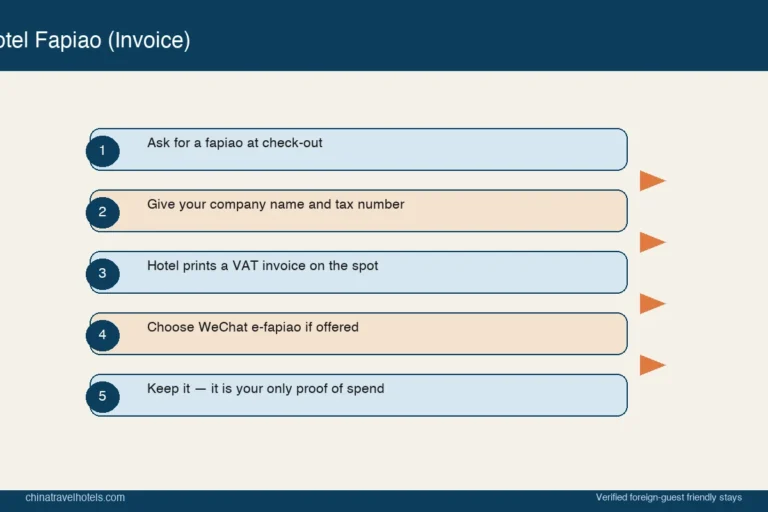
| Business traveller | Passport | Company name and tax number for the fapiao |
| Group of 6+ | All passports | Lead booker’s confirmation |
The pattern is simply that every body in the room needs a document. Rooms are priced per room; registration is per person, and the desk cannot invent a record for somebody it never saw.
The folder I keep on my phone
One note, opened before every arrival, holding three things: a screenshot of the booking confirmation, my home phone number written out in full, and a photo of the passport identity page and the entry stamp, saved offline. The confirmation solves a slow desk system. The phone number fills the check-in form without hunting for signal. The passport photo covers the rare moment when the book itself is at the visa office.
None of it is required. Together it turns the worst-case check-in into a two-minute one, and it has done exactly that for me in Nanjing and once during a power cut in Chengdu.