Ctrip, which runs as Trip.com for international users, and Agoda share a parent company yet behave very differently for a foreigner booking China. Ctrip has the deepest mainland inventory and Chinese-language support; Agoda often wins on budget price but leans on non-refundable rates.
Why the two platforms feel different
Even though Ctrip and Agoda share an owner, they target different travellers. Ctrip is built for the China market and its international face, Trip.com, carries a vast local inventory that includes smaller hotels Booking.com never lists. Agoda grew as a Southeast Asia and Asia-Pacific discounter, so its China strength is mid-range and budget properties where a promo code can shave the rate. For a foreign guest, the practical question is not which is “better” overall but which gets you the right hotel, at the right price, with the right cancellation terms.
Inventory and the hotels you can actually book
Ctrip/Trip.com lists more mainland properties, including Chinese hotels that do not appear on the global platforms. That matters for foreign guests because the hotels most likely to lack a foreign-guest licence are exactly the small local ones, and Ctrip’s listing depth helps you find alternatives fast. Agoda’s China coverage is solid but thinner at the long tail, so if your首选 is a boutique local hotel, check Ctrip first. Our best OTA comparison ranks the three main platforms by scenario.
Price: where each one wins
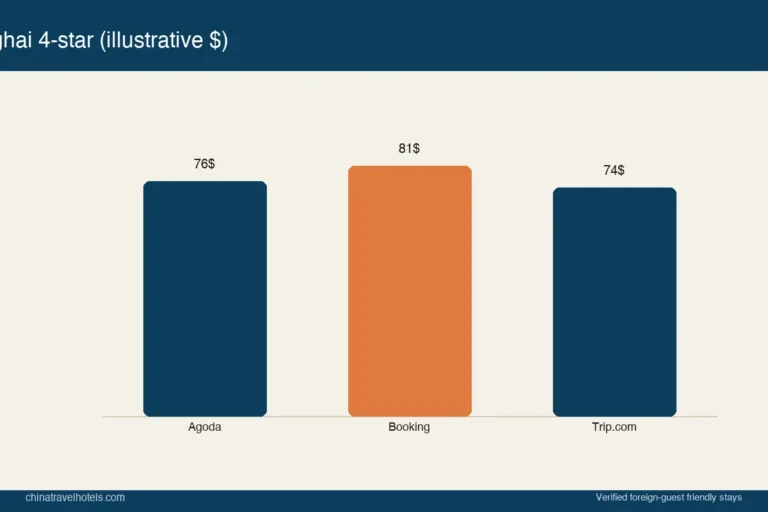
Agoda’s headline prices are frequently lower, but the saving usually attaches to non-refundable rates. Ctrip’s prices are often close once you sign in for member rates, and its flexible rates can beat Agoda’s non-refundable ones when your plans are uncertain. The honest method is to search the same room on both, then compare the all-in price and the cancellation terms side by side rather than trusting either headline.
| Factor | Ctrip / Trip.com | Agoda |
|---|---|---|
| Mainland inventory | Very deep, includes small hotels | Strong on mid and budget |
| Typical price edge | Member and flexible rates | Non-refundable promos |
| China-specific support | Strong, can call hotel in Chinese | Standard platform support |
| Best for | Finding any hotel, uncertain plans | Fixed plans, lowest headline |
Cancellation and flexibility
Ctrip passes through each hotel’s policy just like Agoda does, but its interface tends to surface the flexible options more clearly, and its support can contact a local hotel in Chinese when a booking goes wrong — a real advantage if your flight shifts. Agoda’s best discounts sit on non-refundable rates, so the platform is ideal when your itinerary is locked and you have already confirmed the hotel accepts foreigners. Our best OTA comparison explains how each platform handles cancellation terms.
Support when something breaks
This is where Ctrip pulls ahead for China stays. Because it operates inside the local market, its agents can phone a property and resolve a registration or room problem that Agoda’s more generic support might only email about. If you are nervous about a hotel accepting your passport, Ctrip’s ability to confirm in Chinese is worth more than a slightly lower Agoda price. For a first trip to a smaller city, that support margin is often the deciding factor.
Paying on each platform
Both accept major foreign cards and run English checkout, so payment is not the differentiator. Ctrip sometimes offers more local payment and instalment options aimed at domestic users, but as a foreigner you will mostly use a Visa, Mastercard, or Amex. Agoda is similar. Keep a backup card for the front-desk deposit either way. Our China payment guide explains what to expect at the desk.
App access and language
Ctrip’s Trip.com app is English and works on normal roaming data, though some features assume a China context. Agoda’s app is also English and familiar if you have used it across Asia. Neither requires a Chinese app store, so install and save your passport details before you travel. If you rely on a local SIM or eSIM, confirm the app is not restricted on that network before you need to book on the move.
Loyalty and member rates
Both run tiers that lower prices after a few stays, and both show lower logged-in rates. Sign in before searching on each. If you travel China often, concentrating bookings on one platform compounds the perks, but do not let loyalty override a clearly cheaper all-in price elsewhere. The dependable move is to compare each time and only then decide where your points go.
When to pick which
Choose Ctrip/Trip.com when you need the widest inventory, China-specific support, or a flexible rate for uncertain plans, especially in smaller cities. Choose Agoda when your plans are fixed, you have confirmed the hotel takes foreigners, and you want the lowest non-refundable headline. For most foreign first-timers, starting on Ctrip and price-checking Agoda is the safer routine. The Trip.com vs Booking guide adds the third platform to the picture.
Refunds and disputes on each platform
When a refund is due, both platforms return money to the original card, but the support path differs. Ctrip’s local muscle helps if the dispute is about whether the hotel actually accepted you or held your room, because an agent can call the property and get a factual answer in Chinese. Agoda’s process is more self-service, relying on the written policy and your screenshots. Either way, keep the confirmation email and the policy page; the platform will ask for both, and a foreign guest without them is at a disadvantage.
Booking across multiple cities
If your trip covers several Chinese cities, Ctrip’s train and flight integration is a genuine edge, letting you bundle transport and rooms in one place and keep all confirmations together. Agoda handles multi-city fine but treats each booking separately, which is fine if you prefer to compare per city. For a first China trip with moving parts, the consolidated view on Ctrip reduces the chance a hotel in your second city quietly cannot register you while you are already en route.
Watch the currency and the rate type
Both platforms may display prices in your home currency, but the hotel is ultimately charged and refunded in yuan, so exchange-rate movement can make a refund differ slightly from what you paid. More important is the rate type: a Ctrip member flexible rate and an Agoda non-refundable promo are not the same product even at the same nightly number. Compare like with like — same room, same dates, same cancellation terms — before you decide which platform wins.
Frequently asked questions
Are Ctrip and Agoda the same company?
They share a parent company, but they are separate apps with different inventory emphasis, pricing, and support. Do not assume a rate on one matches the other.
Which has more China hotels?
Ctrip/Trip.com generally lists more mainland properties, including smaller local hotels that Agoda may not carry.
Is Agoda always cheaper?
Often on non-refundable promo rates, but not always on flexible or member rates. Compare the all-in price and terms.
Which is better for support in China?
Ctrip, because it can contact local hotels in Chinese and resolve China-specific problems faster than Agoda’s generic support.
Can I use both for one trip?
Yes. Many travellers book the confirmed hotel on Ctrip and keep Agoda open as a price-check for future nights.
Do both accept foreign cards?
Yes, both accept major foreign cards at checkout and run English interfaces. Keep a backup for the desk deposit.
Which should a first-timer use?
Start on Ctrip/Trip.com for inventory and support, then price-check Agoda. Confirm foreign-guest acceptance before paying any non-refundable rate.