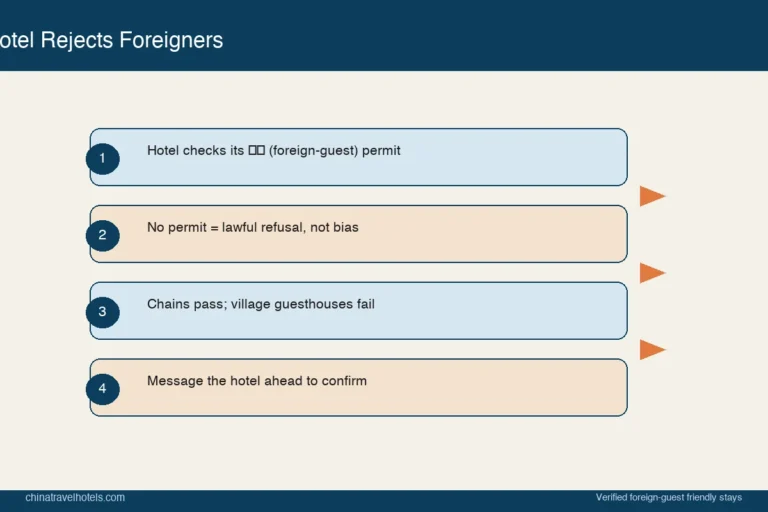
It is a frustrating moment: you arrive at a hotel you booked, and the desk says they cannot take you. In China this is usually not discrimination — it is a licensing and registration issue. Certain properties are simply not set up to register foreign guests with the authorities, and taking you would break the rules they operate under. Understanding the reasons stops the surprise, tells you what to do next, and helps you avoid the situation before you ever reach the desk.
The core reason: registration licensing
Every hotel in China that hosts foreign guests must feed their stay into the local public security system at check-in. That requires a licensed registration terminal connected to the authorities. Hotels that hold this licence take foreigners routinely; hotels that do not are legally unable to, and a desk clerk who turns you away is often just following the rule, not making a personal call. This single fact explains almost every refusal a foreign visitor meets in China.
Not licensed for foreign guests
The most common reason by far is that the property is not licensed to receive foreign nationals. This is typical of small guesthouses, some budget chains, and older inns that cater to domestic travellers and never applied for the foreign-guest licence. They may have empty rooms and want your business, but they cannot process your passport registration, so they cannot check you in. No amount of persuasion changes it — the limitation is systemic, not a snub.
The public security system and small hotels
Smaller hotels often lack the terminal, the trained staff, or the administrative setup to file a foreign stay correctly. Even when a clerk wants to help, a mistake in the registration can create legal exposure for the property, so managers err on the side of refusing. This is why the problem clusters at the low end of the market; mid-range and international hotels almost always have the system and the staff who use it daily.
Domestic-only booking listings
Some online listings are effectively domestic-only: the description is in Chinese, the property says “mainland ID holders” or the booking flow assumes a resident ID number. These are strong signals the place does not take foreign passports. Booking platforms sometimes show such properties to foreign users anyway, which is where the mismatch at the desk comes from. Reading the listing carefully — and confirming by message before paying — avoids the trap. Our guide to hotels that accept foreign passports lists what to look for instead.
Regional and security restrictions
A few areas carry tighter rules than the norm, often near sensitive borders or certain controlled zones, where even licensed hotels may face extra scrutiny for foreign stays. These are the exception, not the rule, and they tend to be places few tourists base themselves in anyway. If your route goes somewhere unusual, confirming foreign-guest acceptance matters more than in a major city, where licensed hotels are plentiful.
“Can’t” versus “won’t”
It is worth separating the two. “Can’t” means no licence or no terminal — the refusal is firm and you should move on. “Won’t” is rarer and might mean a clerk unsure of the process, a language gap, or a misunderstanding about your visa. A polite show of your booking confirmation and a question about the registration step sometimes resolves a “won’t.” But if the answer is a clear “we are not licensed for foreign guests,” the right move is to relocate, not to argue.
What to do if you are refused at the desk
Stay calm. You are not in trouble; the property is. Ask if they can recommend a nearby licensed hotel, or open your booking platform and look for an international brand within a short taxi ride. Contact the platform’s support if you prepaid, because they can often rebook you or refund. Keep your passport ready and your tone cooperative — the desk is as eager to resolve this as you are. Our step-by-step on confirming acceptance before you book is the prevention that makes this scenario unlikely.
How to avoid it before you book
The fix is simple and takes minutes. Book properties that explicitly state they accept foreign guests, prefer mid-range and international hotels, and send one short message confirming they can register your passport. A property with a track record of foreign guests answers in a sentence; one that waffles is a yellow light. Doing this once per trip removes the single biggest source of check-in drama in China.
Red flags versus green flags
| Red flags (book elsewhere) | Green flags (book with confidence) |
|---|---|
| Listing says “mainland ID only” | Listing mentions foreign guests |
| No English, domestic-only description | International brand or chain |
| Clerk won’t answer the registration question | Clear “yes, we register passports” reply |
| Price far below comparable licensed hotels | Normal market rate for the area |
| In a restricted or remote zone | In a major city centre |
Unlicensed does not mean bad
Some of the guesthouses that cannot take foreigners are perfectly clean, friendly and well reviewed by domestic travellers — they simply lack the foreign-guest licence. The refusal says nothing about quality; it is purely administrative. This matters because a low price and great reviews can tempt you toward a property that then cannot check you in. Judge budget options by licence status first, then by review, not the other way around. A wonderful unlicensed inn is still one you cannot legally occupy as a foreign guest, however charming its listing looks.
What the desk should say
A licensed hotel’s response to “can you register a foreign passport?” is a quick, confident yes. An unlicensed one hedges: “we usually only take local ID,” or goes quiet. That contrast is your cheapest screening tool — you do not need to understand the licence, just the tone of the answer. A clear yes means book; a maybe means keep looking. This single question, asked before payment, prevents almost every refusal scenario and takes less time than reading the whole listing.
If you are already in the city with no booking
Arriving without a reservation is riskier for foreigners, because you are choosing a desk on the spot. The safe move is to target an international or major-chain hotel near the station or airport, where licensing is guaranteed, rather than wandering into a random budget property. If you are stranded late, the airport or station itself often has licensed transit hotels. Booking ahead — even the same morning from your phone — beats walking in blind and hoping the first desk can take you.
Frequently asked questions
Is it legal for a Chinese hotel to refuse foreigners?
If the property is not licensed to register foreign guests, refusing is the lawful outcome — they cannot take you regardless of willingness. Licensed hotels generally can and do.
Does this happen at international hotels?
Rarely. International and upscale hotels hold the foreign-guest licence and register passports daily, so refusals there are unusual.
Can I argue my way in?
If the issue is licensing, no. If it is a misunderstanding, a calm confirmation of your booking and the registration step can sometimes help, but don’t expect persuasion to override a licence limit.
What if I already prepaid?
Contact the platform; they can usually rebook you at a licensed property or refund. Keep the confirmation and any refusal note from the desk.
How do I know before booking?
Book properties that state they accept foreigners, prefer established hotels, and send one message confirming they can register your passport.
Are some cities stricter than others?
Major tourist cities have many licensed hotels, so it is easy to find one. Remote or controlled areas can be tighter, which is why confirmation matters more there.