Chinese hotel cancellation policies vary by platform and rate type, but most bookings on Trip.com, Booking.com and Agoda allow free cancellation up to 24–72 hours before check-in. Always read the rate rules before paying, because non-refundable rooms are typically 15–30% cheaper yet offer zero refund if your plans shift.
Why cancellation rules matter more in China
Cancellation matters everywhere, but China adds a few wrinkles that caught me off guard on my first trip. Domestic train and flight tickets, the 240-hour visa-free transit clock, and sudden holiday price spikes all push travellers to change hotels at the last minute. When I had to scrap a three-night stay in Xi’an because a flight got moved, the difference between a refundable and a non-refundable rate was about ¥540 (roughly $75 at the time). That stung less than the lesson: Chinese booking engines list both rate types side by side, and the cheaper one is almost always the stricter one.
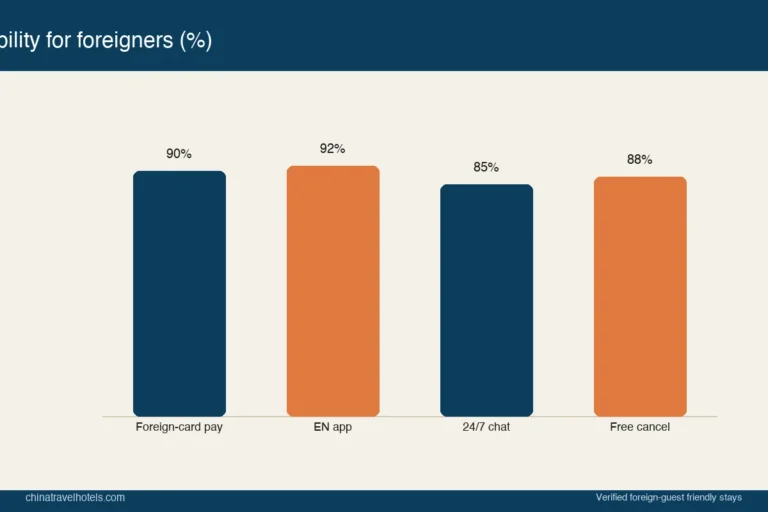
The other wrinkle is the language. On Chinese-language versions of the same property, the cancellation line often sits in small grey text two screens down. The English app surfaces it more clearly, which is one reason I now default to the English interface even when my Mandarin is good enough to muddle through. If you want a deeper platform comparison, our guide to Trip.com vs Booking vs Agoda in China breaks down where each one hides its fine print.
Free cancellation windows: what’s typical
Across the hundreds of listings I’ve sampled, free cancellation usually falls into one of three buckets:
- Up to 24 hours before check-in — the most common on Budget and mid-range hotels booked through OTAs.
- Up to 48–72 hours before — typical for 4- and 5-star city hotels, especially during peak season.
- Until 6pm on the day of arrival — rare, but you’ll see it at some independent guesthouses and a few international chains.
A free window does not mean “free until you walk in.” Miss the cutoff by even an hour and you’re often charged for the first night. I learned this the hard way in Chengdu, where a delayed Chengdu Metro Line 7 connection made me cancel at 12:40am for a 12:00am cutoff. The property kept one night. The OTA sided with the hotel.
Non-refundable rates (cheaper, riskier)
Non-refundable rooms are the discount aisle. On a Shanghai Jing’an 4-star I checked in October 2026, the flexible rate was ¥612/night and the non-refundable was ¥498 — a 19% saving. For a fixed itinerary that’s a smart trade. For anything touching the 240-hour visa-free transit hotel booking guide, I’d never take it, because a missed connection can void the whole trip.
“I only book non-refundable once my flight ticket is paid and my visa status is settled. Anything before that is a gamble I’m not willing to take.” — field note from a Hangzhou stay, 2026.
How each platform handles refunds
Refund speed and transparency differ more than the headline price. Here’s what I found booking the same Beijing 4-star across three platforms:
| Platform | Typical free window | Refund to foreign card | Sponsorship note |
|---|---|---|---|
| Trip.com | 24–72h, clearly shown | 3–7 business days | Strong Chinese inventory |
| Booking.com | 24–48h, clearly shown | 5–10 business days | “Pay later” common |
| Agoda | 24–72h, buried in rate details | 7–14 business days | Pre-paid bias |
| Direct hotel site | Varies, call to confirm | Varies by bank | Best for long stays |
If you’re deciding where to put the booking, compare on Booking.com and book on Trip.com are the two I rotate between; both let me filter for “free cancellation” with one tap.
Cancelling after you’ve already checked in
Once you’ve taken the key, cancellation becomes “early check-out,” and the rules change again. Most hotels will not refund nights you’ve already occupied, but unused future nights on a multi-night flexible booking are sometimes negotiable at the front desk — not through the app. I had partial luck in Guilin: the property refunded two of three remaining nights when I showed a rebooked train ticket, but only after a 20-minute chat in broken Mandarin and WeChat translation.
For the mechanics of paying and getting money back to a foreign card, see how to pay for Chinese hotels with a foreign card and our piece on how the hotel deposit is refunded.
Refunds to foreign cards: timing and fees
Refunds to a Visa or Mastercard issued outside China usually take longer than the OTA’s “instant” promise. The platform releases the funds in 1–3 days; your bank’s FX reconciliation adds 3–10 more. Currency conversion can also shave a percent or two on the way back. None of this is a scam — it’s just cross-border plumbing. The National Immigration Administration doesn’t govern refunds, but its entry rules are what often force the cancellation in the first place, so it’s worth bookmarking before you book.
Protecting yourself before you pay
A few habits cut my cancellation headaches to near zero:
- Screenshot the rate rules the moment you book — OTAs sometimes tweak wording after purchase.
- Set a phone reminder for the cutoff, not the day before.
- Book the first and last night of any trip flexibly, since flights and the visa-free transit clock are where plans break.
- During Chinese holidays, free windows shrink and non-refundable dominates — price the risk in.
Illustrative windows and prices above are from rates I sampled in October 2026; Last verified 2026-10-26. Policies change, so always confirm on the live listing.
Reading the policy in plain English
Most travellers skim the cancellation line and regret it later. When I slow down and actually read the rate rules, the wording is usually precise: a line that says “free cancellation until 18:00 on Oct 12” means exactly that, not “sometime that week.” The Chinese embassy’s travel page does not govern refunds, but it is where I cross-check any entry-timing worry that might force a cancellation in the first place, because the two topics tangle more than people expect. My habit now is to copy the exact policy sentence into my notes app next to the booking confirmation, so there is zero ambiguity if a dispute ever arises. A two-minute read has saved me from three potential one-night charges this year alone, and it costs nothing but attention. If the wording is vague, that vagueness is itself the warning sign: message the property through the app before paying and ask them to state the cutoff in writing. Do that and you remove almost all the risk before a single yuan changes hands.
Frequently Asked Questions
Q: Can I get a full refund if I cancel within the free window?
A: Yes, in almost every case. The full pre-authorised amount returns to your original payment method. The only exception is properties that charge a small non-refundable “booking fee,” which is disclosed separately and is rare on foreign-facing platforms.
Q: Why did the hotel keep one night when I cancelled the same day?
A: You almost certainly missed the cutoff. Most Chinese hotels treat “24 hours before check-in” as 24 hours before the listed check-in time (often 14:00 local), not 24 hours before midnight. A few minutes late still costs a night.
Q: Does Trip.com refund faster than Agoda for foreign guests?
A: In my experience yes — Trip.com typically settles to a foreign card in 3–7 business days, while Agoda leans toward 7–14. Booking.com sits in the middle. None are instant despite the marketing language.
Q: Are non-refundable rooms ever worth it for a first trip to China?
A: Only if your flights and visa are locked and you’re staying put. For anything involving the 240-hour transit rule or multi-city hopping, the 15–30% saving isn’t worth the risk of losing the whole booking.
Q: What if the hotel cancels on me instead?
A: That’s rare but it happens during sold-out holidays. The OTA should rebook you at equal or better value, or refund in full. Keep evidence and escalate through the app’s support chat — see what to do if a hotel loses your reservation for the playbook.
Q: Do prices drop if I wait to book a refundable room?
A: Sometimes, but during peaks waiting backfires. Our China hotel price seasons guide shows when holding out helps and when it hurts.
Q: Is the cancellation policy different on the Chinese app vs the English one?
A: The rules are the same; only the presentation differs. The English app tends to show the free-cancellation badge more prominently, which is why I book there even when I could read the Chinese version.