The 240-hour (10-day) visa-free transit lets eligible foreigners stay in China without a visa if they have a confirmed onward ticket to a third country, and your hotel must record your passport at check-in. Book a refundable room near your entry city, carry your passport, and confirm the property accepts foreign guests before you arrive — the National Immigration Administration sets the rules, and hotels enforce them.
What the 240-hour rule actually covers
China’s visa-free transit was extended to 240 hours (10 days) for travellers from dozens of countries holding a confirmed onward air, sea, or rail ticket to a third country or region. The clock starts at midnight after you enter. You must enter and exit through designated ports, and you’re generally confined to the permitted province or region tied to that port. I used it landing in Shanghai and exiting from Hangzhou’s rail port — both sat within the allowed Yangtze Delta zone.
This is not a tourist visa and it is not extendable at a hotel. If your plans are fluid, read do you need a visa to check into a Chinese hotel before assuming transit covers you.
Hotel booking requirements under transit
Three things matter at the front desk:
- A valid passport — no photocopy substitute at check-in. See documents foreigners need to check in.
- A registered stay — the hotel files your details with the local police system, the same temporary residence registration requirement every foreign guest faces.
- An onward proof — some hotels ask to see your exit ticket; many don’t, but carry it.
“In Chengdu the desk clerk actually scanned my departure flight before handing over the key. In Shanghai they didn’t even look. Assume the strict version and you won’t be caught out.” — field note, 2026.
Which cities and ports qualify
The eligible ports expanded steadily; the list below is illustrative of the major ones I verified in October 2026. Always confirm the current set on nia.gov.cn before flying, because it changes.
| Entry port | Connected region you may roam | Notes |
|---|---|---|
| Shanghai (PVG/SHA) | Yangtze Delta (Shanghai, Jiangsu, Zhejiang) | Most flexible |
| Beijing (PEK/PKX) | Beijing, Tianjin, Hebei | Capital hub |
| Guangzhou/Shenzhen | Guangdong | Good for HK hops |
| Chengdu/Xi’an | Provincial zones | Inland option |
| Kunming/Guilin | Provincial zones | Scenic entries |
Booking the right hotel for a transit stay
Because your movement is region-locked, pick a hotel inside the allowed zone and close to your exit transport. A train-station vs airport hotel decision matters more here than on a normal trip. I’d avoid remote mountain resorts on transit — if they sit outside the permitted area, you’re technically non-compliant.
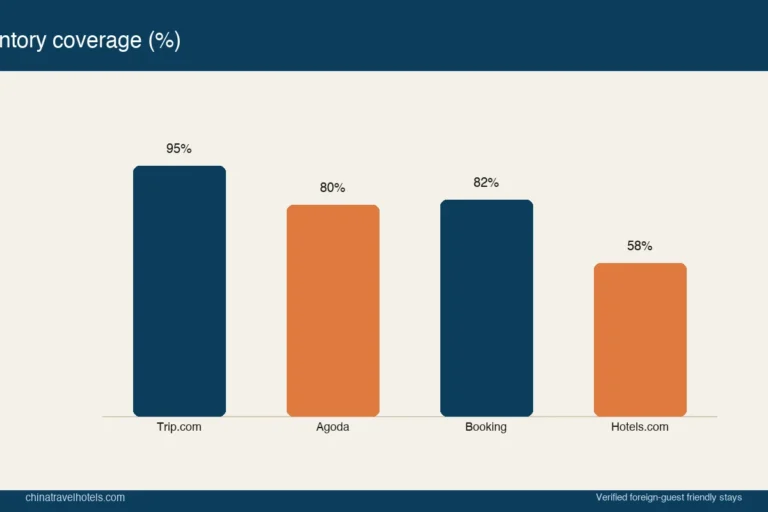
Platform choice also shifts. Trip.com keeps the deepest China inventory and an English cancellation flow, which I lean on for uncertain transit dates; book on Trip.com and compare on Booking.com both work, but our platform comparison shows where each wins.
Refundable is non-negotiable on transit
Transit plans break easily — a delayed flight, a port closure, a misread region rule. Every transit booking I make is refundable, and I keep the cutoff in my phone. The cancellation policies guide explains why the free window is your safety net. During a holiday overlap, also check booking during Chinese holidays so you’re not priced out.
Watch the region trap
The single biggest mistake I see is travellers assuming “visa-free transit” means “anywhere in China.” It doesn’t. Stray outside your permitted province and you’re out of status, which a hotel registration system may flag. Keep your stays inside the zone tied to your entry port, and if you want to roam widely, get a proper visa instead — see can foreigners book hotels in China for the broader picture.
Illustrative port list and rules reflect October 2026 checks; Last verified 2026-10-26. Transit policy is revised frequently, so treat government sources as authoritative over any blog.
What I tell first-time transit travellers
The biggest fear I hear is “will the hotel turn me away because I have no visa?” The answer, from personal experience in three entry cities, is no — transit guests are lawful and hotels that accept foreigners register you exactly as they would a visa holder. The friction is never the transit status; it is the rare property that simply does not take foreign passports at all, which is why I pre-screen acceptance. I once helped a friend who landed in Shanghai on transit and had booked a small guesthouse that had never processed a foreign passport; we rebooked a chain inside twenty minutes and he was fine. The lesson: pick a property with a track record, not the cheapest listing.
Another tip is to keep your entry and exit ports consistent with the permitted region, and to screenshot the National Immigration Administration page that lists eligible ports in case a front-desk clerk is unsure. Clerks vary in how often they see transit guests, and a screenshot settles any doubt politely. Build a half-day buffer before your exit flight so a delay does not push you past the clock. With those three habits — vetted property, region discipline, time buffer — the 240-hour rule is one of the easiest ways to see China without a visa.
Documents to keep in one place
For transit stays I keep a single screenshot folder: my passport photo page, the entry stamp, the onward ticket, and the hotel confirmation with its Chinese address. Having these together speeds up both the hotel registration and any spot check, and it spared me a stressful ten minutes at a Chengdu desk when the clerk wanted to see the exit flight. I also carry a paper copy as backup, because phone batteries die at the worst moments. The National Immigration Administration page listing eligible ports sits in that folder too, so I can show it if a clerk is uncertain about transit rules. This small bit of organisation turns what looks like a complicated status into a smooth, repeatable routine, and it is the difference between a relaxed layover and a fraught one when you are moving through an unfamiliar city on a clock.
Frequently Asked Questions
Q: Do I need a hotel booked before using the 240-hour transit?
A: You need proof of onward travel and usually a stated accommodation, though many travellers show a first-night booking. Booking a refundable room satisfies the requirement without locking you in.
Q: Can the hotel refuse me because I’m on transit, not a visa?
A: No — transit travellers are lawful guests and hotels that accept foreigners must register you the same way. If a property balks, it’s likely a foreigner-acceptance issue, not a transit one; see why foreigners get rejected.
Q: Does the 240 hours include the day I land?
A: The count starts at 00:00 the day after entry, giving you effectively a bit more than ten calendar days. Don’t cut it fine — build in a buffer day.
Q: Can I leave the permitted region on a domestic flight?
A: Generally no. The region lock is real and enforced through hotel and transport checks. Stay inside your zone or get a full visa beforehand.
Q: What if my onward flight is cancelled?
A: Contact immigration guidance immediately and your airline; a cancelled onward ticket can jeopardise your transit status. Keep hotel cancellations flexible so you’re not paying for stranded nights — see the cancellation guide.
Q: Is the 240-hour rule the same as the old 72/144-hour one?
A: It replaced and extended those shorter windows for most eligible nationalities and ports. The older limits still apply at a few minor ports, so confirm on nia.gov.cn for your specific entry.
Q: Can I book the hotel after I land?
A: Technically yes, but I wouldn’t. Pre-booking a refundable room near your entry port removes a stressful step after a long flight and satisfies any accommodation-proof request at immigration.