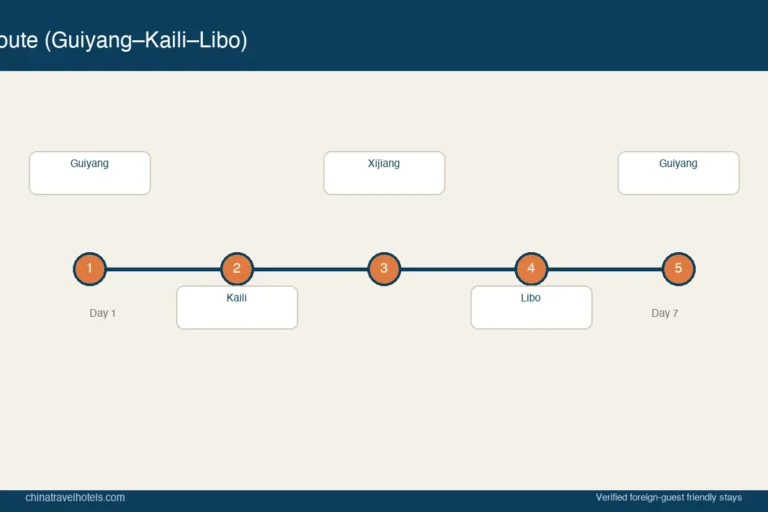
A foreign passport holder’s 8-day Guizhou plan is five bases: two nights in Guiyang, two in the Xijiang Miao village, one at Huangguoshu (Anshun), one in Zhenyuan, and one at Libo, then a return night in Guiyang. High-speed rail and buses link them, and each base has licensed hotels that register foreigners — but the Miao village and Libo inns vary, so confirm the licence each time you book.
Why five bases in a mountain province
Guizhou is China’s most ethnic-minority-rich province, full of Miao and Dong villages, big waterfalls, and karst parks. The sights are scattered, so sleeping near each one saves long daily drives. The rail reaches Guiyang, Anshun, and Kaili; the villages need a bus or driver. All the city bases have foreigner-licensed hotels, but the village lodges thin out, so book ahead and confirm.
Hotels must register foreign guests with public security. Licensed Guizhou hotels do this at check-in; small village guesthouses may not be licensed for foreigners. Confirm before paying — see can foreigners stay in Chinese hotels. For card acceptance by tier, see foreign credit card hotels in China.
Day 1–2 — Guiyang, transit and city base
Fly into Guiyang Longdongbao (KWE). Settle in a hotel near the center or the station. Qianling Park and the provincial museum. Sleep in Guiyang two nights.
Day 3–4 — Xijiang Qianhu Miao, change base
Bus or driver to the Xijiang thousand-household Miao village (~2.5 hours). Check in to a confirmed-foreigner inn inside or just below the village. Evening bonfire and the lit terraces. Sleep there two nights.
Day 5 — Huangguoshu, change base
Driver or train to Anshun, then the Huangguoshu Waterfall (China’s biggest). Sleep near the falls or in Anshun one night.
Day 6 — Zhenyuan, change base
Train or bus to Zhenyuan, the old town on the Wuyang River. Check in near the river. Evening walk along the lit waterfront. Sleep one night.
Day 7 — Libo, change base
Bus or driver to Libo, the Zhangjiang karst forest and the Xiaoqikong bridges. Check in near the park. Sleep one night.
Day 8 — Return Guiyang, depart
Bus or train back to Guiyang for your flight. Eight nights, five bases plus a return.
Night-by-night base plan
| Night | Base area | Why here | Transfer note |
|---|---|---|---|
| 1–2 | Guiyang (center) | Gateway, city | Taxi from KWE |
| 3–4 | Xijiang Miao | Village stay | Bus/driver |
| 5 | Huangguoshu | Waterfall | Train/bus |
| 6 | Zhenyuan (river) | Old town | Bus/train |
| 7 | Libo (park) | Karst forest | Bus/driver |
| 8 | Guiyang (return) | Departure | Bus/train |
Picking each base
Guiyang is the hub — stay near the station for easy exits. The Xijiang village inn gives the real minority-village experience but confirm the foreigner licence; some are not licensed. Zhenyuan and Libo are small, so the river or park-side hotel is the practical pick.
Payment and booking notes
International Guiyang hotels take foreign cards; village and park inns often prefer cash or Alipay. Confirm via confirm hotel accepts foreign guest before paying. Book the Xijiang and Libo rooms ahead in summer and autumn, the peak seasons.
Frequently asked questions
Is eight days enough for Guizhou?
For Guiyang, Xijiang, Huangguoshu, Zhenyuan, and Libo, yes, at a steady pace. Add nights for the Dong villages near Congjiang if you want more.
Do Miao village inns take foreigners?
Licensed ones do; many small ones don’t. Confirm, or stay in Kaili and day-trip Xijiang.
Will my card work?
At international Guiyang hotels, yes. Elsewhere, usually no. Carry cash.
Is the transport easy?
Guiyang, Anshun, and Kaili are on the high-speed rail; villages need buses or a driver. Book drivers ahead.
Is it worth the remote stays?
Yes — the villages and parks are the point of Guizhou, and sleeping there beats a long return drive.
When is best to visit?
Spring and autumn are ideal. Summer is lush but rainy; winter is cold and quiet.
Should I book now or on arrival?
Book before you fly; village and park rooms are limited and fill in peak season.